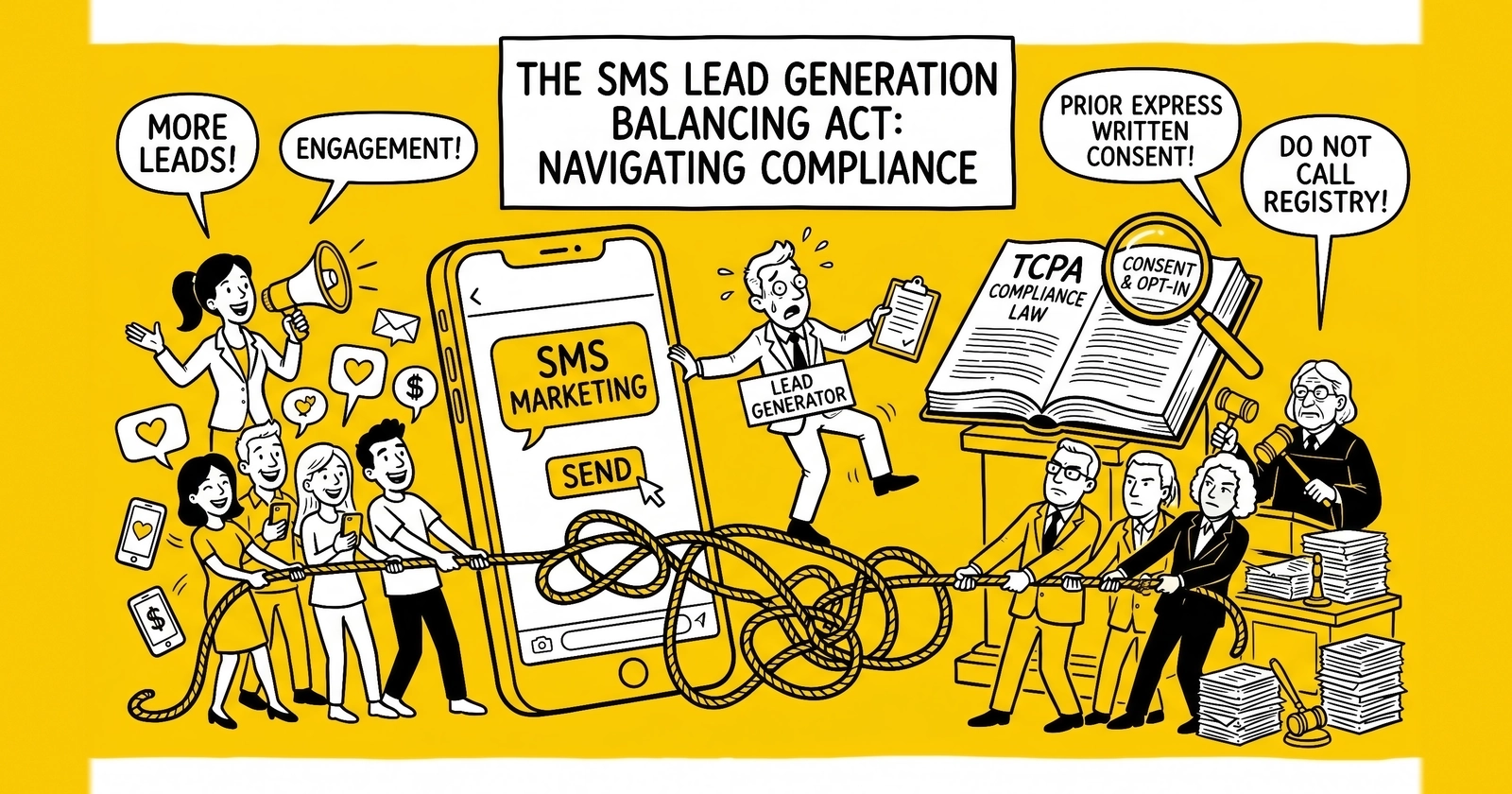
SMS marketing delivers response rates 8-10x higher than email, but TCPA violations carry penalties up to $1,500 per message that can bankrupt lead generation businesses overnight. The difference between profitable SMS lead generation and catastrophic legal exposure lies entirely in consent management practices and documentation rigor.
The SMS Lead Generation Opportunity and Risk Landscape
SMS marketing has become one of the most effective channels for lead generation, with open rates exceeding 98% and response rates of 45% according to Gartner mobile engagement research. For lead generators, these metrics translate directly into conversion performance that other channels cannot match. Prospects who receive SMS follow-up contact within one minute of form submission convert at 391% higher rates per the InsideSales.com / MIT Lead Response Management Study. Leads contacted within five minutes are 21 times more likely to qualify than those contacted after 30 minutes.
The economics are compelling. SMS costs approximately $0.01 to $0.03 per message through most platforms, while generating response rates that dwarf email at $0.001 to $0.01 per send but 1 to 5 percent response rates. The immediacy of text messaging aligns with modern consumer behavior – 90 percent of texts are read within three minutes according to Mobile Marketing Association engagement benchmarks.
Yet SMS lead generation operates under the strictest regulatory framework of any marketing channel. The Telephone Consumer Protection Act (TCPA) governs all commercial text messages, imposing consent requirements, documentation obligations, and penalties that can reach $500 to $1,500 per non-compliant message. A single campaign to 10,000 contacts without proper consent creates potential liability of $5 million to $15 million before class-action multipliers.
The FCC’s one-to-one consent rule was vacated by the U.S. Court of Appeals for the Eleventh Circuit in Insurance Marketing Coalition v. FCC on January 24, 2025 – the day before the rule was scheduled to take effect. The FCC subsequently repealed the rule entirely. The industry, however, has evolved toward seller-specific consent as a best practice, with many sophisticated buyers requiring consent that identifies the specific company authorized to contact the consumer. The detailed coverage of those consent changes appears in the one-to-one consent rule explainer.
A second 2025-2026 doctrinal shift compounds the consent picture. On March 30, 2026, the U.S. District Court for the Northern District of Illinois held in Rabbit v. Rohrman that SMS messages are calls subject to the TCPA’s Do Not Call subsection at 47 U.S.C. § 227(c). The ruling converts every unscrubbed marketing text sent to a DNC-registered number into a potential $500-per-message statutory claim – a structural change that the Illinois SMS DNC ruling deep-dive documents in operator-retrofit detail.
Understanding TCPA compliance is not optional for SMS lead generation. It is the foundation upon which any sustainable SMS program must be built. This analysis provides the practical framework for implementing compliant SMS lead generation: prior express written consent collection, the post-IMC seller-identification standard, the post-Rohrman DNC scrubbing layer, the FCC’s 2024 declaratory ruling on revocation timing, A2P 10DLC carrier registration, multi-location and franchise consent structures, lead-buyer verification protocols, and the documentation rigor that determines outcomes when litigation arrives.
Understanding TCPA Requirements for SMS Marketing
The Legal Foundation of SMS Regulation
The Telephone Consumer Protection Act of 1991 established the foundation for SMS marketing regulation, though the law predates text messaging by years. The FCC has interpreted TCPA to cover SMS as a form of communication equivalent to telephone calls, subjecting text messages to the same consent requirements and restrictions.
TCPA covers three categories of messages with different consent requirements. Marketing messages require prior express written consent – the highest standard. Informational messages such as appointment reminders and order confirmations require prior express consent but not necessarily written documentation. Transactional messages responding to consumer-initiated inquiries may be sent without prior consent under certain conditions.
For lead generation purposes, virtually all SMS contact constitutes marketing requiring prior express written consent. The distinction matters because informational messaging without proper consent still carries TCPA liability, and aggressive interpretation of message content by plaintiffs’ attorneys has caught many operators who believed their messages qualified as informational.
The penalties structure creates asymmetric risk. Negligent violations carry $500 per message in statutory damages. Knowing or willful violations carry $1,500 per message – triple damages. These are statutory minimums, not maximums, and class action aggregation can create exposure in the hundreds of millions for large-scale operations.
The FCC One-to-One Consent Rule (Vacated by the Eleventh Circuit)
The FCC’s December 2023 ruling attempted to require one-to-one consent for lead generation marketing. The U.S. Court of Appeals for the Eleventh Circuit vacated the rule on January 24, 2025 in Insurance Marketing Coalition v. FCC, holding that the FCC exceeded its statutory authority by requiring sellers to be individually named in consent. The opinion issued one day before the rule’s scheduled effective date of January 27, 2025 – the timing detail matters because it preserved the pre-rule status quo without creating a transitional compliance window. The FCC subsequently repealed the rule entirely.
Under the vacated rule framework, a consumer consenting to hear from “marketing partners” would not have provided valid consent for any specific partner. Each seller intending to send SMS would have needed to be individually identified and separately consented to. While this requirement is no longer federal law, understanding its structure matters because many sophisticated buyers have adopted similar practices voluntarily and several state mini-TCPA frameworks (Florida’s FTSA, Oklahoma’s OTSA) retain stricter identification requirements that survive the federal vacatur.
Despite the vacatur, industry practice has evolved toward seller-specific consent as a best practice. Many lead buyers now require consent that identifies the specific company authorized to contact the consumer, not because the FCC requires it, but because it reduces litigation risk and improves lead quality.
For lead generators working through this landscape, options include generating leads exclusively for internal use where consent names only the organization, implementing specific seller identification in consent flows for buyers who require it, or clearly documenting that consent covers multiple identified parties where buyers accept that approach. The broader context of prior express written consent requirements applies equally to SMS and voice calls.
Required Elements of Valid SMS Consent
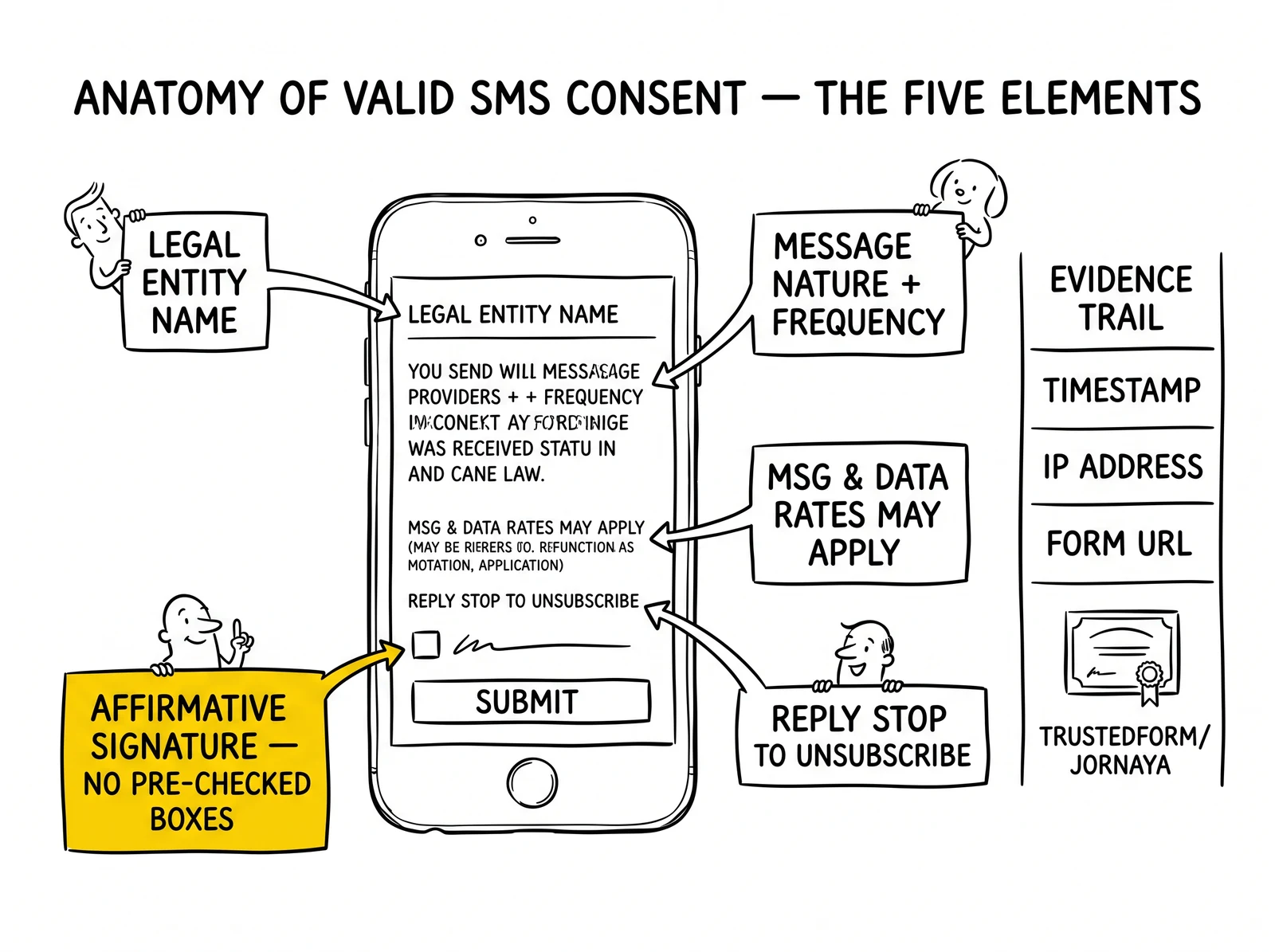
Valid prior express written consent under TCPA requires specific elements without which consent is legally ineffective.
Clear and Conspicuous Disclosure
The consent disclosure must appear prominently rather than buried in terms and conditions. FCC guidance indicates that consent language should appear near the point of collection in readable font size, using clear language that average consumers can understand. Footnotes, hyperlinked disclosures, or separate pages requiring navigation do not satisfy conspicuousness requirements.
Identification of Consenting Parties
The consumer must consent to receive messages from a specifically identified entity. The entity name must be legally accurate – trade names alone may be insufficient if they differ from the legal entity sending messages. For lead generation involving multiple sellers, each seller must be identified in a manner that allows consumers to understand who will contact them.
Description of Message Content and Frequency
Consent must disclose the nature of messages consumers will receive and their expected frequency. Generic phrases like “marketing messages” provide minimal protection. More specific descriptions such as “promotional offers for insurance products” or “appointment reminders and service offers” better document the consent scope. Frequency estimates should be accurate – consent to “occasional” messages does not authorize daily contact.
Consumer Signature
Prior express written consent requires a signature, which can be electronic. E-SIGN Act compliance allows electronic signatures including form submissions, checkbox acknowledgments, and similar mechanisms. The signature must demonstrate affirmative action – pre-checked boxes do not constitute signatures.
Documentation of Consent Transaction
Beyond obtaining consent, TCPA compliance requires maintaining proof of consent including the exact language presented, the timestamp of consent, the source of consent such as form URL and IP address, and any applicable version controls for consent language.
SMS as DNC-Bound Calls After Rabbit v. Rohrman
The TCPA framework that operators internalized for SMS through 2025 treated the autodialer subsection (§ 227(b)) as the dominant litigation vector. The Do Not Call subsection (§ 227(c)) – which governs solicitations to numbers on the National DNC Registry – was widely understood to apply to voice telemarketing, with SMS coverage technically open in most circuits. Rabbit v. Rohrman, decided by the U.S. District Court for the Northern District of Illinois on March 30, 2026, closed that question at the trial-court level. The ruling held that SMS marketing messages qualify as calls subject to 47 U.S.C. § 227(c) and 47 C.F.R. § 64.1200(c), exposing every text sent to a DNC-registered number without documented consent or an established business relationship to the same $500-per-violation statutory damages that have powered TCPA voice litigation for two decades.
The reasoning rested on three pillars. First, the FCC’s 2003 Report and Order – the foundational rulemaking implementing the 1991 statute – expressly stated that “calls” within the meaning of the TCPA include text messages directed to wireless numbers. Second, every appellate court to address the question, beginning with the Ninth Circuit’s Satterfield v. Simon & Schuster (2009), has accepted that SMS qualifies as a call for autodialer-subsection purposes. Third, the FCC’s 2024 Declaratory Ruling on revocation explicitly addressed text-message opt-outs, implicitly confirming that the agency views the entire TCPA framework – including the DNC subsection – as covering SMS.
The April 9, 2026 TCPAWorld report on a $3,787-per-claimant SMS settlement compounded the ruling’s operational impact. Earlier TCPA class settlements typically distributed $50 to $200 per claimant after attorney fees and cy-pres carve-outs. The $3,787 figure reflects a smaller defined class combined with a fund sized to approach the $500 statutory minimum after fees, and plaintiff firms now use the number as an opening anchor in settlement demands. The math has changed: a 100,000-message campaign sent to a list with 30 percent DNC penetration produces 30,000 potential class members at the statutory floor – $15 million theoretical exposure before willful trebling.
The structural compliance gap Rohrman exposes is that the SMS marketing stack does not perform DNC scrubbing as a default service. Twilio, Plivo, MessageBird, Sinch, Attentive, Klaviyo, and ActiveCampaign all expect the brand to maintain DNC compliance through external integrations. Twilio’s Trust Hub directs senders to third-party DNC services through Functions or external API calls. Attentive’s compliance documentation places DNC obligations on the brand. The compliance gap is platform-wide, not a feature one vendor offers and another lacks.
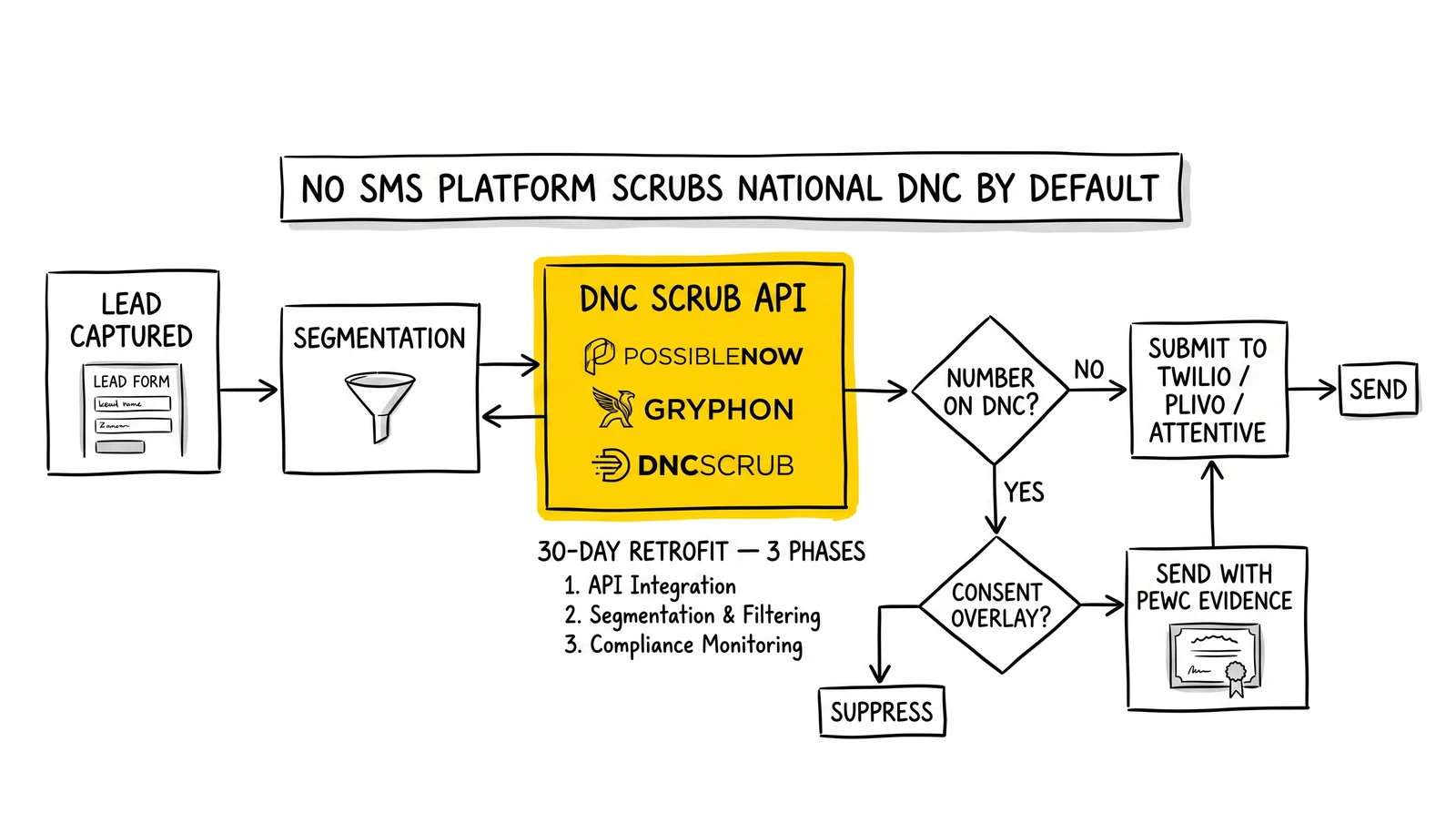
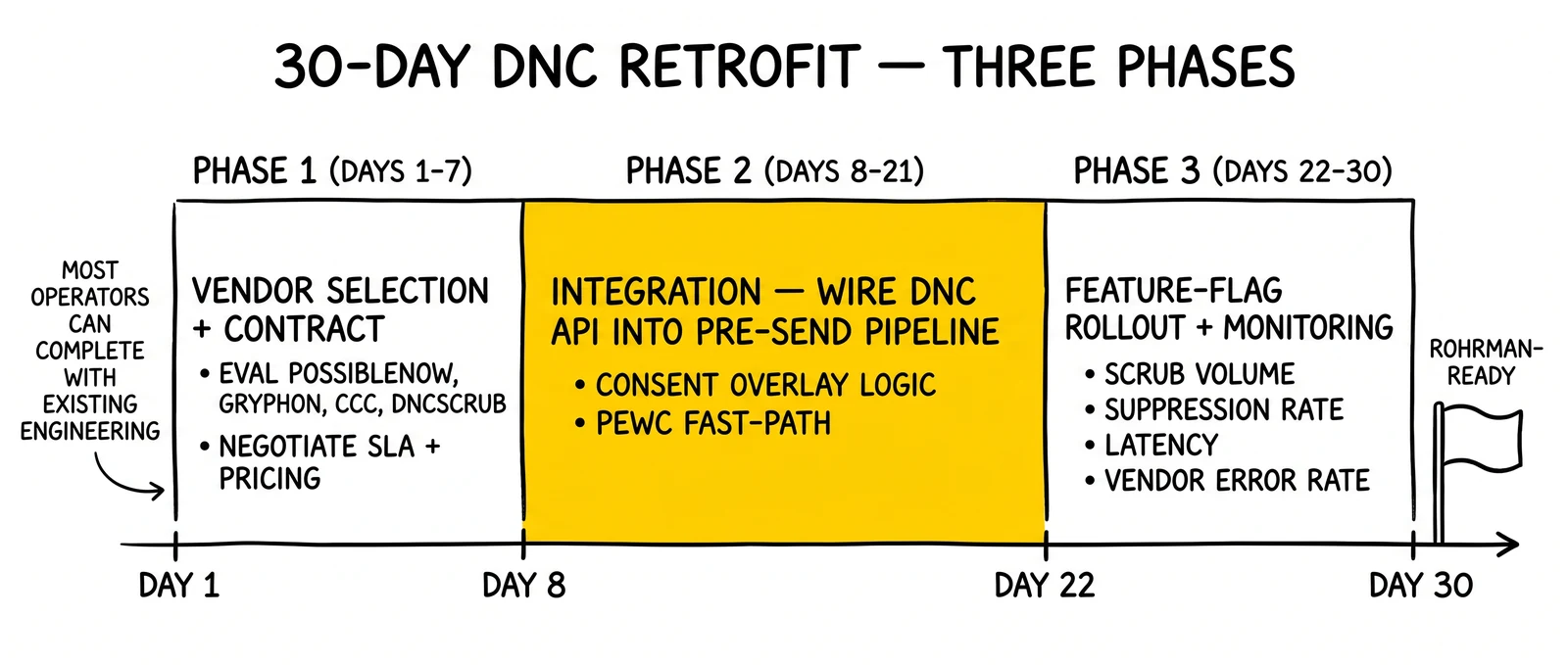
The retrofit work breaks into three phases that most operators with engineering capacity can complete in 30 days. Phase 1 (days 1 to 7) covers vendor selection and contracting with PossibleNOW, Gryphon.ai, Contact Center Compliance, or DNCScrub. Phase 2 (days 8 to 21) wires the DNC scrub API into the SMS pre-send pipeline between list segmentation and message submission, with consent-overlay logic that allows numbers carrying documented prior express written consent to proceed even when DNC-registered. Phase 3 (days 22 to 30) deploys behind a feature flag, validates scrub-result logging, and rolls out to all SMS campaigns with monitoring dashboards covering scrub volume, suppression rate, latency, and vendor error rate.
The practical implication for operators sending SMS into Illinois is immediate compliance pressure; for operators sending elsewhere, Rohrman establishes persuasive authority that plaintiff firms will cite in follow-on filings within 60 to 90 days. The full operator playbook – including the FCC interpretive history, the circuit-split landscape, the vendor comparison matrix, the 30-day retrofit checklist, and the litigation-defense record requirements – appears in the Illinois SMS DNC ruling deep-dive.
The FCC 2024 Revocation Rule – 10 Business Days as the Federal Floor
The FCC’s December 2024 Declaratory Ruling on consent revocation established two binding standards relevant to SMS lead generation. The first requires that consumers be permitted to revoke consent through any reasonable method – replying to a message, calling a published number, emailing a documented address, or sending a written notice. Operators cannot mandate a specific revocation channel as a precondition to honoring an opt-out. The second requires that revocation be processed within 10 business days as the federal regulatory floor.
The 10-business-day standard is a ceiling on regulator enforcement timing, not a target for compliance teams. Industry best practice processes opt-outs within minutes through automated platforms because any message sent after a revocation request creates willful violation exposure at $1,500 per message. Operators relying on the federal floor as the operational target will lose litigation: the gap between “reasonable time” defenses and the 10-business-day floor compresses any procedural argument that delayed processing was acceptable.
The 2024 Declaratory Ruling also extended the revoke-all principle: a single opt-out from a consumer should apply across all marketing communications from the sender, not just the specific channel where the opt-out was made. The revoke-all rule’s effective date was originally scheduled for April 11, 2025, then delayed to April 11, 2026, and most recently delayed to January 31, 2027 by FCC Order DA 26-12 issued on January 6, 2026. The repeated delays reflect industry petitioning over technical implementation costs, not a substantive retreat from the rule. Operators with two-year horizons should plan for cross-channel suppression infrastructure linking SMS, voice, email, and other contact methods to a unified opt-out registry that updates within minutes of any revocation event.
A separate 2024 FCC action – the February 8, 2024 Declaratory Ruling on AI-generated voices – established that AI-cloned or synthetic voices used in robocalls constitute “artificial or prerecorded” voices subject to the TCPA’s prerecorded-voice prohibitions. The ruling does not directly address SMS, but its reasoning matters for operators running multi-channel campaigns: a synthetic-voice IVR follow-up to an SMS-initiated lead, sent without express consent, falls under the same prohibitions that govern traditional prerecorded voice calls. Multi-channel SMS programs that hand off to voice should validate that voice-side consent disclosures cover artificial-voice playback explicitly.
Consent Language That Provides Real Protection
Anatomy of Compliant Consent Language
Consent language must balance legal requirements with user experience. Overly lengthy disclosures reduce form conversion. Insufficient disclosures create legal exposure. The challenge is crafting language that provides genuine protection while maintaining practical usability.
Effective consent language includes five components: entity identification, message description, frequency disclosure, opt-out mechanism, and standard rate disclaimer.
Single-Entity Consent Example
The following consent language works for businesses collecting leads for their own use:
“By clicking Submit, I consent to receive marketing text messages from [Legal Entity Name] at the phone number provided. Message frequency varies. Message and data rates may apply. Reply STOP to unsubscribe. Consent is not a condition of purchase.”
This language identifies the consenting entity by legal name, describes messages as marketing, addresses frequency, notes standard rates, provides opt-out instructions, and clarifies that consent is not required for purchase.
Multi-Seller Consent Example
For lead generators providing leads to specific partners, consent language must identify each potential recipient:
“By clicking Submit, I consent to receive marketing text messages from the following companies: [Company A Legal Name], [Company B Legal Name], [Company C Legal Name]. Each company may send messages related to [product/service category]. Message frequency varies by sender. Message and data rates may apply. Reply STOP to unsubscribe from individual senders. Consent is not a condition of purchase.”
This approach satisfies one-to-one consent requirements by naming each entity while allowing bundled collection. The challenge is maintaining this consent language as partners change, requiring version control and documentation.
Consent Language Variations by Use Case
Different lead generation scenarios require adapted consent language to address specific circumstances.
Real-Time Lead Distribution
For leads sold immediately to buyers determined at the moment of form submission:
“By clicking Submit, I consent to receive marketing text messages from [Buyer Name], who has been matched to my inquiry based on my location and needs. [Buyer Name] may send messages about [product/service]. Message frequency varies. Message and data rates may apply. Reply STOP to unsubscribe. Consent is not a condition of purchase.”
This language works when the specific buyer is known at consent time. Dynamic insertion of buyer names requires technical implementation ensuring accurate matching between consent documentation and actual message senders.
Appointment and Follow-Up Sequences
For businesses using SMS to confirm appointments or follow up on inquiries:
“By clicking Submit, I consent to receive text messages from [Legal Entity Name] regarding my inquiry, including appointment confirmations, reminders, and related service information. You may also receive promotional offers. Message frequency varies based on your interaction with us. Message and data rates may apply. Reply STOP to unsubscribe. Consent is not a condition of purchase.”
This language covers both transactional and marketing use cases, important because aggressive plaintiffs may characterize follow-up messages as marketing requiring the highest consent standard.
Aged Lead Re-Engagement
Re-contacting leads after extended periods requires consideration of whether original consent remains valid:
“By clicking Submit, I consent to receive text messages from [Legal Entity Name] about [product/service] for up to [X months/years] from today. Message frequency varies. Message and data rates may apply. Reply STOP to unsubscribe at any time. Consent is not a condition of purchase.”
Defining consent duration provides documentation of temporal scope. Industry practice varies, with most operators treating consent as valid for 18-24 months absent opt-out, though litigation risk increases with time elapsed.
Critical Consent Language Mistakes
Certain consent language patterns create legal exposure despite appearing reasonable.
Mistake: Buried Consent
Consent language appearing only in terms of service or privacy policies does not satisfy conspicuousness requirements. Even with checkbox acknowledgment, courts have found consent invalid when disclosure required navigating away from the form or reading lengthy documents to find consent language.
Mistake: Pre-Checked Consent Boxes
Pre-checked checkboxes do not constitute affirmative consent under E-SIGN Act requirements. Consumers must take action to indicate consent. Pre-checked boxes inverted to require unchecking to decline consent face similar challenges.
Mistake: Vague Entity References
Consent to receive messages from “our partners” or “affiliated companies” without naming specific entities does not satisfy one-to-one consent requirements. Even specific numbers like “up to 5 partners” without naming those partners fails the identification requirement.
Mistake: Missing Opt-Out Instructions
Consent language must inform consumers how to revoke consent. Standard practice includes “Reply STOP to unsubscribe” or equivalent. Failure to provide opt-out mechanism voids consent validity.
Mistake: Conditioning Consent on Purchase
While consent can be collected as part of a transaction, it cannot be a condition of completing the transaction. Language implying that consumers must consent to receive messages to complete their purchase creates legal exposure under TCPA’s prohibition on conditioning purchases on consent.
Technical Implementation for Compliance
Consent Capture and Documentation Systems
Compliant SMS lead generation requires technical infrastructure capturing and preserving consent evidence. Manual processes cannot scale and introduce documentation gaps that create litigation exposure.
Required Capture Elements
Every consent transaction must capture specific data elements: the exact consent language presented including version identifier, timestamp in a consistent timezone with second-level precision, source URL where consent was collected, IP address of the consenting device, device and browser information for verification, and form field values including the phone number consented.
This data must be stored in immutable form – systems that allow modification or deletion of consent records create evidentiary problems when litigation requires proving consent existed at the time of message transmission. For detailed retention guidance, see our consent documentation and retention guide.
Technical Architecture Options
Small-scale operations can implement consent documentation through database logging with timestamp and source fields, form submission receipts emailed to compliance addresses, and CRM records with consent metadata attached to contact records.
Enterprise-scale operations require more sophisticated infrastructure: dedicated consent management platforms, cryptographic hashing of consent records for tamper evidence, integration with message transmission systems for consent verification before sending, and audit logging of all consent record access and modifications.
Several consent management platforms serve lead generation specifically, including ActiveProspect TrustedForm, Jornaya LeadID, and similar services that provide third-party verification of consent collection including page content capture, timestamp certification, and litigation support packages.
SMS Platform Compliance Features
Selecting SMS platforms with built-in compliance features reduces operational risk and implementation burden.
Essential Platform Features
Opt-out processing must automatically suppress numbers replying with STOP or similar opt-out keywords. Manual opt-out processing creates delays that generate complaints and potential violations. Platforms should process opt-outs within minutes and prevent any further messages to suppressed numbers.
Quiet hours enforcement prevents message transmission during restricted hours. Federal restrictions limit certain messages to 8am-9pm in the recipient’s local timezone. Some states impose stricter windows. Platforms should automatically queue messages for compliant delivery times.
Consent verification integrations allow checking consent status before message transmission. For lead buyers receiving leads from external sources, verifying consent against the seller’s documentation before initiating contact reduces exposure from consent gaps.
Message content templates with approval workflows prevent well-intentioned staff from sending non-compliant content. Templates pre-approved by compliance review ensure consistent messaging meeting disclosure requirements.
| Platform Feature | Risk Mitigation | Implementation Priority |
|---|---|---|
| Automatic opt-out processing | Prevents post-opt-out violations | Critical |
| Quiet hours enforcement | Prevents time restriction violations | Critical |
| Consent verification API | Prevents messaging without consent | High |
| Template management | Prevents content compliance errors | High |
| Delivery receipts | Documents message transmission | Medium |
| Rate limiting | Prevents harassment complaints | Medium |
| A2P registration support | Carrier compliance | Critical |
A2P Registration Requirements
Application-to-Person (A2P) SMS registration through The Campaign Registry (TCR) is now required by major carriers. Unregistered SMS campaigns face message filtering and blocking. Registration requires business verification, campaign use case approval, and ongoing compliance with carrier content policies.
Registration categories relevant to lead generation include marketing campaigns for promotional messages, lead generation for appointment setting and qualification, and mixed content for campaigns combining informational and promotional messages. Each category has different approval requirements and throughput limits.
State-by-State SMS DNC Requirements
The federal TCPA framework after Rabbit v. Rohrman now overlays a patchwork of state mini-TCPA statutes that retain stricter standards in several jurisdictions. Operators sending into multiple state markets must satisfy the strictest applicable rule, not the federal floor. The matrix below captures the binding requirements as of the April 2026 reference point.
| State | Statute | SMS Coverage | DNC Scrubbing Required | Per-Violation Damages | Private Right of Action |
|---|---|---|---|---|---|
| Federal (post-Rohrman, N.D. Ill. binding) | TCPA § 227(c) | Yes | National DNC Registry | $500 / $1,500 willful | Yes |
| Florida | FTSA (Fla. Stat. § 501.059) | Explicit | State DNC + National | $500-$1,500 | Yes |
| Oklahoma | OTSA (15 O.S. § 775C.1) | Explicit | State DNC + National | $500-$1,500 | Yes |
| Washington | CEMA (RCW 19.190) | Interpretive | Practical yes | $500 + actual | Yes |
| Maryland | MTCPA | Yes | State DNC + National | $500-$1,500 | Yes |
| Texas | Tex. Bus. & Com. Code § 305 | Yes | State DNC | $500-$5,000 | Yes |
| New York | Gen. Bus. Law § 399-p | Voice only (SMS unsettled) | Voice DNC | $50-$1,000 | Yes |
| California | CCPA / Bus. & Prof. § 17592 | Yes via TCPA hooks | National DNC | TCPA defaults | TCPA defaults |
| All other states | TCPA federal floor | Yes (post-Rohrman persuasive) | National DNC | $500 / $1,500 willful | Yes |
Florida’s FTSA, enacted in 2021 and refined in 2023, was the modern catalyst for state-level SMS expansion and produced an immediate wave of class filings. Operators sending into Florida have therefore had an SMS DNC compliance imperative since 2021 – the infrastructure built for FTSA extends to the National DNC Registry with minimal incremental cost. Oklahoma’s OTSA, effective November 2022, mirrors the FTSA framework. Maryland’s mini-TCPA includes both call and text coverage. Washington’s CEMA, while focused on commercial electronic messages, has been interpreted to cover SMS in several private actions. Operators that have geofenced FL and OK out of campaigns to avoid state exposure must now invert the architecture to suppress National-DNC-registered numbers across all states unless consent overlay applies.
Building Compliant Message Sequences
SMS sequences for lead engagement must maintain compliance across multiple messages while achieving marketing objectives.
Initial Contact Message Requirements
First messages must identify the sender by company name, reference the consent basis or how the recipient’s number was obtained, and include opt-out instructions. A compliant initial contact might read:
“Hi [Name], this is [Company] following up on your recent inquiry about [product/service]. Reply YES to receive information or STOP to unsubscribe.”
This message identifies the sender, references the consent origin, and provides clear response options including opt-out.
Follow-Up Message Requirements
Subsequent messages can be more promotional but must maintain sender identification and opt-out availability. Frequency should align with consent disclosures – if consent promised “occasional” messages, daily contact creates exposure.
Opt-Out Confirmation Requirements
When recipients opt out, confirmation is required within a reasonable timeframe. Best practice sends immediate confirmation:
“You’ve been unsubscribed from [Company] messages. You will not receive further texts. Reply START to resubscribe.”
This confirms the opt-out processed, sets expectations for no further messages, and provides re-subscription path for those who opted out accidentally.
Operational Compliance Practices
Building a TCPA Compliance Program
Sustainable SMS lead generation requires systematic compliance rather than ad-hoc risk management. A compliance program institutionalizes practices that prevent violations.
Written Policies and Procedures
Documentation of SMS marketing policies should cover consent collection requirements, message content standards, opt-out processing procedures, complaint handling protocols, and audit procedures. Written policies create accountability, enable training, and demonstrate good faith in the event of litigation.
Training and Accountability
Personnel involved in SMS marketing must understand compliance requirements. Training should cover TCPA basics, company-specific procedures, red flag recognition, and escalation paths for compliance questions. Training records document organizational commitment to compliance.
Audit and Monitoring
Regular compliance audits identify gaps before they create liability. Audit procedures should review consent documentation completeness, message content compliance, opt-out processing timeliness, and complaint patterns. Monthly audits for active campaigns and quarterly thorough reviews represent reasonable practice.
Vendor Management
Third parties involved in SMS marketing – platforms, data providers, lead sources – create potential liability. Vendor agreements should include compliance representations, audit rights, and indemnification for violations caused by vendor failures. Due diligence on vendor compliance practices before engagement prevents inheriting others’ problems.
Managing Opt-Outs and Complaints
Opt-out processing and complaint management directly impact litigation exposure. Poor handling converts minor issues into major liability.
Opt-Out Processing Standards
The FCC’s December 2024 Declaratory Ruling on revocation established 10 business days as the federal regulatory floor for processing any-reasonable-method opt-outs. The 10-business-day floor is a ceiling on regulator enforcement timing, not a target for compliance teams. Industry best practice processes opt-outs within minutes using automated systems. Any message sent after an opt-out request creates willful violation exposure at $1,500 per message.
Opt-out recognition should include standard keywords STOP, UNSUBSCRIBE, CANCEL, END, and QUIT. Systems should handle case variations and common misspellings. Responses that do not clearly match opt-out intent should trigger clarification messages rather than assuming continued consent.
Complaint Response Protocols
Consumer complaints to company contacts, BBB, or regulatory agencies require prompt response. Complaint response procedures should include immediate message suppression for the complaining number, investigation of consent documentation, response to the complainant acknowledging the complaint, and root cause analysis to prevent recurrence.
Most litigation begins with ignored complaints. Consumers who feel heard typically do not seek attorneys. Prompt, respectful complaint resolution is both good business practice and litigation prevention.
Do Not Contact List Management
Beyond individual opt-outs, businesses should maintain suppression lists including internal opt-out compilations, purchased DNC databases for full coverage, and litigation suppression lists for previous complainants who present improved risk.
Cross-channel suppression is important – an opt-out from SMS should update email preferences and vice versa when the same phone and email belong to the same individual. Unified suppression prevents the consumer experience of opting out in one channel only to receive contact through another.
Documentation Retention and Litigation Readiness
When TCPA litigation occurs, the availability and quality of documentation often determines outcomes. Proactive documentation practices enable effective defense.
Retention Requirements
Consent documentation should be retained for the statute of limitations period plus buffer – typically 4-6 years depending on state. Longer retention is prudent given that discovery of violations can extend limitations through various legal doctrines.
Retention should include original consent language and forms, consent transaction records with all captured elements, message transmission logs with content and timestamps, opt-out processing records, and complaint files with investigation notes and responses.
Litigation Hold Procedures
Upon receiving notice of potential litigation such as demand letters, complaints, or regulatory inquiries, organizations must immediately preserve relevant documentation. Litigation holds suspend normal retention policies and require affirmative steps to prevent document destruction.
Hold procedures should identify custodians of relevant data, suspend automatic deletion processes, secure backup copies of critical systems, and document hold implementation for court review if necessary.
Expert and Evidence Preparation
TCPA defense typically requires expert testimony on consent collection practices, message transmission systems, and industry standards. Maintaining relationships with qualified experts and organizing documentation for potential litigation review reduces response time when litigation arises.
Consent Collection Strategies That Convert
Balancing Compliance and Conversion
Strict consent requirements create tension with conversion optimization. Long consent disclosures and additional form fields reduce completion rates. The challenge is implementing compliant consent collection that minimizes conversion impact.
Research from Formstack indicates that each additional form field reduces conversion rates by approximately 4%. Consent checkboxes and disclosure text add friction that affects lead volume. However, leads captured without proper consent have no value – they cannot be contacted legally and create liability exposure.
The optimal approach integrates consent smoothly rather than adding obstacles. Well-designed consent flows can maintain conversion rates within 10-15% of pre-consent baselines while providing genuine legal protection.
Design Patterns for Compliant Consent
Inline Consent Integration
Rather than separate consent checkboxes below forms, integrate consent acknowledgment into the submission action:
“By clicking Get My Quote, I consent to receive text messages from [Company] about insurance products. Message frequency varies. Msg & data rates apply. Reply STOP to unsubscribe. Consent not required for purchase.”
This approach places consent at the action point, making it feel like part of the natural flow rather than an additional requirement. The action button text itself implies consent, supported by clear disclosure text.
Progressive Consent Collection
For multi-step forms, collect consent at the step where phone number is provided rather than the final submission. This creates clear connection between the phone number and the consent to text that number.
Step 1 collects basic information like name and email. Step 2 collects contact preferences including phone with adjacent consent language. Step 3 collects additional qualification data. This structure associates consent directly with the phone field, improving consent-to-phone matching and documentation clarity.
Value-Oriented Consent Framing
Frame consent in terms of benefits rather than obligations:
“Enter your phone number to receive instant quotes via text. By providing your number, you consent to receive messages from [Company]. Reply STOP anytime.”
This approach leads with value (instant quotes) while maintaining required consent elements. Consumers perceive the request as beneficial rather than intrusive.
Testing Consent Variations
A/B testing consent language and presentation improves conversion while maintaining compliance. However, test variations must all meet compliance requirements – testing non-compliant variations creates liability for the test traffic.
Testable Elements
Consent language wording can vary in structure and emphasis while maintaining required elements. Testing formal versus conversational tone, disclosure placement, and emphasis of different elements identifies optimal approaches.
Visual presentation including font size, placement relative to form fields, and checkbox styling affects attention and completion without changing consent substance.
Action button text variations like “Get My Quote” versus “Submit” versus “Send My Information” influence perceived consent without changing actual consent scope.
Non-Testable Elements
Certain elements must remain constant regardless of testing: identification of consenting entities, disclosure of message type and frequency, opt-out instructions, and signature mechanism. Testing removal or reduction of required elements creates liability for test traffic even if the control maintains compliance.
Managing SMS Lead Generation at Scale
Volume Considerations and Carrier Relations
High-volume SMS campaigns face challenges beyond basic compliance. Carrier filtering, throughput limits, and spam detection systems affect deliverability for legitimate compliant messages.
Carrier Registration and Throughput
A2P registration through The Campaign Registry establishes legitimacy with carriers. Registered campaigns receive higher throughput limits and reduced filtering. Registration requires brand verification documenting business legitimacy, campaign registration describing use case and content, and ongoing compliance with registered use case.
Throughput varies by registration tier. Low-volume local campaigns may be limited to 1 message per second. Verified high-volume campaigns can achieve 100+ messages per second. Planning message distribution timing around throughput limits prevents delivery delays.
Maintaining Sender Reputation
Carrier spam filtering evaluates message patterns, complaint rates, and opt-out ratios. Poor metrics result in filtering that blocks legitimate messages.
Reputation factors include complaint rates where industry threshold is below 0.1% of messages generating complaints, opt-out rates where improved rates signal unwanted messaging, message content patterns where repetitive content triggers spam filters, and send velocity where sudden volume spikes trigger security reviews.
Maintaining reputation requires genuine consent ensuring recipients expect and want messages, quality content providing value rather than aggressive selling, proper frequency aligning with consent disclosures, and responsive opt-out processing honoring requests immediately.
Multi-Location and Franchise Considerations
Businesses with multiple locations or franchise structures face additional SMS compliance complexity around entity identification and consent scope.
Entity Identification for Multi-Location
Consent must identify the entity that will send messages. For franchises, the legal structure determines consent requirements. If the franchisor sends messages on behalf of franchisees, consent should identify the franchisor. If individual franchisees send messages, consent must identify the specific franchisee.
Ambiguous identification creates litigation exposure. A consumer who consents to receive messages from “ABC Company” may claim they did not consent to messages from “ABC Company – Springfield Location” if the consent was unclear about multi-location structure.
Centralized vs. Distributed SMS Operations
Centralized SMS operations where corporate sends all messages simplify compliance through consistent practices but may reduce personalization and local relevance. Distributed operations where locations send their own messages enable local engagement but multiply compliance risk across locations.
Hybrid approaches often work best: centralized platform and compliance oversight with location-level execution within approved frameworks. This provides local engagement capability while maintaining systematic compliance.
Lead Buyer SMS Considerations
Lead buyers receiving purchased leads face consent validity questions that require careful management.
Consent Verification Before Contact
Before sending SMS to purchased leads, buyers should verify consent documentation including the exact consent language shown to the consumer, confirmation that the buyer was specifically identified in consent, timestamp and source verification, and chain of custody from collection to purchase.
Leads without adequate consent documentation should not receive SMS contact regardless of other contact methods that may be valid. The cost of TCPA litigation far exceeds the value of marginally more leads contacted.
Contractual Protection
Lead purchase agreements should include seller representations that consent was properly obtained, documentation delivery requirements specifying what consent evidence sellers must provide, audit rights allowing buyers to verify seller consent practices, and indemnification for losses from consent defects.
These contractual protections do not eliminate buyer liability – the FCC has made clear that message senders bear responsibility for consent validity – but they provide recourse against sellers whose practices create liability. For an overview of TCPA obligations that affect both SMS and voice operations, see the TCPA compliance guide for lead generators.
Key Takeaways
-
SMS lead generation operates under TCPA regulations imposing penalties of $500-1,500 per non-compliant message, creating potential liability in millions of dollars for campaigns without proper consent, making compliance the foundation of any sustainable SMS program.
-
Though the FCC’s one-to-one consent rule was vacated by the Eleventh Circuit in January 2025, many sophisticated buyers require specific seller identification rather than generic partner consent, fundamentally changing lead generation SMS practices as buyers increasingly require each potential message sender to be individually named.
-
Valid SMS consent requires five elements: entity identification, message description, frequency disclosure, opt-out mechanism, and standard rate disclaimer, all presented conspicuously near the point of collection with consumer signature through affirmative action such as form submission or checkbox selection.
-
Consent documentation must capture and preserve the exact language presented, timestamp, source URL, IP address, and phone number in immutable form that can be produced in litigation, with retention for 4-6 years covering statute of limitations plus buffer.
-
Technical infrastructure must include automatic opt-out processing within minutes, quiet hours enforcement, consent verification before transmission, and A2P registration with carriers to maintain deliverability and demonstrate systematic compliance.
-
Consent language mistakes that create legal exposure include buried disclosures in terms of service, pre-checked consent boxes, vague partner references, missing opt-out instructions, and conditioning consent on purchase – each potentially voiding consent validity.
-
Compliance programs should include written policies, personnel training, regular audits, and vendor management with agreements that include compliance representations, audit rights, and indemnification for third-party failures.
-
Opt-out processing within minutes rather than hours or days prevents willful violation exposure at triple damages while demonstrating good faith, with systems that recognize standard keywords and common variations.
-
Lead buyers must verify consent documentation before SMS contact including exact language, timestamp, source verification, and specific buyer identification, with contractual protections providing recourse but not eliminating sender liability.
-
Balancing compliance and conversion requires integrated consent design using inline language, progressive collection at phone number entry, and value-oriented framing that maintains required elements while minimizing friction.
Sources
- CTIA – State of the Wireless Industry – SMS usage statistics and mobile messaging industry data supporting open rate claims
- FCC – Stop Unwanted Robocalls and Texts (TCPA Consumer Guide) – TCPA application to SMS, $500-$1,500 per-violation penalty structure, consent requirements
- Telephone Consumer Protection Act (47 U.S.C. § 227) – Statutory basis for SMS compliance requirements and penalty exposure
- FCC 2024 Declaratory Ruling on One-to-One Consent and Revocation of Consent – Source for the 10-business-day revocation floor and the original revoke-all rule structure
- Insurance Marketing Coalition v. FCC – Eleventh Circuit (Jan. 24, 2025) – Vacatur of the FCC one-to-one consent rule
- FCC Declaratory Ruling on AI-Generated Voices Under TCPA (Feb. 8, 2024) – AI-cloned voices treated as artificial/prerecorded under TCPA prohibitions
- FCC Order DA 26-12 – Revoke-All Effective Date Delay to Jan. 31, 2027 (Jan. 6, 2026) – Most recent delay of the cross-channel revocation rule
- TCPAWorld – Rabbit Hole: Illinois Federal Judge Holds SMS Messages Are Calls Subject to TCPA DNC Rules (Mar. 30, 2026) – N.D. Ill. ruling extending DNC subsection to SMS
- TrueDialog – SMS Marketing Statistics – SMS response-rate and engagement benchmarks
- ActiveProspect TrustedForm – Third-party consent verification platform documentation
- Gartner – Mobile Marketing Engagement Benchmarks – Source for the 98% open-rate / 45% response-rate figures
- InsideSales / MIT Lead Response Management Study – 391% conversion-lift figure for one-minute follow-up
- Formstack – Form Conversion Report – 4%-per-additional-field conversion-rate finding
- Mobile Marketing Association – SMS Engagement Benchmarks – 90%-of-texts-read-in-three-minutes figure
- The Campaign Registry – A2P 10DLC Registration – Brand and campaign registration requirements for U.S. mobile carriers
SMS lead generation delivers exceptional engagement rates that justify the compliance investment required. The businesses succeeding with SMS maintain rigorous consent practices, systematic documentation, and operational discipline that turns regulatory requirements from obstacles into infrastructure. After Rabbit v. Rohrman, the SMS marketing stack’s structural DNC gap has become a litigation runway – operators who close it now will continue running profitable SMS programs in 2027 and beyond, while operators waiting for further clarity will discover that clarity arrives in the form of a class action complaint.