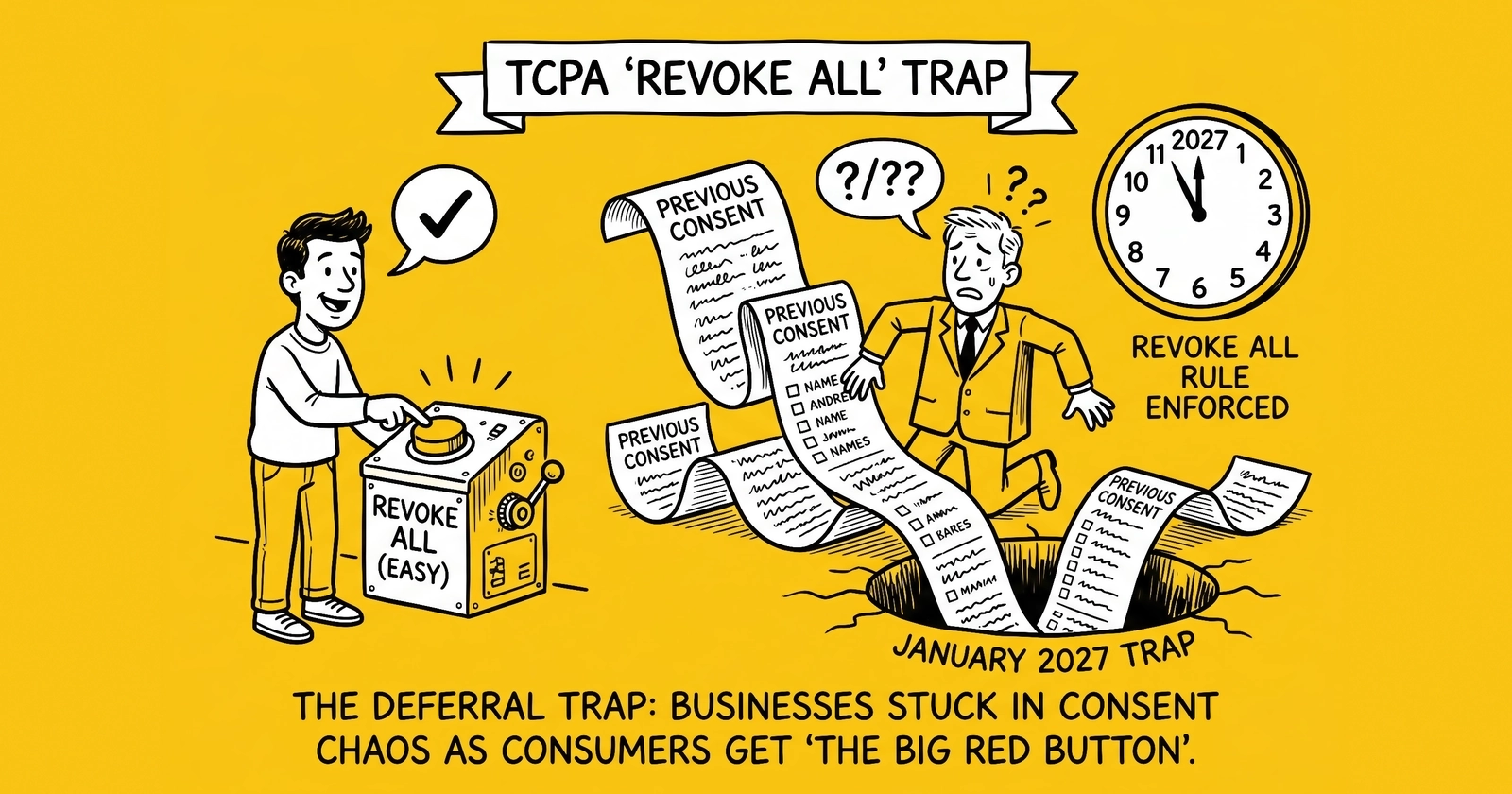
A narrow deferral, read as a broad reprieve, is how compliance programs miss the obligations that are already live.
The Deferral That Isn’t a Reprieve
On January 6, 2026, the FCC’s Consumer and Governmental Affairs Bureau issued Order DA 26-12 in docket CG 02-278, extending the effective date of one specific clause inside 47 C.F.R. § 64.1200(a)(10) – the cross-topic “revoke-all” requirement – from April 11, 2026 to January 31, 2027. Across roughly 72 hours, the trade press read it as good news. Hunton Andrews Kurth ran the headline straight. TCPAWorld, the Troutman Amin LLP tracker that most TCPA practitioners refresh before they pour the morning coffee, framed it as a reprieve. McGuireWoods, Burr & Forman, Wiley Rein, Mac Murray & Shuster, and a dozen other firms posted client alerts the same week. The general tone: the cross-business-unit suppression integration that financial services trade groups had been begging the FCC to push, got pushed.
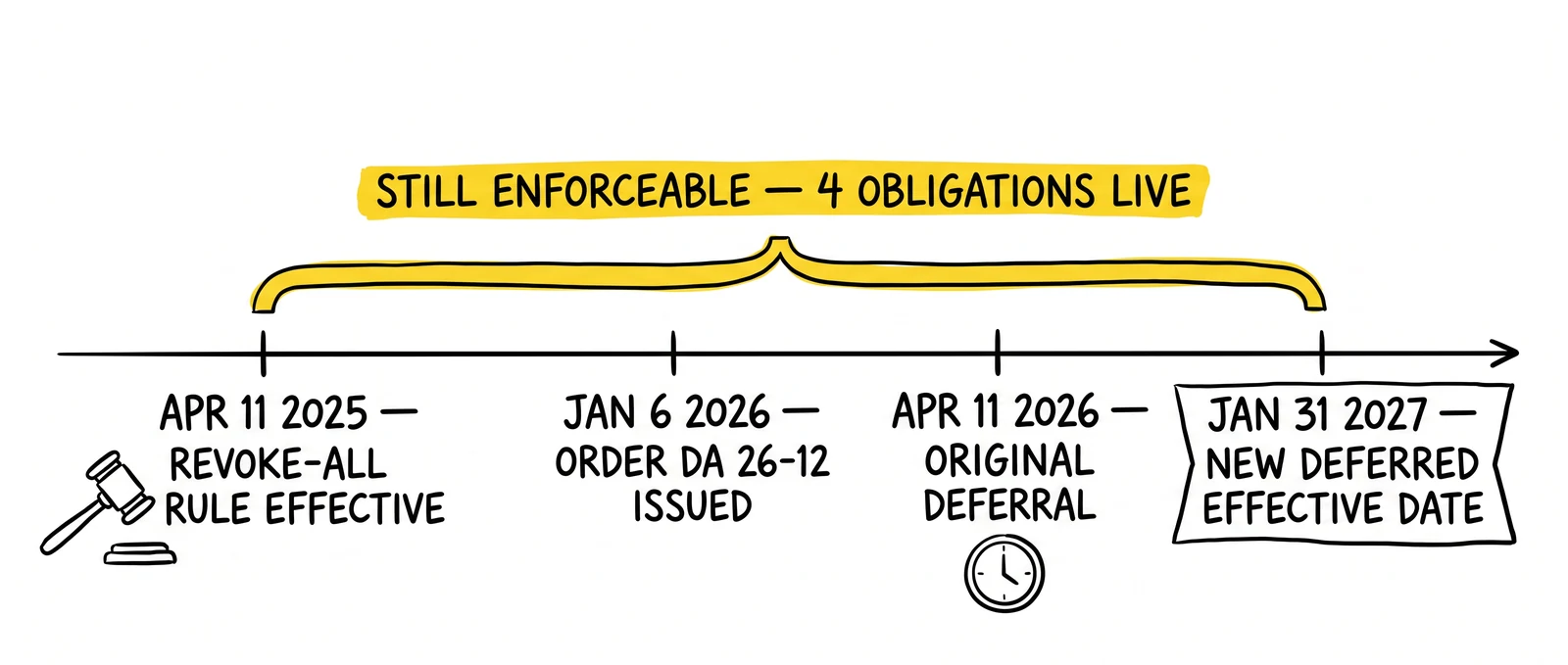
That much is true. What is not true – and what most internal compliance dashboards are quietly miscoding right now – is that the extension touched anything else. The other four portions of the February 2024 TCPA Consent Order all took effect on April 11, 2025 and remain fully enforceable. The 10-business-day processing window for revocation requests, the expanded list of reasonable opt-out commands, the rule that an opt-out from an exempted informational call counts as full revocation of consent, and the clear-disclosure requirement for opt-out methods – none of those were extended. None of them are negotiable. A consumer who texts STOP on a Tuesday and gets the next robotext on day 11 is the same theoretical $500-to-$1,500 statutory damages claim it was on April 12, 2025. Order DA 26-12 did not change that.
The trap is the framing. Operators who hear “deadline extended” and reprioritize the entire revocation workstream are concentrating risk on every vector except the one the deferral actually addresses. The compliance team’s job over the next 60 days is to separate what the bureau actually did from what general counsel’s eyes will tell them it did. That separation, done right, looks like a clear sheet of paper with two columns: “Deferred to January 31, 2027” with exactly one entry, and “In force on April 11, 2025” with four.
What Order DA 26-12 Actually Does
The order is six pages of dense bureau-speak, but the operative paragraphs are short. The Consumer and Governmental Affairs Bureau found good cause under 47 C.F.R. § 1.3 to extend the effective date of the cross-topic clause of 47 C.F.R. § 64.1200(a)(10), citing the pending October 29, 2025 Further Notice of Proposed Rulemaking in CG 02-278 and the implementation challenges raised by petitioners including America’s Credit Unions, the Defense Credit Union Council, and the American Bankers Association. The bureau preserved the rule. It did not vacate it. It did not suspend the underlying February 2024 TCPA Consent Order. It moved one effective date.
The cross-topic clause is the provision that would require a caller to treat a revocation received in response to one type of message – say, a fraud alert from a credit union’s checking account business unit – as applying to all future robocalls and robotexts from that caller on unrelated topics, including the same credit union’s mortgage refinance robocall campaign. In a multi-brand or multi-business-unit organization, that means a STOP to brand A has to propagate to brands B, C, D, and so on, across whatever dialer, ESP, SMS aggregator, and CRM stacks each brand runs. For a typical lead aggregator running between two and seven downstream business units on disconnected vendor platforms, that propagation requires real integration work. The estimated cost range from the 2025 petition record runs from $15,000 to over $1,000,000 depending on stack complexity, which is why the trade groups petitioned and why the bureau deferred.
The narrow scope, in plain numbers
The extension covers exactly one fact pattern: a single STOP applied across unrelated message categories from the same caller. Every other revocation scenario is unaffected:
| Fact pattern | Status as of June 2026 | Source |
|---|---|---|
| STOP propagates across unrelated topics from same caller | Deferred to January 31, 2027 | DA 26-12 |
| Opt-out processed within 10 business days | In force since April 11, 2025 | TCPA Consent Order |
| STOP / QUIT / END / REVOKE / OPT OUT / CANCEL / UNSUBSCRIBE all recognized | In force since April 11, 2025 | TCPA Consent Order |
| Opt-out from exempted informational call counts as full revocation | In force since April 11, 2025 | TCPA Consent Order |
| Clear disclosure of opt-out methods in initial disclosures | In force since April 11, 2025 | TCPA Consent Order |
Operators who read the January 6 order as covering anything in the bottom four rows are reading the wrong order.
Why financial services trade groups won this round and consumer groups didn’t
The bureau’s “good cause” finding rested on two arguments that the petitioners filed and the consumer advocacy groups largely could not rebut. First, the implementation cost for multi-business-unit organizations was concrete and quantified; the consumer-side benefit was probabilistic and harder to model. Second, the October 29, 2025 FNPRM had explicitly invited comment on whether to modify or replace the cross-topic clause to “give consumers more tailored control” – which signaled that the rule’s final form was undecided, and forcing an enterprise-wide build before the rulemaking concluded would burn capital on infrastructure that might be obsolete inside twelve months.
That second argument is the one operators should sit with. The bureau effectively acknowledged in writing that it might modify or scrap the cross-topic clause. It did not say it would. An FNPRM is not a final order, and the rulemaking typically runs nine to eighteen months – putting a likely final order anywhere between mid-2026 and Q2 2027, which is to say, plausibly after the January 31, 2027 effective date. If the FNPRM resolves with a substantially modified cross-topic rule, the compliance team gets the rest of 2027 to integrate. If it resolves with the rule intact, the compliance team has a regulatory cliff with no remaining deferrals to grab.
The Four Obligations That Stayed Live
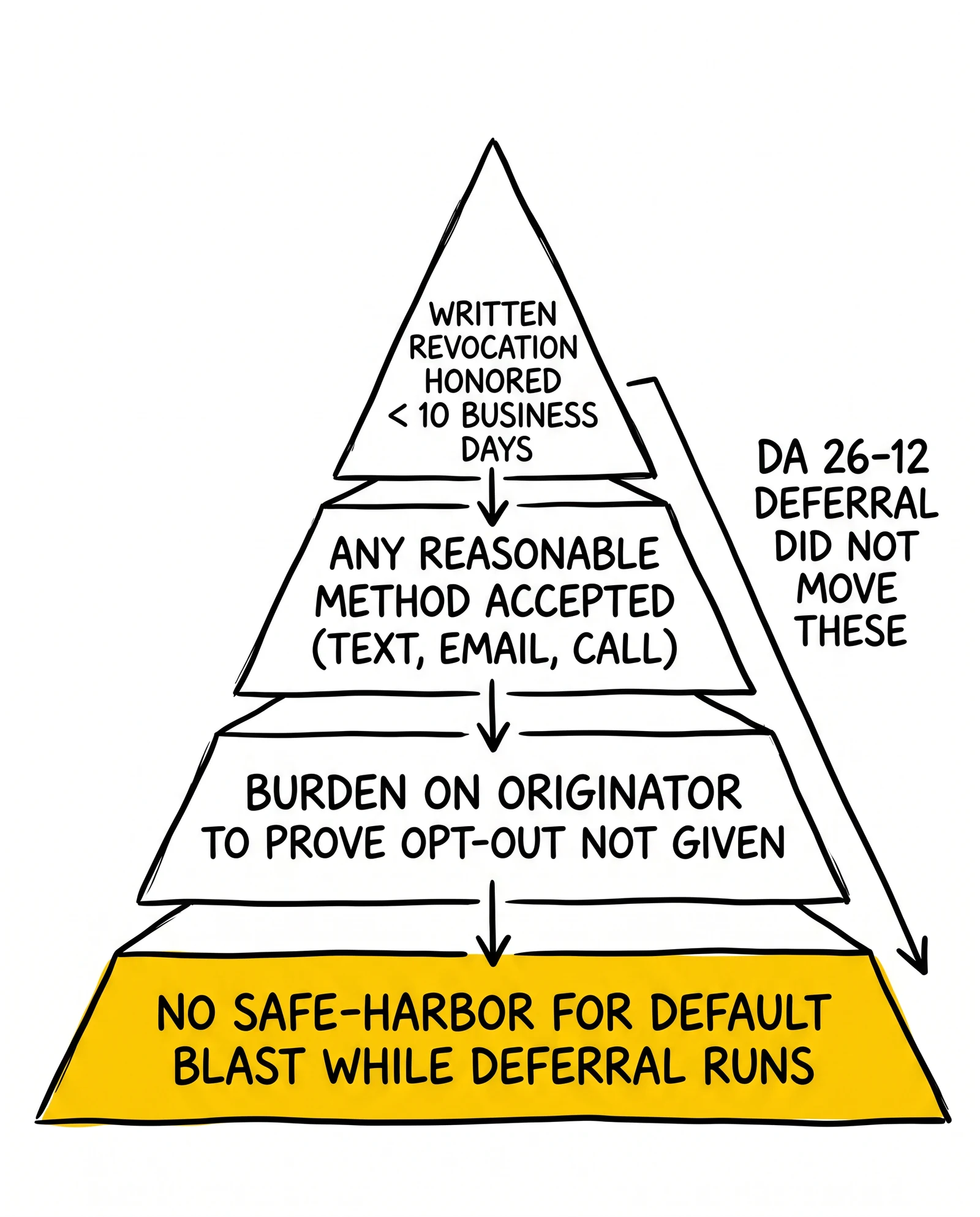
The most consequential single point in this article: the April 11, 2025 portion of the TCPA Consent Order is fully enforceable today, has been for fourteen months as of publish date, and the most common 2025 TCPA plaintiff claim is not a cross-topic suppression failure. It is a botched STOP. Operators auditing their TCPA posture against the January 31, 2027 effective date are auditing the wrong deadline. The audit should be against April 11, 2025, with thirteen months of accumulated drift to review.
The 10-business-day processing window
The February 2024 Consent Order shortened the maximum revocation processing window from 30 days to 10 business days. That single change is the most operationally consequential clause in the rule. A dialer that ingests STOP commands once a day instead of in real time can still be compliant. A dialer that ingests STOP commands weekly cannot. A CRM that pushes suppression-list updates to affiliates on a 14-day cron job is non-compliant by four business days, every cycle. A vendor that promises 30-day suppression-list synchronization in its master services agreement is offering non-compliant performance.
Audit question: take the most recent 90 days of STOP commands from any consumer-facing channel. For each STOP, measure the elapsed business days between receipt at the channel of origin and confirmed suppression on every downstream outbound system, including any third-party callers under vendor flow-down. If the 95th percentile is over 10 business days, the operator is non-compliant on the 95th-percentile fact pattern. The plaintiff bar reads dialer logs in discovery.
The expanded reasonable opt-out vocabulary
The Consent Order codified that STOP, QUIT, END, REVOKE, OPT OUT, CANCEL, UNSUBSCRIBE, and any other reasonable expression of intent to revoke must be honored. The pre-2025 industry default was STOP, and many dialer and SMS aggregator configurations still accept only STOP as the trigger keyword. A consumer who texts QUIT to a Medicare lead campaign and continues to receive robotexts because the dialer was not configured to recognize QUIT is a per-message TCPA claim, full stop. The Consent Order also explicitly preserves “any other reasonable means” – including verbal revocation on a live call, an email reply with “please stop calling,” a chat message in a conversational SMS thread, or a postal letter to the operator’s address of record. Operators whose suppression intake is text-keyword-only are non-compliant by design.
Audit question: take the most recent 30 days of inbound text traffic across all SMS aggregators and outbound platforms. Count messages that contain any of the seven enumerated revocation terms but were not processed as revocations because the dialer was configured to accept only STOP. Each one is a theoretical TCPA exposure. The same audit should run against the call center for verbal revocations not captured in CRM disposition codes, and against the support inbox for email replies that contained revocation language and were processed as customer service tickets rather than suppression events.
Opt-out from exempted informational calls
The rule that opt-out from an exempted informational call – a fraud alert, an appointment reminder, a prescription refill notification, a utility outage notice – counts as full revocation of consent for that caller on that topic is the clause that catches healthcare, financial services, and utility operators most often. The pre-2025 industry assumption was that exempted informational calls were exempted from the consent regime entirely, and a STOP to an exempted call did not have to propagate. The Consent Order said the opposite: an opt-out from an exempted call is a full revocation, processed inside 10 business days, recognized through any reasonable expression.
For lead operators, this matters less directly – most lead campaigns are not exempted informational – but it matters indirectly through downstream buyers and through the dual-purpose call problem. A Medicare carrier that runs both exempted plan-administration calls and marketing calls to the same beneficiary list must process a STOP to either as a full revocation. Lead aggregators selling into Medicare carriers should expect tighter buyer-side suppression list requirements in 2026 and 2027 as carriers tighten their own compliance against this rule.
Clear disclosure of opt-out methods
The final April 2025 obligation: initial messages must clearly disclose opt-out methods. This is the simplest of the four to audit and the easiest to fix, but it is also where pre-2024 message templates that were never updated continue to ship. Audit question: pull the actual SMS templates and call scripts that hit consumers in the most recent 30 days. Count any that do not include a clear, conspicuous statement of how to opt out, in language a typical consumer can understand. Each one is a per-message exposure. Templates last edited in 2023 are almost certainly non-compliant.
Why “Defer The Whole Thing” Is The Wrong Plan
The compliance team that has been instructed to deprioritize the revocation workstream is responding to a single signal – the bureau pushed the deadline – without checking whether the signal applies to the workstream they were actually building. In most lead operator stacks, the workstream had three components: cross-topic suppression integration across business units (the build that just got pushed), 10-business-day processing audits against the existing pipeline (live since April 2025), and vendor flow-down updates so that affiliates honor the new vocabulary and timeline (live since April 2025). Deferring the entire workstream because one of the three components got pushed is a category error.
The vendor flow-down problem doesn’t move
Lead aggregators running ping/post and waterfall distribution have downstream buyers, partners, and affiliates whose compliance posture is tied to the master agreement language. If those agreements reference “TCPA-compliant suppression list synchronization” without a specific 10-business-day SLA, the agreement is effectively non-compliant for any post-April 2025 contact. If the agreement references “the FCC’s revocation rule effective date” without specifying which clause, the agreement is ambiguous between the April 2025 portions (in force) and the cross-topic portion (deferred). Either way, the agreement needs an addendum that nails the timeline against each obligation specifically.
Vendor flow-down failure is also the single most common source of vicarious TCPA liability for the aggregator. When a downstream affiliate texts a consumer who had revoked consent through an upstream channel, the consumer’s lawyer sues the entity with the deepest pocket – which in most ping/post structures is the aggregator that captured the original lead and sold it down the chain. The aggregator’s defense rests on whether the master agreement specified a propagation timeline tight enough to meet the federal rule. Order DA 26-12 does not extend that defense. The defense is whatever the master agreement says, on the April 2025 portions, regardless of the cross-topic deferral.
The canonical contact record is value-additive regardless
The infrastructure that supports the cross-topic clause – a single canonical contact record per consumer, channel-tagged consent receipts with timestamps and source context, audit logs that survive the 4-year TCPA statute window – is value-additive for every other compliance regime the operator faces. State mini-TCPAs in Florida, Oklahoma, Washington, and the FTSA/OTSA/CEMA framework all require multi-channel suppression at standards that are stricter or stranger than the federal cross-topic rule would impose. GDPR and the EU ePrivacy directive require record-of-consent that maps to channel-tagged receipts. The CCPA’s deletion right and the right to limit sensitive personal information require operators to know which records to delete and which channels to suppress. The McLaughlin v. McKesson ruling means district courts can apply common-law totality-of-the-circumstances tests that look very similar to the cross-topic rule even without it being on the federal books.
In short, the operator who scopes the cross-topic build narrowly to “what the federal rule requires” is solving the wrong problem. The operator who scopes the build to “a canonical consumer record with channel-tagged consent receipts and an audit trail that survives a four-year statute” is solving the federal rule, the state regimes, the EU regimes, and the district court common law all at once. The deferral changes the timing on one of those, and the others were already in force.
The Q4 2026 cliff is closer than the calendar suggests
Order DA 26-12 sets the new effective date at January 31, 2027 – twelve months and 25 days from the publish date of this article. That sounds comfortable. It is not. The FNPRM is expected to resolve sometime between Q3 2026 and Q2 2027. If it resolves in October 2026 with the cross-topic rule intact, the compliance team has 3 months to finish a multi-business-unit integration that the pre-extension cost estimates put at 9 to 12 months for most multi-brand operators. If it resolves in March 2027 with the rule modified, the team has whatever effective date the modified rule sets – likely 6 to 12 months after the final order – to integrate. The realistic worst case is a Q4 2026 FNPRM resolution that confirms the original rule, with January 31, 2027 still binding, and 3 months to deliver a 12-month build. That is the cliff. Building canonical contact records now means the cliff is a software deployment problem rather than a system integration problem.
The Audit Checklist for the Next 60 Days
The audit that maps to Order DA 26-12 reality has nine line items, broken into three sections. The first section covers what’s already live and where most operators have drift since April 2025. The second covers what the deferral actually deferred and what the no-regret prep is. The third covers vendor and contract obligations that move independently of the federal rule timing. Every line item should resolve to a specific evidence artifact – a log file, a contract clause, a configuration screenshot – that survives discovery.
Section A: April 2025 obligations (in force; verify compliance now)
-
10-business-day STOP audit. Pull last 90 days of inbound STOPs across every channel. Measure receipt-to-suppression elapsed business days at p50 and p95. Any p95 over 10 business days is a finding. Document for every channel, every dialer, every aggregator.
-
Reasonable opt-out vocabulary audit. Confirm that every dialer, ESP, and SMS aggregator recognizes STOP, QUIT, END, REVOKE, OPT OUT, CANCEL, UNSUBSCRIBE, plus reasonable expressions in free-text replies. Capture configuration screenshots. Any keyword-only configuration is a finding.
-
Verbal and email revocation capture audit. Confirm that call center dispositions include a revocation code that triggers CRM suppression, and that the customer service inbox routes revocation-language emails to suppression rather than support. Any orphan revocation path is a finding.
-
Exempted-call propagation audit. For operators with downstream Medicare, healthcare, financial services, or utility buyers, confirm that the buyer-side STOPs flow back to the aggregator-side suppression list within the 10-business-day window. Any silent buyer-side suppression that does not propagate upstream is a vicarious liability finding.
-
Disclosure language audit. Pull every SMS template and call script that hit consumers in the most recent 30 days. Confirm each contains clear, conspicuous opt-out disclosure. Any template last edited before April 2024 needs review.
Section B: January 2027 obligations (deferred; build the foundation now)
-
Canonical contact record gap analysis. Map every system that holds consumer contact data. Identify duplicates, orphan records, and any system that cannot resolve a phone number to a single canonical identity. Estimate engineering cost to consolidate. Capture as a 12-month roadmap with quarterly checkpoints.
-
Channel-tagged consent receipt audit. Confirm that TrustedForm, Jornaya, ActiveProspect, or equivalent consent capture solutions are storing per-channel timestamps, source attribution, and the exact consent disclosure language served at consent time. Any gap is a TCPA defense weakness regardless of cross-topic timing.
-
FNPRM monitoring assignment. Assign a named individual on the compliance or legal team to monitor docket CG 02-278 for the FNPRM resolution. The resolution date determines the cliff. Calibrate the cross-topic integration roadmap to ship 90 days before the resolution date plus the effective date offset, whichever is earlier.
Section C: Vendor and contract obligations (move independently)
- Master agreement addendum. Push an addendum to every downstream buyer, ping/post partner, and affiliate master agreement that explicitly references the 10-business-day processing window, the seven-keyword reasonable opt-out vocabulary, and the verbal-and-email revocation capture obligation. Reference Order DA 26-12 as a defined date for the cross-topic clause. Refuse to sign new agreements without this addendum.
The nine-item audit is not optional. Each line resolves to a finding or to a clean evidence artifact, and the artifacts collectively constitute the operator’s TCPA defense for the four years following any contact. Deferring the audit because Order DA 26-12 pushed the cross-topic effective date is exactly the trap the rule’s framing creates.
How Plaintiff Firms Read Order DA 26-12
The framing trap is not symmetric. Operators read the order and tend to underweight what stayed live. Plaintiff firms read the order and tend to overweight what stayed live – because the live obligations are where the per-claim damages flow and the live obligations are where most operator stacks have measurable drift. The serial TCPA litigators who file the bulk of 2025 and 2026 class actions are not waiting for the cross-topic clause. They are filing on the 10-business-day window, the missed STOP, and the keyword-only configurations.
The mathematical reason: every revocation request creates a discrete fact pattern. A consumer who texted STOP on day 0 and received a robotext on day 11 is a single fact pattern with a per-message damages number. A consumer who texted QUIT to a dialer that only recognized STOP is the same pattern. A consumer who replied “please remove me” to an outbound email and was not suppressed is the same pattern. Each of these is independently provable from operator log files in discovery, and the plaintiff firm’s discovery requests have been refined over five years to surface them efficiently. The cross-topic fact pattern is harder to prove because it requires the plaintiff to demonstrate that brand A and brand B are operated by the same caller – a question that defendants can sometimes confuse through corporate structure arguments. The April 2025 fact patterns require none of that argument. They are pure log-file plays.
The shift in plaintiff strategy since the McLaughlin v. McKesson ruling in June 2025 has reinforced this. With Hobbs Act deference gone, district courts can apply state-by-state common-law analysis to revocation questions. In plaintiff-friendly jurisdictions, a court can hold that a single STOP from a consumer to brand A reasonably applied to brand B under a totality-of-the-circumstances theory, regardless of whether the FCC’s cross-topic clause is technically in force. Order DA 26-12 buys time on the federal cross-topic clause; it does not create a federal safe harbor for the underlying fact pattern. The plaintiff bar already knows this.
For lead aggregators, the operational read is straightforward: assume the live obligations are where the next 18 months of TCPA class action filings concentrate, because the math says they will. Building the cross-topic infrastructure now is a defense against both the live obligations (which it incidentally hardens) and the eventual January 31, 2027 effective date. Building only the cross-topic infrastructure and ignoring the live obligations is the worst possible allocation.
Key Takeaways
-
The deferral covers exactly one fact pattern. Order DA 26-12 extended the cross-topic clause of 47 C.F.R. § 64.1200(a)(10) to January 31, 2027. Every other portion of the February 2024 TCPA Consent Order – the 10-business-day processing window, the expanded reasonable opt-out vocabulary, the exempted-call treatment, and the clear-disclosure requirement – took effect April 11, 2025 and is fully enforceable today.
-
The most common 2025 TCPA claim is not a cross-topic failure. Missed STOPs, keyword-only configurations, and 11-plus-day suppression cycles are the bread-and-butter plaintiff filings. Operators auditing against the January 31, 2027 deadline are auditing the wrong rule.
-
The 9-item audit checklist is mandatory, not optional. Five line items verify April 2025 compliance, three line items build the cross-topic foundation, one line item updates vendor master agreements. Each resolves to a discoverable evidence artifact that survives the 4-year statute window.
-
Vendor flow-down moves independently of any FCC deferral. Master agreements that reference “TCPA-compliant suppression” without 10-business-day SLAs are non-compliant for any post-April 2025 contact. Aggregators are the deepest pocket in ping/post structures and the natural target for vicarious liability.
-
The canonical contact record is value-additive across regimes. State mini-TCPAs, GDPR, CCPA, McLaughlin-era district court common law, and the eventual cross-topic rule all require some version of the same infrastructure. Building it now is risk-management arbitrage.
-
The Q4 2026 cliff is closer than January 2027 suggests. A late FNPRM resolution with the rule intact leaves 3 months to ship a 9-to-12-month integration. Operators who defer foundation work until the FNPRM resolves face a binary outcome with one-way downside.
-
Plaintiff firms have already absorbed Order DA 26-12. The serial litigator strategy in 2026 concentrates on April 2025 fact patterns because they are log-file plays with cleaner discovery and harder defenses. The cross-topic deferral changes none of that.
-
McLaughlin v. McKesson removes the federal safe harbor logic. District courts can apply common-law totality-of-the-circumstances tests that look like the cross-topic rule even without the rule being in force. The deferral buys federal regulatory time, not litigation safety.
-
Document the audit, file the evidence, refresh quarterly. Every artifact generated by the 9-item audit becomes part of the operator’s TCPA defense file for the next four years. The cost of generating artifacts now is dramatically lower than the cost of reconstructing them under a discovery order in 2028.
Sources
- CGB Extends the Effective Date of the TCPA’s Consent Revocation Rule (Order DA 26-12, FCC, January 6, 2026)
- Federal Communications Commission DA 26-12 – Order (FCC, January 6, 2026)
- BREAKING: FCC Pushes Back TCPA Consent Revocation Rule – New Effective Date Now January 31, 2027! (TCPAWorld, Troutman Amin LLP, January 7, 2026)
- Portion of TCPA Global Revocation Rules Further Extended – Now Effective January 2027 (Hunton Andrews Kurth, January 2026)
- FCC Further Extends Effective Date for TCPA ‘Revoke-All’ Rule (Consumer Financial Services Law Monitor, McGuireWoods/Burr & Forman, January 2026)
- FCC Delays Effective Date of TCPA Revoke-All Rule Until January 31, 2027 (Burr & Forman LLP, January 2026)
- FCC Extends Limited Waiver for Part of the TCPA Consent Revocation Rule (Wiley Rein, January 2026)
- Delayed Again! FCC Pushes Back TCPA’s ‘Revoke All’ Rule to January 31, 2027 (Mac Murray & Shuster LLP, January 2026)