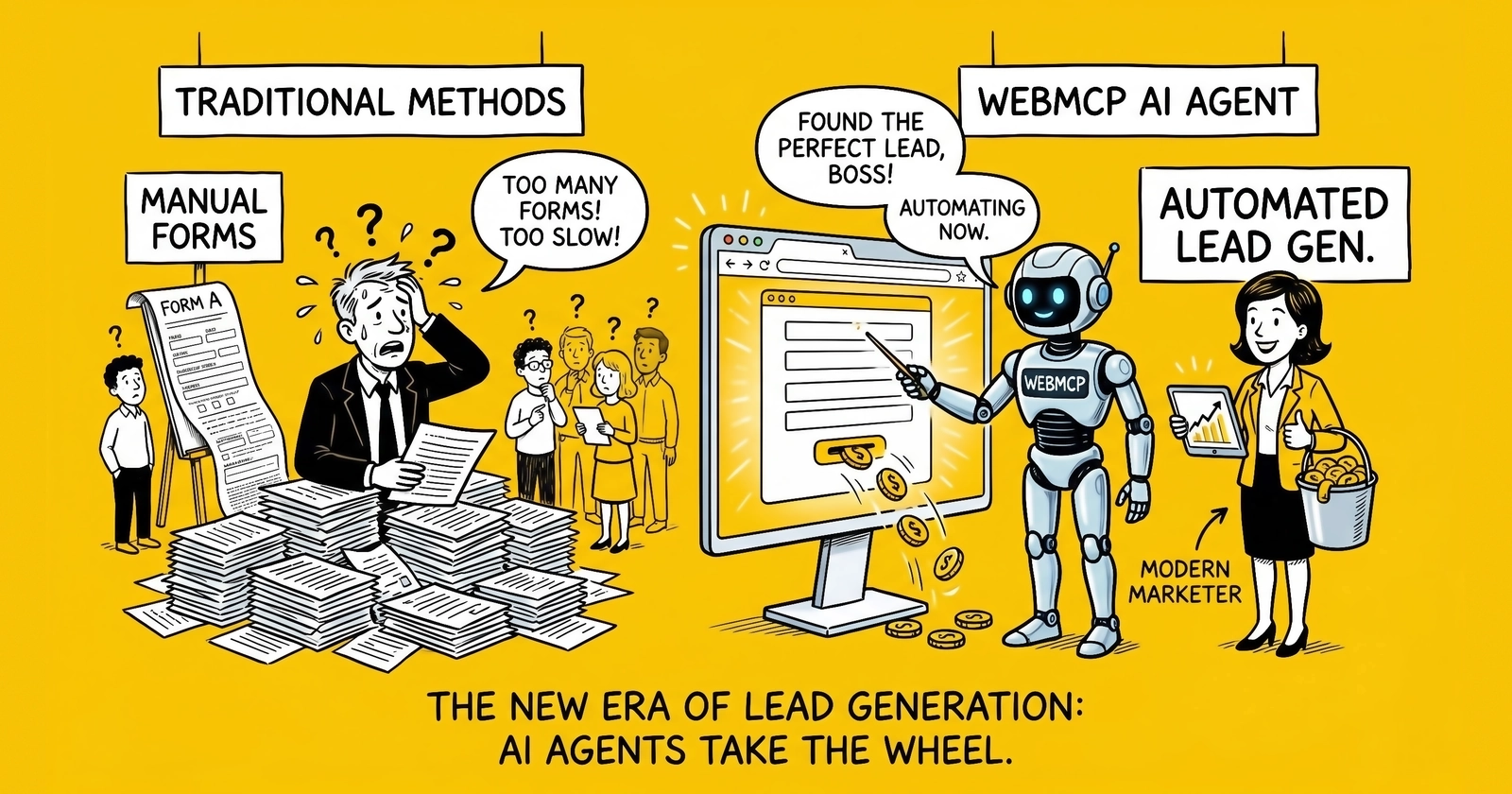
The browser, not the backend, is becoming the runtime where AI agents and authenticated services meet.
The browser becomes the AI runtime
Implementation state, early 2026: Chrome Canary and Microsoft Edge are exposing flag-level WebMCP-style support behind a chrome://flags/#webmcp-for-testing entry and analogous Edge surface; stable-release commitments from either browser vendor have not been confirmed against a primary source as of publication. The W3C Web Machine Learning Community Group accepted the unified proposal in September 2025. Treat the runtime described below as preview / canary / flag and design fallbacks accordingly.
In early 2026 Google’s Chrome team began exposing WebMCP-style support behind a feature flag in Chrome Canary – reported as Chrome 146 Canary behind chrome://flags/#webmcp-for-testing, treated here as a preview-channel data point rather than confirmed stable-release shipment – with the W3C draft adding a navigator.modelContext JavaScript API to secure-context web pages. The flag turns each tab into a tool-registration surface that any AI agent can call into. Microsoft Edge teammates co-authored the specification, and Edge has analogous flag-level support emerging on a parallel timeline. The W3C Web Machine Learning Community Group accepted the unified proposal in September 2025, drawing together three independent efforts: Alex Nahas’s MCP-B prototype built at Amazon in January 2025, Google Chrome’s “Script Tools” exploration, and Microsoft’s “Web Model Context” explainer. WebMCP is not Anthropic’s Model Context Protocol running in a browser. It is a different protocol, built for a different problem, and it changes what AI agents can do with authenticated web sessions. To keep the three layers straight: MCP-the-protocol is the JSON-RPC standard that lets a model call server-side tools (covered in the MCP protocol primer); MCP enterprise middleware is the deployed server tier sitting between AI clients and lead-gen platforms (covered in MCP as enterprise middleware); WebMCP, the subject of this article, is the in-browser runtime that lets any authenticated tab register tools an agent can call without OAuth or a backend MCP server at all. This article focuses on the runtime architecture itself; a forthcoming companion piece on tool-defined lead capture will cover the design pattern that sits on top – how to define the tool catalog, attestation flow, and tool-aware routing operators ship into their funnel.
The lead-generation industry has been watching this convergence with the same posture it brought to the Amazon v. Perplexity Comet litigation: a mix of opportunism and dread. Gartner projected in November 2025 that AI agents will intermediate more than 15 trillion dollars in B2B spending by 2028, with 90 percent of B2B purchases handled by agents within three years. The MCP ecosystem reached 97 million monthly SDK downloads in 2025. Cloudflare’s MCP Demo Day in May 2025 saw Anthropic, Asana, Atlassian, Block, Intercom, Linear, PayPal, Sentry, Stripe, and Webflow all launch remote MCP servers in a single afternoon. WebMCP is the layer that makes those servers reachable from inside any authenticated browser session – without OAuth, without server-side token plumbing, and without the lethal-trifecta security model that has hobbled vision-based agents like ChatGPT Atlas and Comet.
For lead-gen operators, B2B SaaS publishers, and CRM platform owners, the strategic question is no longer whether agents will reach their applications. They will. The question is which tools to expose, under whose consent, with what attribution, and on what timeline. The answers determine whether the operator captures the new agent traffic or watches it route around them.
How navigator.modelContext actually works
WebMCP defines a single global object on every secure-context web page: navigator.modelContext. The object exposes a registerTool method that accepts a tool definition with three required fields – a unique name, a natural-language description, and a JSON Schema for inputs – plus an execute callback that runs when the agent invokes the tool. The pattern lifted directly from Anthropic’s MCP, but the implementation is browser-native rather than JSON-RPC.
A lead-gen-specific example clarifies the model. A solar comparison site that wants to expose qualification logic to an in-browser agent would register something like:
navigator.modelContext.registerTool({
  name: 'qualify_lead',
  description: 'Score and qualify an inbound solar lead against installer ICP criteria',
  inputSchema: {
    type: 'object',
    properties: {
      zipcode: { type: 'string' },
      monthly_kwh: { type: 'number' },
      roof_age_years: { type: 'integer' },
      homeowner: { type: 'boolean' }
    },
    required: ['zipcode', 'homeowner']
  },
  async execute(args) {
    const score = await runICPScoring(args);
    return { content: [{ type: 'text', text: JSON.stringify(score) }] };
  }
});
The agent reads the registered tools through the browser’s WebMCP surface, sees a typed contract, and calls qualify_lead with structured arguments. The execute callback runs in the page’s own JavaScript context, which means it inherits the user’s session cookies, federated SSO state, and any first-party data the page already holds. There is no separate authentication step. The agent never sees the underlying API endpoint, the database connection string, or the scoring weights – only the tool name and the typed return value.
WebMCP defines two complementary API surfaces. The imperative API, shown above, handles dynamic logic in JavaScript. The declarative API does the same job for static HTML forms by adding three attributes – toolname, tooldescription, and toolparamdescription – to existing markup. A standard lead-capture form becomes agent-callable without a single line of JavaScript:
<form action="/intake" method="post"
      toolname="submit_lead"
      tooldescription="Submit a qualified solar lead to the marketplace">
  <input name="zipcode" toolparamdescription="Five-digit US ZIP code" />
  <input name="email" toolparamdescription="Consumer email address" />
  <input name="phone" toolparamdescription="Consumer mobile number" />
  <button type="submit">Get my quote</button>
</form>
The declarative path is what makes WebMCP adoption tractable. A lead-gen marketplace that wants to expose its intake form to declared agents can ship the change in an afternoon. The imperative path is what makes WebMCP powerful for stateful CRM and SaaS interactions where the tool needs to read the current view, query the page’s data layer, or compose responses across multiple internal systems.
The transport architecture has five distinct paths. In-page communication is direct through navigator.modelContext. Tab transport uses window.postMessage for client-to-page communication within a single tab, with origin validation. Extension transport uses Chrome’s runtime.messaging to surface tools to extension components. Iframe transport uses postMessage for cross-origin embedded apps. A native-server relay bridges browser extensions to local MCP clients like Claude Desktop through a stdio proxy on port 12306. None of the paths uses ServiceWorkers. Tools persist only for the page lifetime – navigation clears all registered tools, which is a deliberate scoping choice that prevents cross-tab attacks.
The official spec lives at webmachinelearning.github.io/webmcp/, with the implementation reference at github.com/webmachinelearning/webmcp and Google Chrome Labs companion demos at github.com/GoogleChromeLabs/webmcp-tools. The spec editors are Brandon Walderman, Leo Lee, and Andrew Nolan from Microsoft, plus David Bokan, Khushal Sagar, Dominic Farolino, and Hannah Van Opstal from Google.
The MCP-B to WebMCP convergence
WebMCP did not start as a W3C effort. It started as a single engineer’s frustration at Amazon. Alex Nahas, a backend engineer at Amazon and the GitHub user @MiguelsPizza, hit the same wall every enterprise hits when the Model Context Protocol meets a real authentication stack. Anthropic’s MCP standardized on OAuth 2.1 for authorization, which is correct for greenfield deployments but unworkable for an organization where thousands of internal services were already federated through a browser-resident SSO layer that did not speak OAuth 2.1.
Amazon’s authorization fabric runs through a browser experience that signs employees into every dashboard, every internal tool, every operational console. The credentials live in the browser as session cookies. The federation lives in the browser as a chain of redirects and trust handoffs. None of it had OAuth 2.1 endpoints, and retrofitting OAuth 2.1 onto thousands of services for the sake of an emerging AI protocol was not realistic. Nahas observed that the browser already solved the authentication problem. The simplest path was to run MCP inside the browser and let it inherit the federation that was already there.
He integrated the MCP TypeScript SDK into a client-side JavaScript application and built a custom postMessage transport between the page and a Chrome extension. The result was MCP-B – a way for AI agents to call MCP tools that lived inside an authenticated browser tab, with no OAuth flow, no token storage, and no backend infrastructure beyond what the page already had. The original MCP-B repository, now MiguelsPizza/WebMCP on GitHub, accumulated more than 1,800 stars. The WebMCP-org organization maintains 17 supporting repositories including transports, React hooks, Chrome DevTools integration, and framework examples for vanilla TypeScript, React, Rails, Angular, and Phoenix LiveView.
The Chrome team had been working on a parallel effort called Script Tools. The Edge team had published a “Web Model Context” explainer. By August 2025 all three efforts converged into a single proposal under the W3C Web Machine Learning Community Group. The community group accepted the unified specification in September 2025. Roughly six months later, Chrome Canary / flag-level WebMCP-style support began emerging as a preview surface behind an experimental feature flag.
The naming creates ongoing confusion, because WebMCP and MCP share a conceptual model but not a wire protocol. Anthropic’s MCP uses JSON-RPC 2.0 over stdio, Streamable HTTP, or Server-Sent Events. WebMCP is a browser-native API. The W3C working group explicitly chose not to couple the WebMCP specification to the MCP wire protocol, which means a WebMCP tool does not need to know anything about JSON-RPC and an MCP server does not need to know anything about navigator.modelContext. The two protocols address different layers and the browser’s role is to bridge them when needed.
| Dimension | Anthropic MCP | WebMCP (W3C) |
|---|---|---|
| Wire protocol | JSON-RPC 2.0 | Browser-native API |
| Transport | stdio, Streamable HTTP, SSE | navigator.modelContext, postMessage |
| Execution | Server-side (Python, Node) | Client-side browser JavaScript |
| Authentication | OAuth 2.1, API keys | Browser session cookies, federated SSO |
| Primitives | Tools, Resources, Prompts | Tools only (v1) |
| Architecture | Client-server | Page-as-server |
| Lifecycle | Persistent server process | Ephemeral, cleared on navigation |
| Governance | Agentic AI Foundation (Linux Foundation) | W3C Community Group |
| Token efficiency vs. screenshots | Variable | Approximately 89% fewer tokens |
Source: WebMCP W3C draft, Anthropic MCP specification, Cloudflare Code Mode benchmarks, 2025–2026.
OAuth-flow reduction and the session-first identity model
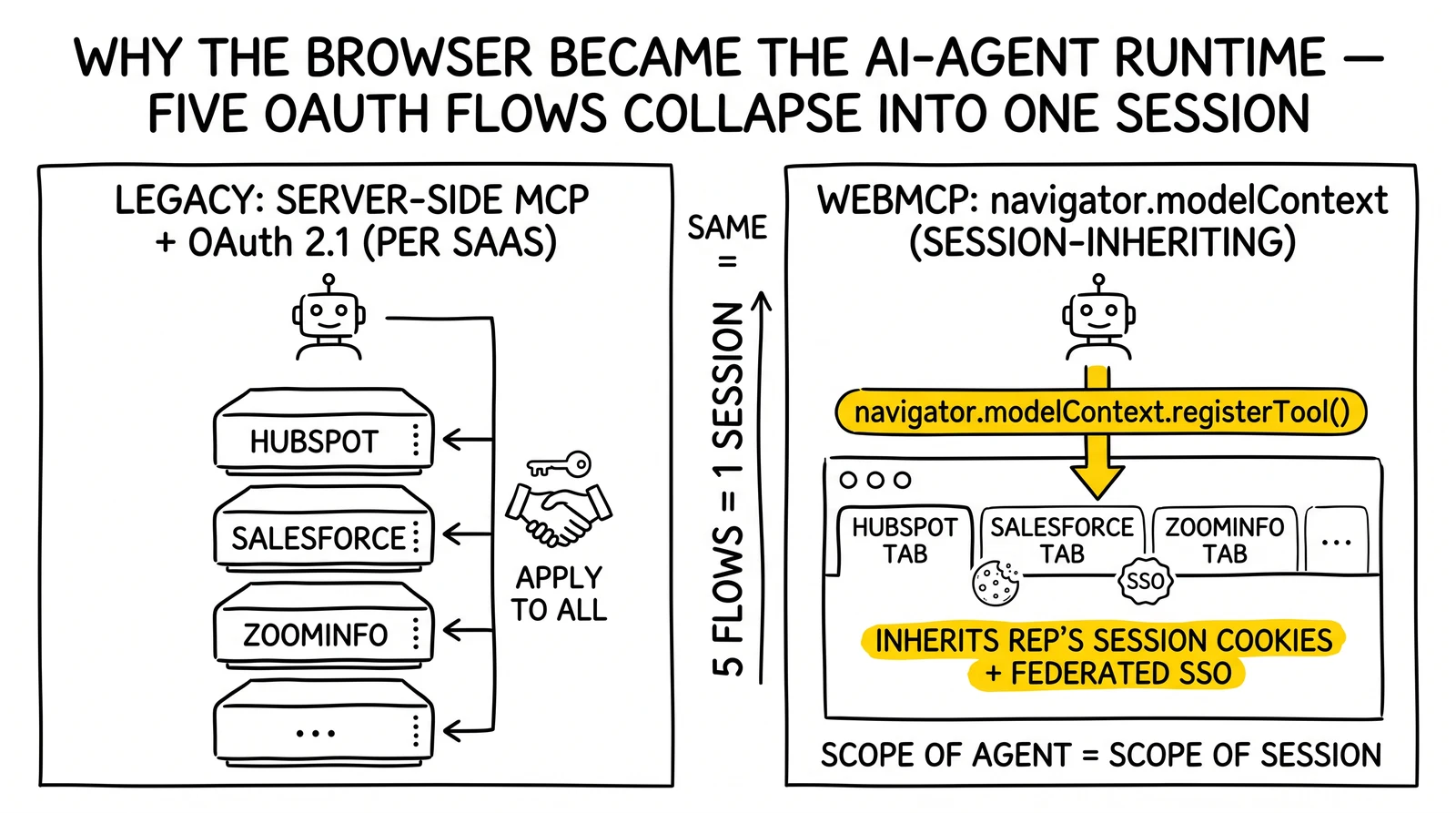
The most consequential property of WebMCP is not the API shape. It is the authentication model. Standard MCP integrations require credential management infrastructure: OAuth client registration, token refresh logic, secure credential storage, audit logging, and security review. For a lead-gen operator that wants to give an AI agent access to HubSpot, Salesforce, ZoomInfo, Apollo, and a TrustedForm console, that is five OAuth integrations, five credential vaults, five audit trails, and five places where a leaked token compromises the operator’s data.
WebMCP can reduce a separate OAuth flow for each of those services when each page safely mediates the rep’s authenticated session. If the rep is logged into HubSpot in tab one, the agent calling tools registered on that page can inherit the rep’s HubSpot session cookies. If the rep is logged into Salesforce in tab two, the agent’s tools on that tab can inherit the Salesforce session. Each tool runs in its own origin, bound by the same-origin policy, with no cross-tab leakage. The browser’s security model – which the industry has spent thirty years hardening – becomes part of the agent’s authentication surface, alongside whatever OAuth surfaces remain in the operator’s stack.
This is why Google and Microsoft are co-authoring the specification. WebMCP makes the browser the default AI agent runtime. Every dollar spent giving an agent access to an enterprise SaaS through OAuth is a dollar that does not flow through the browser. By making the browser the path of least resistance, the specification compounds Chrome and Edge’s strategic position from rendering engine to agent execution surface. The same logic applies to SaaS publishers: a HubSpot or Salesforce that exposes WebMCP tools captures agent traffic that would otherwise route around it through brittle vision-based automation or third-party scraping.
The session-first model has three operational consequences for lead-gen and B2B SaaS operators. First, scope of access matches scope of session. The agent cannot reach data the rep cannot reach. Permission models built into the application transfer to the agent automatically. Second, audit trails are unified. Every agent action is logged in the same SaaS audit log as the rep’s manual actions, because the agent is acting through the rep’s session. Third, revocation is unified. Logging the rep out kills the agent’s access at the same instant. There is no separate process to deprovision agent credentials when a rep leaves the organization.
The lethal trifecta – a term coined by Simon Willison in 2025 to describe the failure mode where an agent has read access to private data, read access to attacker-controlled instructions, and write access to a sensitive sink – is acknowledged but not solved in WebMCP v1. The spec includes a requestUserInteraction() function that pauses execution for explicit user confirmation on sensitive actions, and tools inherit the origin security boundary. For lead-gen operators the practical guidance is straightforward: any tool that touches consent capture, payment, or outbound communication must require user confirmation by default. The browser will prompt the user when tools are first registered and when agents invoke them, but operators should not rely on browser prompts as the only consent layer.
Lead-generation applications: what changes in 12 months
The compound effect of WebMCP, the broader MCP ecosystem, and the existing CRM-MCP integrations creates four lead-gen-specific patterns that did not exist in early 2025.
Real-time visitor qualification through registered tools. A WebMCP-enabled marketing site can register a qualify_visitor tool that exposes behavioral signals – pages visited, time on site, form interactions, scroll depth – to an AI agent operating in the visitor’s tab or in a sales rep’s tab where the visitor is observed through a session-replay tool. The agent cross-references the signal against ICP criteria pulled from a CRM MCP server and routes high-intent visitors to a human rep through a route_to_rep tool. Qualified.com’s Piper agent and Warmly’s revenue-orchestration platform already implement this pattern with proprietary infrastructure. WebMCP makes the pattern composable across vendors and standardized at the protocol layer. The site swaps Piper for a competitor by changing one line of JavaScript, not by re-instrumenting the page.
Autonomous enrichment and outreach through the rep’s authenticated stack. An AI SDR agent operating across a rep’s browser tabs can discover a prospect on LinkedIn (through a WebMCP tool registered on LinkedIn’s page or a Chrome extension), enrich the contact through ZoomInfo’s MCP server, check for existing records in Salesforce through its native MCP client, and add the prospect to an outreach sequence in Lemlist or Apollo – each step running through the rep’s authenticated session. Clay’s “waterfall enrichment” across more than 100 data providers, currently delivered as a proprietary platform, becomes an orchestratable workflow across any browser-accessible service. The agent does not need its own Apollo seat or its own ZoomInfo license. It uses the rep’s licenses through the rep’s session.
Form submission and lead distribution at agent scale. WebMCP’s declarative API turns any HTML form with toolname and tooldescription attributes into an agent-callable lead-submission endpoint. An AI buyer agent shopping for solar quotes on behalf of a homeowner can fill and submit lead capture forms across a marketplace’s network, paired with Microsoft’s Playwright MCP server (29,600 GitHub stars) for navigation between sites. The same agent can register for vendor demos, complete event RSVP forms, and request white-paper downloads – all through structured tool calls instead of brittle CSS selectors. For lead-gen marketplaces this is the moment of decision: register the form as a tool and accept declared agent traffic, or leave the form un-instrumented and let stealth agents try to scrape it. The Amazon v. Perplexity ruling clarified that stealth scraping carries CFAA exposure. WebMCP creates the declared channel that Amazon’s posture implicitly demands.
Agent-to-agent B2B negotiation grounded in browser sessions. Google’s Agent2Agent (A2A) protocol launched in April 2025 with more than 50 partners including Salesforce, SAP, PayPal, ServiceNow, Workday, and Atlassian, and was contributed to the Linux Foundation in 2025. A2A handles agent-to-agent communication. MCP and WebMCP handle agent-to-tool communication. The convergence means a buyer’s procurement agent can discover a vendor’s sales agent through A2A Agent Cards, negotiate pricing through structured MCP tool calls, and execute the transaction through WebMCP tools registered on the vendor’s quote-and-checkout pages – all within browser sessions held by the human principals on each side. The Stripe Agentic Commerce Protocol, co-developed with OpenAI, layers payment authorization through Shared Payment Tokens scoped to a specific merchant and cart total, which closes the transaction loop without exposing buyer payment credentials to the agent.
| Use case | Current state (2025) | With WebMCP (2026–2027) |
|---|---|---|
| Visitor qualification | Proprietary vendor (Qualified, Warmly) | Composable tool registration via qualify_visitor |
| CRM enrichment | OAuth tokens, server-side ETL, batch sync | Browser session inheritance, real-time tool calls |
| Lead-form submission | Vision-based agents scrape DOM | Declarative toolname attributes expose typed forms |
| Outbound sequencing | Single-vendor platforms (Apollo, Outreach) | Cross-vendor orchestration through the rep’s session |
| AI SDR replacement | Monolithic platforms (11x, Artisan, Monaco) | Composable agents calling registered tools |
| B2B agent negotiation | Custom integrations | A2A + MCP + WebMCP + Stripe ACP stack |
Source: vendor product documentation 2025, MCP-B/WebMCP-org repositories, Google A2A specification, Stripe ACP documentation.
B2B SaaS implications: every authenticated service becomes agent-callable
The CRM ecosystem is the leading edge. HubSpot operates two official MCP servers: a remote server at mcp.hubspot.com providing OAuth 2.1-gated read access to contacts, companies, deals, tickets, users, carts, invoices, orders, line items, products, quotes, subscriptions, and segments, plus a local developer CLI server for build workflows. Salesforce shipped Agentforce 3 with native MCP client support in the July 2025 pilot, with general availability targeted for early 2026. The Salesforce AgentExchange marketplace launched with more than 30 launch partners offering curated MCP servers. The platform built a ChatGPT integration enabling bidirectional CRM operations – creating leads, updating opportunities, triggering workflows – in roughly four weeks using MCP as the integration backbone.
ZoomInfo launched direct MCP access to its GTM intelligence layer, enabling agents to query verified contact and company data natively without the company’s REST API. Apollo is accessible through Composio’s MCP integration platform with tools for finding leads, sending outreach, managing contacts, and bulk enrichment. The pattern is the same across the GTM stack: every vendor that wants to participate in the agent economy is shipping an MCP server. The vendors that are not shipping one are quietly losing their integration position.
WebMCP adds the missing layer for the use cases where a server-side MCP integration is impractical or too slow. A rep’s CRM session cannot wait 800 milliseconds for an OAuth round-trip every time the agent needs to read a deal record. A WebMCP tool registered on the CRM’s deal page returns the data in tens of milliseconds because the page already has it. For real-time qualification, in-call agent assist, and live workflow automation, the latency difference is the difference between usable and unusable.
The B2B SaaS implications cascade. Every authenticated service with a web interface becomes a candidate for WebMCP instrumentation. Marketing automation platforms (HubSpot, Marketo, Customer.io). Sales engagement tools (Outreach, Salesloft, Apollo). Customer success platforms (Gainsight, Catalyst). Revenue intelligence (Gong, Chorus). Data warehouses with web consoles (Snowflake, BigQuery, Databricks). Each one has thousands of internal SaaS-to-SaaS integrations today. WebMCP is a way to expose those integrations to the rep’s AI agent without rewriting them. The vendor that ships WebMCP tools becomes the vendor the rep’s agent talks to first.
The Amazon v. Perplexity tension: declared agents versus stealth
The Amazon v. Perplexity Comet litigation, decided at the preliminary injunction stage on March 9–10, 2026, sets the legal floor for buyer-side AI agents accessing third-party platforms. Judge Maxine Chesney’s order rested on the Computer Fraud and Abuse Act, holding that Comet accessed Amazon accounts with the user’s permission but without Amazon’s authorization. The Ninth Circuit issued an administrative stay on March 17, 2026 and extended the stay on March 30, 2026 pending appeal. The legal question is unresolved, but the operator-level question is not. The block-or-whitelist decision has to be made now.
WebMCP changes the framing of that decision. Comet’s specific failure was that it presented as a standard Chromium browser without a distinct user agent, which the court treated as evidence of intent to evade detection. The agent operated through the user’s logged-in session but did not declare itself to the platform. WebMCP creates the declared channel. A platform that registers WebMCP tools is explicitly opting agents in to specific actions, with explicit input schemas, with explicit consent gates. An agent calling those tools is not evading detection – it is using the interface the platform built for it.
This inverts the Comet posture. Amazon’s argument was that user consent does not substitute for platform authorization. WebMCP gives the platform a way to grant authorization explicitly. A solar marketplace that registers a search_quotes tool but does not register a submit_lead tool has communicated which actions agents are authorized to take. An agent that calls search_quotes is operating within the platform’s grant. An agent that submits the lead form by scraping the DOM is doing what Comet did to Amazon.
For lead-gen marketplaces the strategic implication is the opposite of Amazon’s posture. Thumbtack signed declared-agent partnerships with OpenAI in October 2025 and Anthropic on April 23, 2026. Angi struck a deal with Amazon Alexa+ in December 2025. These marketplaces are choosing the whitelisted-pipe posture because their unit economics depend on agent-mediated discovery and routing rather than direct-to-consumer search. WebMCP is the standard interface for that whitelisted pipe. A Thumbtack registering WebMCP tools is functionally exposing the same surface as the OpenAI partnership but to any compliant agent rather than only OpenAI’s.
The marketplaces choosing Amazon’s block posture face a different calculus. Their detection stacks – Cloudflare Turnstile, Akamai Bot Manager, custom Chromium fingerprinting – block stealth Comet traffic. They do not need to block declared WebMCP traffic because declared traffic does not reach the form unless the operator registered the tool in the first place. The control surface moves from request-time detection to deployment-time tool registration.
The 15-trillion-dollar projection and what it changes
Gartner’s November 2025 forecast that AI agents will intermediate more than 15 trillion dollars in B2B spending by 2028 is the projection most cited in agent-economy strategy decks. The accompanying claim – 90 percent of B2B purchases handled by AI agents within three years – is the more aggressive number. Both rest on the same methodology: a survey of more than 350 sourcing leaders combined with vendor-revenue projections from Gartner’s CMO and CIO Spend models. Gartner’s parallel prediction that AI agents will outnumber human sellers ten-to-one by 2028 implies an installed base of roughly 50 million B2B-purchasing agents, each transacting on behalf of one or more human principals.
Lead-gen revenue models have to absorb three structural shifts to participate in that flow.
The buying agent replaces the buying committee. B2B purchase decisions have historically required averaging six to ten human stakeholders. An agent that acts on behalf of all six, queries vendor MCP servers, runs comparative analysis, and surfaces a short list compresses the cycle from months to days. The lead-gen vendor’s job changes from generating leads for the next quarter’s pipeline to generating qualified data feeds that the agent can ingest right now. Marketplaces that monetize speed of qualification benefit. Marketplaces that monetize length of consideration cycle do not.
The cost-per-lead floor moves down. AI SDR platforms (11x.ai, Artisan, Monaco) cost roughly 1,000 to 5,000 dollars per month, replacing human SDRs at 55,000 to 80,000 dollars per year. 11x raised 50 million dollars in Series B from Andreessen Horowitz at a 350 million valuation; reporting from August 2025 indicated the company was running at approximately 25 million dollars in ARR. Artisan raised a 25 million Series A from Glade Brook Capital and HubSpot Ventures. Leading platforms report 30 to 95 percent increases in qualified leads and 65 percent faster sales cycles, though those numbers are vendor-supplied and have not been independently audited. None of those platforms are explicitly WebMCP-native today, but every one needs browser-level access to CRMs and enrichment platforms – which is exactly what WebMCP standardizes.
Attribution fragments further. Current attribution models are already strained by signal loss from privacy changes, walled-garden reporting, and cross-device journeys. Adding agent-mediated discovery, agent-to-agent negotiation, and agent-completed transactions means the human who eventually appears in the CRM is at the end of a chain the operator cannot see. The vendor that survives is the one that captures attribution at the tool-call layer – every WebMCP and MCP tool invocation logged with its agent identity, its principal, its session, and its outcome. The vendors that do not capture this lose visibility into which leads their channel actually generated.
The compound implication for lead-gen revenue is structural rather than incremental. The current AI SDR platforms are monolithic – they integrate one CRM, one enrichment provider, one outreach tool, one calendar tool, one CRM-write target. WebMCP plus MCP creates a composable architecture where any vendor with a browser interface or an MCP server is a potential building block. The winner is not the best monolithic AI SDR. It is the best orchestration layer that composes WebMCP-enabled services. Clay’s model – 100-plus data providers behind a single platform – is the template, but implemented as a protocol rather than a single vendor’s product. The agentic-commerce playbook for lead-gen mapped this terrain in 2024; WebMCP is the infrastructure that makes the map navigable.
Compliance gotchas: TCPA, consent capture, and the new attribution problem
The most-overlooked dimension of WebMCP for lead-gen operators is compliance. The protocol does not change the underlying consent law. TCPA prior express written consent (PEWC) still requires the consumer’s affirmative act, properly disclosed, properly retained. The FCC’s 2024 declaratory ruling confirmed that AI-generated synthetic voices are treated as prerecorded messages under the TCPA and require prior express consent. State mini-TCPA statutes, including Florida’s FTSA and Oklahoma’s TCPA analogue, layer on additional consent and disclosure requirements. None of that changes when an agent fills the form. What changes is who pressed the button.
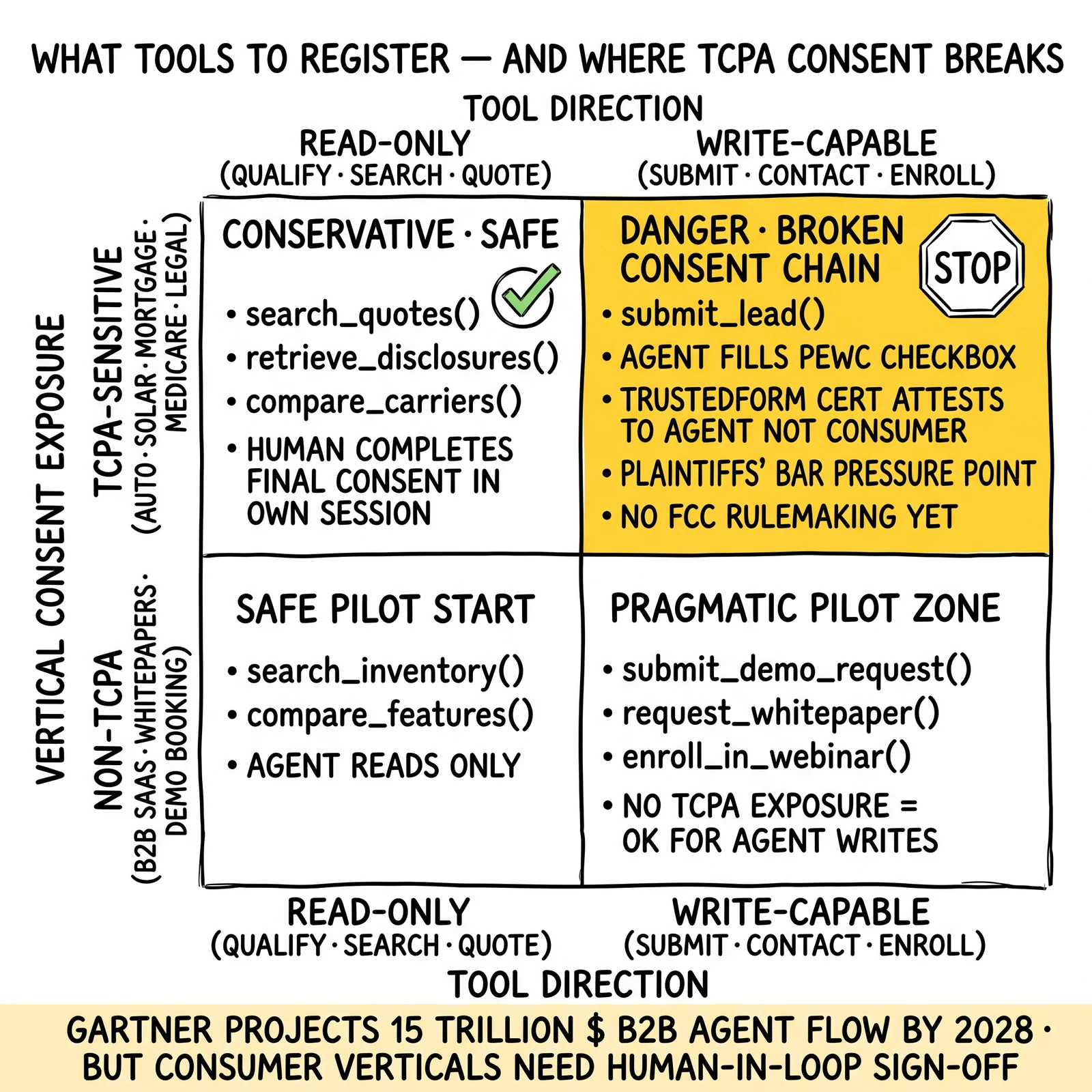
The compliance problem decomposes into three questions. First, did the consumer consent at all? An agent that submits a lead form on a homeowner’s behalf is not the consumer pressing the consent checkbox. If the lead-gen operator’s TrustedForm or Jornaya certificate captures the agent’s interaction, the certificate attests to the agent’s act, not the consumer’s. The certificate’s evidentiary value is degraded. Plaintiffs’ bar will press this point hard. Second, was the consent properly disclosed? PEWC requires clear and conspicuous disclosure of the contacting party, the means of contact (call, text, prerecorded), and the connection between the consent and the consumer’s request. An agent that fills the form may not see the disclosure at all if the agent is operating from cached or summarized page content. Third, was the consent properly retained? The 10-day opt-out processing window the FCC has enforced since April 2025 applies regardless of whether the original lead came from a human or an agent. Operators must retain consent records and process opt-outs at the consumer level, not the agent level.
The conservative compliance posture is to refuse agent-completed lead submissions for any vertical with TCPA exposure – auto insurance, home services, solar, mortgage, Medicare, legal. The marketplace registers read-only WebMCP tools (search inventory, retrieve quotes, view disclosures) but does not register submit_lead. The consumer must complete the final consent step in their own session, with their own click, with the consent-capture pixel firing on the consumer’s browser. The agent prepares the lead. The consumer signs it. This preserves the TrustedForm certificate’s evidentiary chain and aligns with the CFAA-flavored authorization argument from Amazon v. Perplexity.
The aggressive compliance posture is to build an agent-specific consent flow. The agent identifies itself through an A2A Agent Card. The marketplace’s WebMCP tool checks an allowlist of declared agents whose principals (the human consumers) have completed an agent-delegation consent through a separate flow, retained by the marketplace. The lead is submitted by the agent on the consumer’s behalf, with the certificate attesting to both the agent’s submission and the consumer’s pre-existing delegation. This is closer to power-of-attorney than to direct PEWC, and there is no published regulatory guidance affirming that it satisfies TCPA. Operators choosing this path are placing a bet on a future FCC rulemaking that does not exist yet.
The middle posture is to pilot agent submissions in non-TCPA verticals first – B2B SaaS lead capture, white-paper requests, demo bookings – and let the regulatory and case law mature before extending to consumer verticals. This is the path most large lead-gen operators are signaling. The next twelve months will produce the first FTC enforcement actions naming agent-completed forms, the first state AG investigations of agent-mediated consumer transactions, and the first plaintiffs’ bar test cases under the FTSA. Operators who launched aggressive postures without infrastructure to retract them will be the named defendants.
The 12-month browser rollout calendar
The WebMCP rollout cadence is observable, with several variables operators should track. Chrome Canary / flag-level WebMCP-style support is emerging in early 2026; Chrome stable-release timing has not been confirmed against a primary source as of publication, with Google I/O and Cloud Next 2026 as the most likely formal-announcement venues. Microsoft Edge has analogous flag-level support emerging on a parallel timeline because Edge ships Chromium with minimal divergence on platform APIs, and the Edge team co-authored the spec. Treat all browser-side state as preview / canary / flag pending stable-release confirmation through primary documentation.
Safari has not committed publicly. Apple’s pattern with Chromium-originated APIs is to wait for stability and standardization before implementing, then implement selectively with a privacy overlay. WebKit has not posted a position document on navigator.modelContext as of April 2026. Firefox’s Mozilla position is similarly unstated; the organization’s pattern with W3C Community Group drafts is to await Working Group standardization before committing. Operators should not plan on Safari or Firefox before late 2027.
The polyfill is the workaround. The @mcp-b/global npm package at version 2.2.0 (approximately 16 KB ESM) ships the full navigator.modelContext API to every browser today, not just Chrome Canary. Production teams shipping WebMCP-instrumented apps in 2026 are using the polyfill to reach the entire browser audience while waiting for native support. Hemanth’s webmcp-connect bridges any remote MCP server to Chrome’s WebMCP API in three lines of code, which lets operators connect existing MCP infrastructure (HubSpot, Salesforce, ZoomInfo) into the browser-native interface without rebuilding the integrations.
The adoption gate is not browser support. It is publisher tool registration. WebMCP-style support runs in Chrome Canary / flag-level today, but a tool only exists if a page registers it. The chicken-and-egg dynamic is the same one every platform API faces. The declarative API, with three HTML attributes per form, is the bridge: it lowers the registration barrier to the smallest possible code change. Google can crawl and index tool-enabled pages, which means Google Search has a route to surface agent-callable tools in results. The day Google Search shows “this site supports AI agents” badges on lead-gen marketplaces is the day the chicken-and-egg breaks. Operators who registered tools first capture the agent-mediated discovery flow. Operators who waited compete from behind.
The pragmatic six-to-nine-month build window for a marketplace-grade WebMCP implementation includes: detection infrastructure to identify which agents reach which pages, tool-registration logic for the imperative and declarative APIs, consent gates aligned to TCPA and state-mini-TCPA requirements, observability for tool-call attribution, and rate-limit policy. Operators starting in April 2026 reach production by late 2026 – exactly when Chrome stable rolls out. Operators starting after Chrome stable rolls out compete for agent traffic that has already routed elsewhere.
Key Takeaways
- WebMCP is a W3C standard, not Anthropic’s MCP in a browser. It defines
navigator.modelContext, a browser-native API where the page itself is the tool server. The wire protocol differs from MCP’s JSON-RPC entirely. Operators conflating the two will misjudge the integration work and the security posture. - OAuth-flow reduction is the strategic core. WebMCP can reduce a separate OAuth flow when a page safely mediates an authenticated session; it does not by itself eliminate every OAuth surface in the stack. By inheriting the user’s authenticated browser session, it can collapse multiple separate OAuth integrations into the rep’s existing CRM, enrichment, and outreach logins. Vendors that ship WebMCP tools become a path-of-least-resistance integration.
- Chrome Canary / flag-level WebMCP-style support is emerging in early 2026. Public reporting points to Chrome 146 Canary behind
chrome://flags/#webmcp-for-testing; treat this as a preview-channel surface rather than confirmed stable-release shipment. Stable-release timing has not been confirmed against a primary source as of publication; Edge has analogous flag-level support on a parallel timeline; Safari and Firefox have no committed timeline. The@mcp-b/globalpolyfill works in every browser today, so operators do not need to wait for stable-release Chrome support. - The Amazon v. Perplexity Comet ruling and WebMCP push in opposite directions. Amazon’s posture blocks stealth agents; WebMCP enables declared agents. Marketplaces choosing the Thumbtack-and-Angi whitelisted-pipe model get a standardized protocol for that pipe. Marketplaces choosing the Amazon block-at-the-firewall model get a clear demarcation line: declared tool calls are authorized, scraping is not.
- The 15-trillion-dollar 2028 projection compresses lead-gen revenue cycles. Gartner’s forecast that 90 percent of B2B purchases will be agent-mediated by 2028 means lead-gen marketplaces must capture attribution at the tool-call layer. Operators that log every WebMCP and MCP invocation with agent identity and principal preserve attribution; operators that do not lose visibility.
- TCPA consent compliance does not transfer to agents automatically. PEWC requires the consumer’s affirmative act. The conservative posture is to register read-only WebMCP tools and require human consumers to complete the final consent step. The aggressive posture builds agent-delegation consent and bets on regulatory tolerance that does not yet exist.
- The CRM ecosystem has already moved. HubSpot operates two official MCP servers, Salesforce shipped Agentforce 3 with native MCP client support in July 2025, ZoomInfo and Apollo are accessible through MCP. WebMCP is the layer that exposes these MCP-server-side capabilities to in-browser agents without OAuth round-trips.
- AI SDR economics are the leading-edge use case. 11x.ai (50-million Series B at 350-million valuation), Artisan (25-million Series A), and Monaco (35-million from Founders Fund) replace 55,000-dollar-a-year human SDRs with 1,000-to-5,000-dollar-a-month agents. None are WebMCP-native yet; all will be by mid-2027.
- The publisher tool-registration gate is the adoption bottleneck. Browser support is necessary but not sufficient. The declarative API’s three HTML attributes are the lowest-friction registration path. Google Search surfacing agent-callable tools in results is the demand signal that breaks the chicken-and-egg dynamic.
- The build window is six-to-nine months. Detection, tool registration, consent gates, observability, and rate limits. Operators starting in April 2026 reach production when Chrome stable ships. Operators waiting until Chrome stable ships compete for agent traffic that has already routed elsewhere.
Frequently Asked Questions
1. What is WebMCP and how is it different from Anthropic’s MCP?
WebMCP is a W3C Community Group draft that defines navigator.modelContext, a JavaScript API any web page can use to register tools that AI agents call directly inside the browser. Anthropic’s Model Context Protocol uses JSON-RPC 2.0 over stdio or Streamable HTTP and connects clients to backend servers. WebMCP shares the conceptual model of typed tools but is a browser-native API where the page itself is the server. It does not use JSON-RPC, does not require a separate OAuth flow when a page safely mediates an authenticated session, and inherits the user’s existing session cookies and federated single sign-on. Chrome Canary / flag-level WebMCP-style support is emerging in early 2026 behind a chrome://flags entry; treat the surface as preview / canary / flag rather than as stable-release support.
2. When does WebMCP reach Chrome stable and other browsers?
As of early 2026, Chrome Canary and Microsoft Edge are exposing flag-level WebMCP-style support; stable-release commitments from either browser vendor have not been confirmed against a primary source as of publication. Microsoft co-authored the specification through Edge teammates, so Edge follow-on implementation is expected. Safari and Firefox have not committed publicly. The mcp-b/global polyfill at npm package version 2.2.0 ships the navigator.modelContext API to every browser today, which is how production teams are building WebMCP-enabled apps while Chrome and Edge remain in preview / canary / flag state.
3. How does WebMCP reduce the OAuth flow for AI agents accessing CRMs?
Standard MCP servers exposing CRM data require OAuth 2.1 token flows, server-side infrastructure, and credential management. WebMCP runs inside the user’s existing authenticated browser tab, so a tool registered on a HubSpot or Salesforce page can inherit the rep’s session cookies and SSO context. The agent calls qualify_lead or update_deal through navigator.modelContext, the page’s JavaScript executes the call against the same authenticated session the rep is using, and the response returns through the API. WebMCP can reduce a separate OAuth flow when a page safely mediates an authenticated session; it does not by itself eliminate every OAuth surface in the stack. This was the original problem Alex Nahas built MCP-B to solve at Amazon in January 2025, where federated SSO existed but OAuth 2.1 was not implemented internally.
4. What does WebMCP mean for lead-gen ping-post intake forms?
WebMCP’s declarative API lets any HTML form become an agent-callable tool by adding toolname, tooldescription, and toolparamdescription attributes to existing markup. A solar comparison site or insurance marketplace can expose its lead intake form as a structured tool without rewriting the page in JavaScript. AI buyer agents can then submit qualified consumer data through the declared interface rather than scraping the form. The compliance question is unchanged: TCPA prior express written consent still requires the consumer’s affirmative act, and an agent submitting a form on the consumer’s behalf does not satisfy PEWC unless the consent capture happened earlier in the consumer’s own session. Lead-gen operators must decide whether to accept agent submissions at all and, if so, how to certify the consent chain.
5. Does WebMCP change the Amazon v. Perplexity Comet ruling?
WebMCP changes the framing but not the underlying authorization question. Judge Maxine Chesney’s March 2026 preliminary injunction against Comet rested on the Computer Fraud and Abuse Act, holding that user permission to an AI agent does not substitute for platform authorization. WebMCP creates an opt-in channel where the platform itself declares which tools an agent can call, which functionally inverts the Comet posture: instead of an agent logging in covertly and reading the DOM, the platform exposes an explicit interface and the agent calls it through navigator.modelContext. Marketplaces choosing the Amazon block-at-the-firewall posture can continue to do so. Marketplaces choosing the Thumbtack and Angi whitelisted-pipe posture get a standardized way to expose that pipe without building a custom server.
6. How does WebMCP compare to OpenAI Operator, Claude for Chrome, and Comet?
Operator, Claude for Chrome, ChatGPT Atlas, and Comet are agents – products that use vision models or DOM parsing to operate browsers on behalf of users. WebMCP is a protocol – a tool-registration API that any of those agents can call into. The agents and the protocol are complementary, not competitive. An agent reading screenshots at roughly 2MB per frame burns approximately 89 percent more tokens than calling a structured WebMCP tool that returns typed JSON. Cloudflare’s Code Mode demonstration collapsed 2,500 API endpoints into two tools consuming about 1,000 tokens, a 99.9 percent reduction. Agents that adopt WebMCP gain reliability, lower cost, and resilience to UI changes. Agents that ignore it remain stuck parsing pixels.
7. What is the lethal trifecta security problem in WebMCP?
The lethal trifecta is the security failure mode where an AI agent has simultaneously read access to private data, read access to attacker-controlled instructions, and write access to a sensitive sink. Any two are tolerable; all three is catastrophic. WebMCP’s spec acknowledges this is an unsolved problem and scopes it out of v1. The browser model partially mitigates it through same-origin policy, ephemeral tool registration that clears on navigation, and the requestUserInteraction function that pauses execution for explicit user confirmation on sensitive actions. For lead-gen operators, the practical implication is that any tool touching consent capture, payment, or data export must require user confirmation by default, and operators should not register tools that combine read access to consumer PII with write access to outbound channels.
8. How big is the agent-driven B2B commerce opportunity?
Gartner projects AI agents will intermediate more than 15 trillion dollars in B2B spending by 2028, with 90 percent of B2B purchases handled by AI agents within three years. McKinsey estimates the broader agentic commerce opportunity at three to five trillion dollars by 2030 for goods alone, excluding services and B2B. The MCP ecosystem hit 97 million monthly SDK downloads in 2025, with 5,867 listed servers on the Glama directory and growth from 100,000 server downloads in November 2024 to 8 million by April 2025. The AI SDR market replacing 55,000-dollar-a-year humans with 1,000-to-5,000-dollar-a-month agents is the leading-edge use case; 11x.ai raised 50 million dollars at a 350 million valuation, and Artisan raised a 25 million Series A from Glade Brook and HubSpot Ventures.
9. Should lead-gen publishers register WebMCP tools or block agents?
The decision turns on revenue model and consent posture. Publishers that monetize affiliate clicks or research traffic should register declared tools because agent reads are functionally equivalent to researcher reads. Publishers that sell exclusive leads with TCPA consent capture should not register lead-submission tools by default because agent-completed forms break the consent chain. The middle path is to register read-only qualification tools (search inventory, retrieve quotes, view disclosures) while requiring human-completed submission for the final consent capture. This gives the agent enough surface to be useful while preserving the operator’s TrustedForm or Jornaya certificate as evidence of human consent. The Amazon v. Perplexity ruling confirms that the declared-versus-stealth distinction is the legal hinge.
10. What infrastructure should operators build now?
Three priorities. First, instrument detection so the operator knows which agents reach which pages – the same telemetry stack used to detect Comet’s stealth Chromium fingerprint applies to declared agents reading robots.txt and llms.txt. Second, decide the tool surface – what does the publisher want agents to do, what consent does the publisher require, and what is the rate-limit policy. Third, ship the polyfill – mcp-b/global makes navigator.modelContext available in every browser today, so operators do not need to wait for Chrome stable to start exposing tools. The build window is six to nine months for a marketplace-grade implementation including detection, tool registration, consent gates, and observability. Starting after Gartner’s 15-trillion-dollar 2028 projection materializes means competing from structural disadvantage.
The browser stopped being a rendering surface in 2026. It became the runtime where AI agents and authenticated services meet, where consent is captured or evaded, where lead-gen marketplaces decide whether to expose tools or block scrapers, and where the 15-trillion-dollar B2B agent commerce flow Gartner projected for 2028 will route. Operators who treat WebMCP as a Chrome experiment will discover that the experiment was the infrastructure. The decisions made about tool registration, consent gates, and detection in the next nine months determine whether the lead-gen marketplace participates in the agent economy or watches it route around them through a competing publisher who shipped first.
Sources
- World Wide Web Consortium, “WebMCP – W3C Web Machine Learning Community Group Draft,” webmachinelearning.github.io/webmcp/, 2025–2026
- Google Chrome team, WebMCP early-preview / flag-level release in Chrome Canary (reported as Chrome 146 Canary, behind chrome://flags/#webmcp-for-testing), early 2026 (VentureBeat coverage)
- WebMCP Repository, github.com/webmachinelearning/webmcp, 2025–2026
- Arcade.dev, “WebMCP: Making Every Website a Tool for AI Agents – Alex Nahas Interview,” 2025
- Gartner, “Predicts by 2028 AI Agents Will Outnumber Sellers by 10X,” Gartner Press Release, November 18, 2025
- Gartner / Digital Commerce 360, “AI agents will command $15 trillion in B2B purchases by 2028,” November 28, 2025
- Bloomberg, “Amazon Wins Court Order to Halt Perplexity’s AI Shopping Bots on Marketplace,” March 10, 2026
- Stripe Newsroom, “Stripe powers Instant Checkout in ChatGPT and releases Agentic Commerce Protocol codeveloped with OpenAI,” 2025
- Stripe Documentation, “Integrate the Agentic Commerce Protocol,” docs.stripe.com/agentic-commerce/protocol, 2025–2026
- Salesforce Developers Blog, “Introducing MCP Support Across Salesforce,” June 2025
- HubSpot Developers, “HubSpot MCP Server,” developers.hubspot.com/mcp, 2025
- Cloudflare Blog, “MCP Demo Day: How 10 leading AI companies built MCP servers on Cloudflare,” May 1, 2025
- Google Developers Blog, “Announcing the Agent2Agent Protocol (A2A),” April 9, 2025
- U.S. Federal Communications Commission, “FCC Confirms TCPA Applies to AI Technologies that Generate Human Voices,” 2024
- The New Stack, “How WebMCP Lets Developers Control AI Agents With JavaScript,” 2025