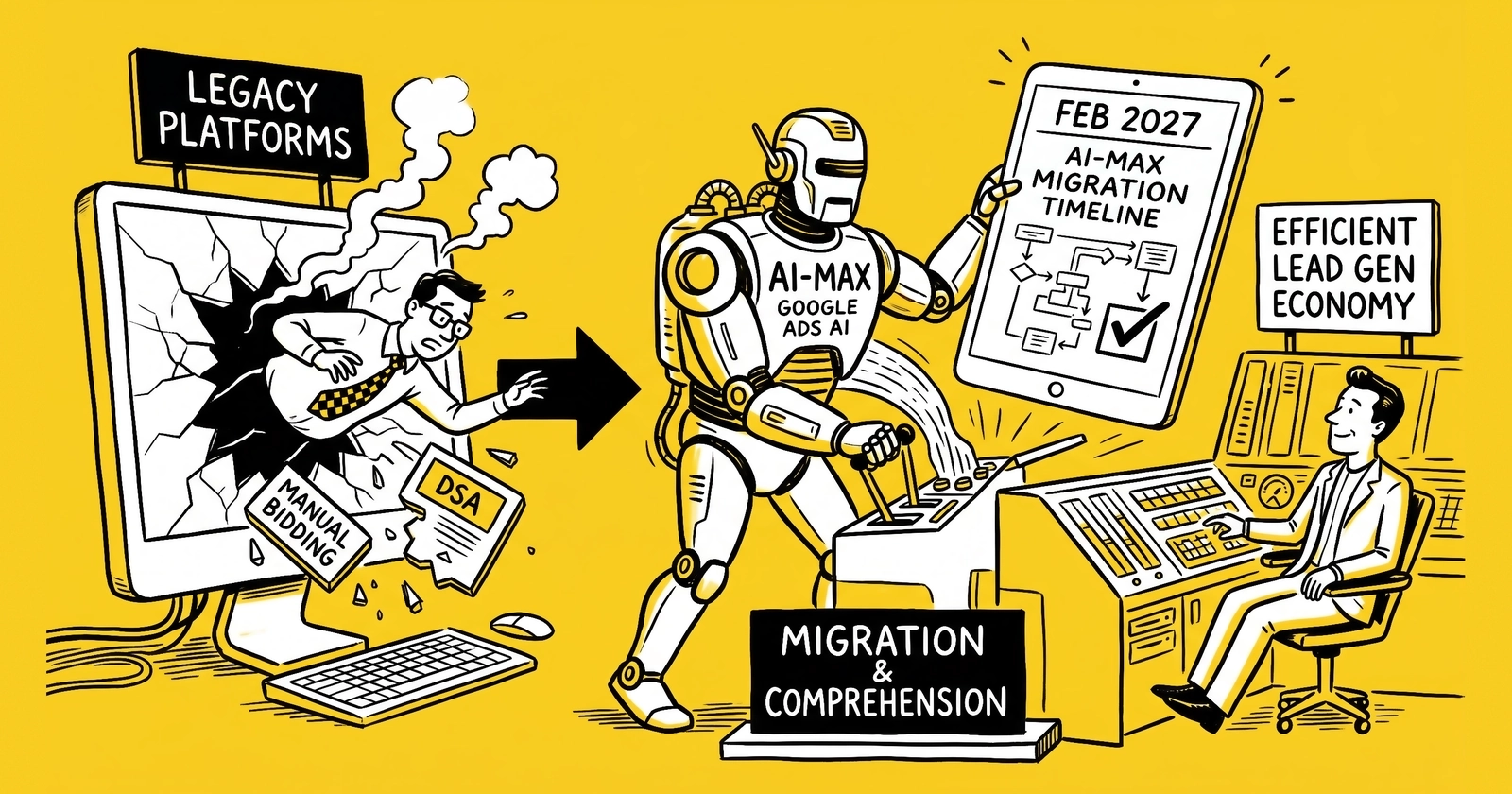
The June 11 extension split a single September deadline into two operative dates that lead-generation operators must plan against separately – and the AI Mode eligibility rule clarified on June 10 was different from what trade-press coverage assumed.
Two Deadlines, Not One – What Google Actually Changed on June 11
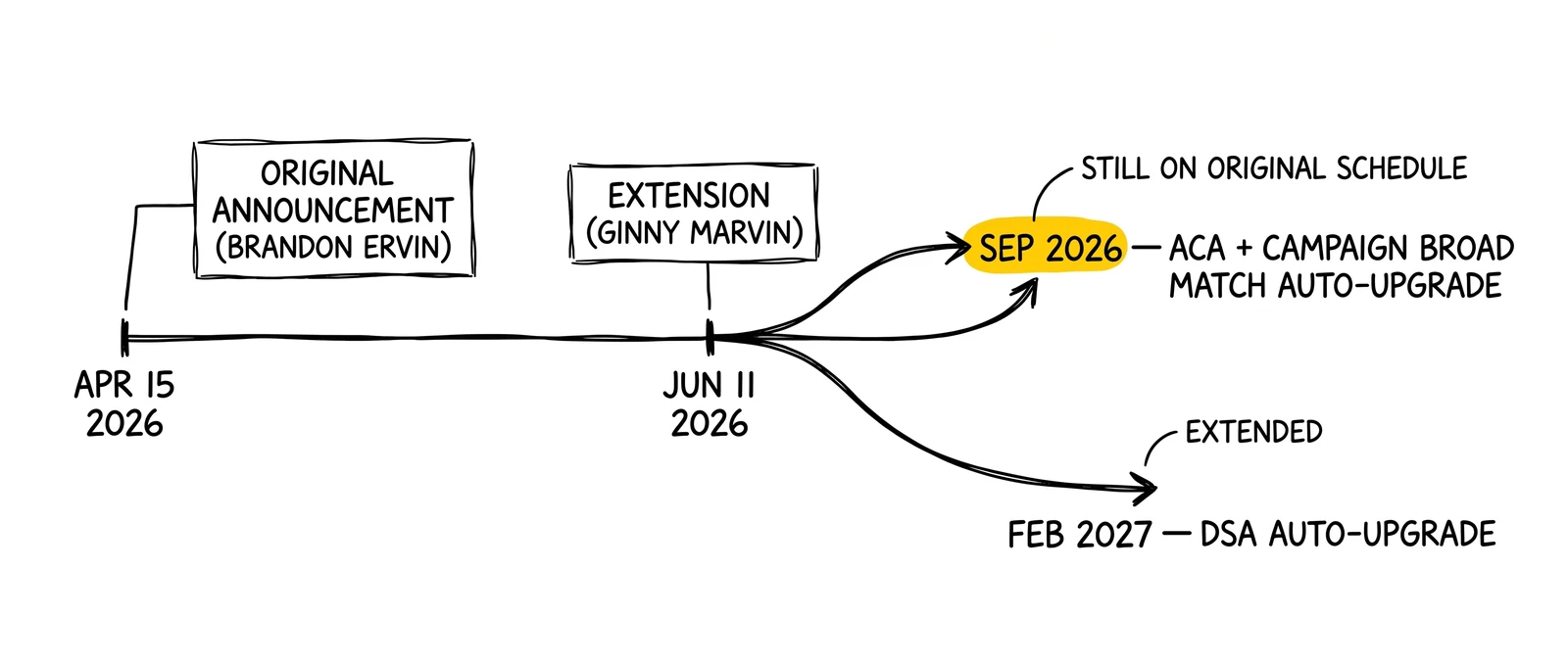
Brandon Ervin, Director of Product Management at Google Ads, announced on April 15, 2026 that Dynamic Search Ads would auto-migrate to AI Max for Search starting September 2026. The original timeline placed DSAs, automatically created assets, and campaign-level broad match on the same auto-upgrade schedule. Most trade-press coverage adopted the September 2026 framing as a single deadline that operators needed to plan against.
On June 11, 2026, Google Ads Liaison Ginny Marvin announced an extension. The Google Ads Developer Blog post titled “Dynamic Search Ads (DSA) Automigration Delayed to February 2027 and Campaign Creation Restored” formalized the change. New DSA campaign creation was restored on June 15. The extension applied specifically to Dynamic Search Ads. The September 2026 schedule for automatically created assets and campaign-level broad match remained intact.
The structural detail matters. Most lead-gen accounts run broad match plus Smart Bidding as the dominant targeting and bidding pattern, particularly in high-intent verticals where the broader match surface produces meaningful incremental conversion volume. Those accounts auto-upgrade in September 2026 under the unchanged ACA and broad-match-settings schedule, regardless of the DSA extension. Operators that read the June 11 trade-press coverage as “DSA migration extended to February 2027” without distinguishing the two operative dates will plan against the wrong calendar.
For verticals where DSAs were the dominant targeting type – primarily ecommerce running large catalog inventories – the February 2027 extension gives meaningful additional runway. For lead-gen verticals where DSAs were a secondary or experimental channel, the relevant deadline is still September 2026 because the underlying campaign architecture relies on ACA and campaign-level broad match. The article walks through the implications, with specific attention to the verticals where the deadline confusion creates the most compliance exposure.
The Original April 15 Announcement and What Moved to GA
The April 15, 2026 Google Ads blog post by Brandon Ervin confirmed two things alongside the DSA migration announcement. First, AI Max for Search had moved out of beta to general availability. Second, the consolidated feature set that AI Max ships includes search-term matching (succeeding broad match), text customization (asset rewriting via AI), and final URL expansion (allowing Google to route clicks to landing pages other than the ad’s final URL).
The three features are interconnected. Search-term matching extends query coverage beyond keyword-list targeting. Text customization rewrites the headline and description content the user sees against the matched query. Final URL expansion routes the resulting click to whichever landing page Google’s relevance scoring selects from the advertiser’s domain. The features compound in production – query coverage expands, ad copy adjusts, and landing-page routing varies based on AI judgment about query intent and page content match.
Google’s published AI Max performance numbers from the April 15 announcement and the May 20 Google Marketing Live reiteration include 14 percent lift in conversions or conversion value at similar cost per acquisition versus matching-only AI Max use; 27 percent lift for campaigns with more than 70 percent exact or phrase match conversions in non-retail verticals; and 14 percent conversion lift attributed specifically to Google tag gateway. The methodology cited is “Google Internal Data, Global, Finance, July-December 2024 versus January-June 2025.” The numbers are Google-confirmed benchmarks.
Industry tracking figures occasionally cited alongside Google’s numbers – Digital Applied’s 25.5 percent AI Mode placement share, 35 percent CPC premium, and 18 percent engagement lift – are third-party agency-blog estimates without disclosed methodology. Operators should attribute the Digital Applied numbers as industry tracking estimates rather than as Google-published benchmarks. The distinction matters for budget-defense conversations with CFOs who will discount any number that cannot be traced to a verifiable source.
What AI Mode Ad Eligibility Actually Requires
Ginny Marvin clarified the AI Mode placement eligibility rule on June 10, 2026 in a Google Ads Liaison statement covered by Search Engine Land. The clarification corrected an industry framing that had been circulating since the May 20 Google Marketing Live announcement.
The correct rule: campaigns using broad-match-style targeting are eligible to show in AI Mode and AI Overviews surfaces. The eligible campaign types include broad-match Standard Search, AI Max for Search, Performance Max, and Shopping. Standard Search campaigns using only exact match or phrase match keywords are not eligible until broad match is enabled. Google Ads Help confirms: “Text and Shopping ads from existing Search, Shopping and Performance Max campaigns are eligible to show within the AI Overviews.”
The earlier industry framing that AI Mode required Performance Max or AI Max for Search specifically – and that Standard Search was wholesale excluded – was incorrect. The exclusion applies only to Standard Search campaigns with exact-or-phrase-match-only targeting. Operators currently running broad-match Standard Search campaigns already qualify for AI Mode placements without requiring migration to AI Max or Performance Max.
The clarification reshapes the migration urgency calculation. Operators with broad-match Standard Search accounts capture AI Mode inventory at the same eligibility tier as AI Max accounts. The migration to AI Max becomes a question of feature-level optimization rather than placement-eligibility unlock. The September 2026 ACA flip and the February 2027 DSA migration still apply on their respective schedules, but operators no longer face a binary “migrate or lose AI Mode placements” decision.
The competitive landscape implication is that the AI Mode placement market is broader than the early-2026 narratives suggested. More campaign types qualify; the auction therefore includes a larger advertiser pool than the narrower interpretation implied. The CPC premium Digital Applied reported should be interpreted against the broader auction surface rather than against a constrained Performance Max plus AI Max subset.
The URL Expansion Compliance Surface for Regulated Verticals
AI Max’s final URL expansion is the feature lead-generation operators in regulated verticals must specifically address before September 2026. The mechanism: Google’s relevance scoring routes paid clicks to landing pages other than the ad’s specified final URL, selecting from pages on the advertiser’s domain. For consumer retail or ecommerce, the routing typically produces conversion benefits. For regulated verticals, the routing creates compliance exposure that the ad-creative review process does not cover.
Insurance advertisers face the NAIC Model Bulletin on the Use of AI Systems by Insurers, adopted December 2023 and adopted by approximately half of US states by 2026. The Bulletin requires insurers to govern third-party AI marketing tools with documented controls and auditable outputs. Carriers and agencies remain legally accountable for the compliance posture of any landing page Google’s AI routes traffic to, regardless of whether the carrier specifically reviewed that page for the underlying ad. California’s NAIC AI Evaluation Tool pilot, running January through September 2026, formalizes the audit-trail expectations. AI-generated headlines paired with AI-routed landing pages create governance exposure that the NAIC framework does not contemplate exemptions for.
Mortgage advertisers face Regulation Z section 1026.24 trigger-term rules. When mortgage advertising includes APR, monthly payment amounts, “no money down” language, or similar trigger terms, the regulation requires full disclosure within the ad and the destination page. AI Max’s URL expansion can route traffic to deep landing pages on the lender’s site containing trigger-term content that the original ad reviewer did not anticipate. The compliance exposure runs through the same mechanism the August 2024 CFPB Treasury comment flagged: “There are no exceptions to the federal consumer financial protection laws for new technologies.” The federal pullback under the March 2026 executive order shifted enforcement weight toward state Attorneys General, who are hiring ex-CFPB staff.
Solar advertisers face the most aggressive enforcement landscape. The FTC, in conjunction with state AGs in Connecticut, Arizona, Texas, and Florida, has opened solar enforcement fronts on savings claims and financing claims – exactly the claim categories AI Max text customization is most likely to auto-generate. The August 2025 MediaAlpha settlement at $45 million (within the $145 million combined Assurance IQ plus MediaAlpha total) established that lead-gen marketplaces are themselves in regulatory scope. A solar lead aggregator running AI Max with auto-generated “$0 down” headlines and final URL expansion is structurally the most enforcement-exposed configuration in performance marketing.
The standard mitigation across all three verticals is the same. Disable final URL expansion. Maintain an explicit URL allowlist of compliance-reviewed landing pages. Pull text customization reports weekly, route through compliance review, and blocklist drift terms (“guaranteed approval,” “free quote in 60 seconds,” “no credit check”) at account level. The mitigation removes some of the AI Max performance benefit but is operationally required before September 2026 for regulated-vertical advertisers.
TrustedForm and Jornaya Certificates Under URL Expansion
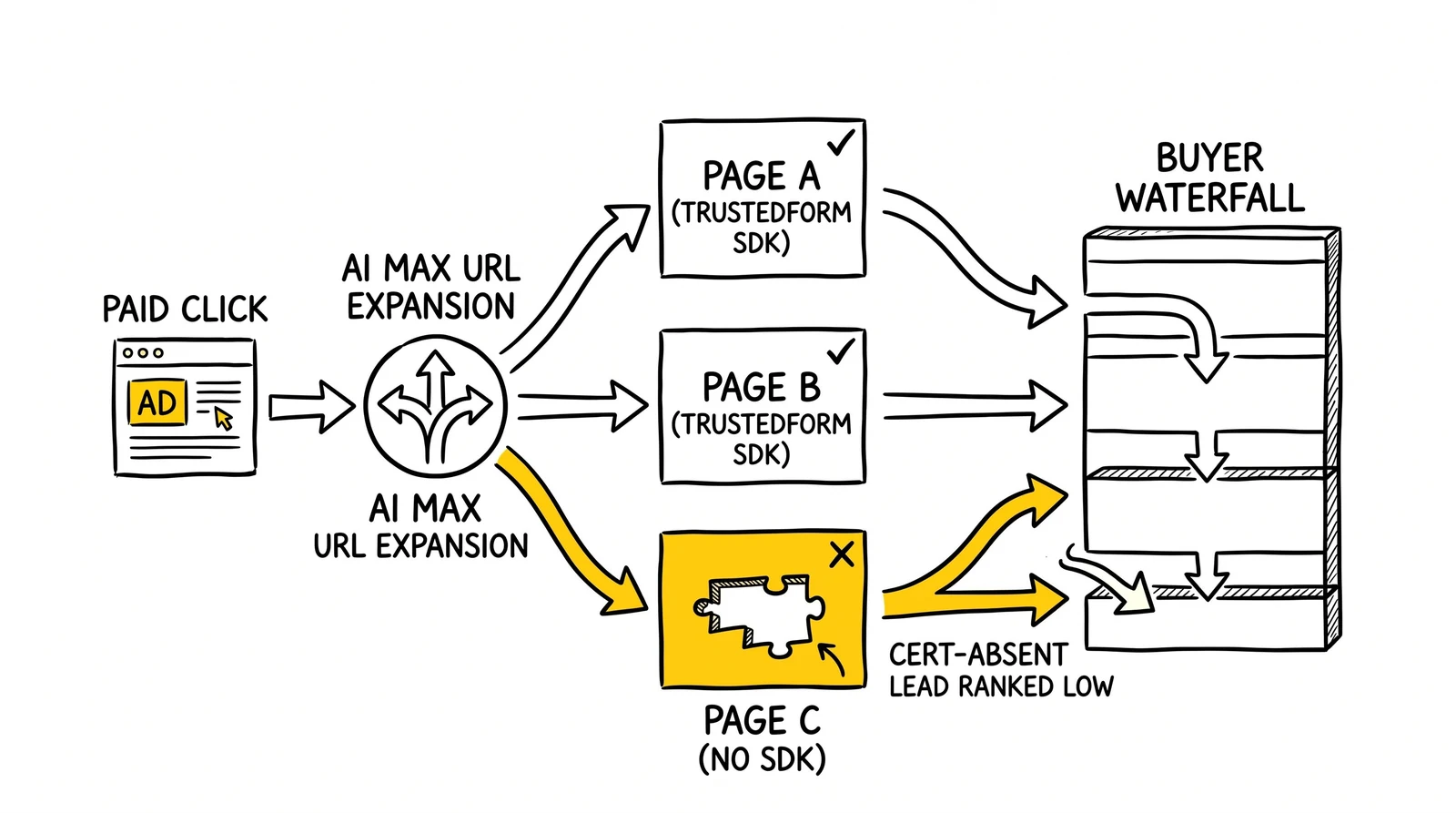
The lead-gen-specific architectural problem that broader AI Max coverage does not address: final URL expansion can route paid clicks to landing-page variants that do not have the TrustedForm or Jornaya consent-capture JavaScript SDK embedded.
The mechanism: TrustedForm Certify is a JavaScript SDK that captures the consumer session on the advertiser’s form-host page. The certificate is generated when the SDK fires during the form-fill interaction. Ping-post buyer waterfalls price the certificate as the TCPA-defensibility artifact. Buyers ranking leads by certificate eligibility downgrade certificate-absent leads in the waterfall.
When AI Max routes traffic to a page variant without the SDK, no certificate is generated for the resulting lead. The lead enters the buyer waterfall at a reduced ranking, and the per-lead CPL achievable from the AI-Max-originated traffic compresses correspondingly. The downstream economic consequence runs through the buyer-waterfall pricing rather than the AI Max channel-level performance metrics, which makes it less visible in the standard channel-performance reporting.
ActiveProspect’s December 2025 Bot Detection product launch – flagging more than 150,000 leads per week – demonstrates the industry doubling down on certificate-level signal exactly as AI Max removes certificate-eligible sessions through URL expansion. The arms-race dynamic between AI-mediated routing and consent-capture infrastructure is now operationally live. Lead operators running AI Max with URL expansion enabled face a structural disadvantage in buyer waterfalls that competitors running tightly-controlled landing pages without URL expansion do not face.
The operator action is to maintain SDK coverage on every page in the AI Max URL allowlist if URL expansion is enabled, or to disable URL expansion entirely. The choice depends on the operator’s tolerance for the AI Max performance benefit versus the certificate-coverage operational overhead. For regulated verticals where URL expansion is already disabled for compliance reasons, the certificate-coverage question is moot. For general-services and other less-regulated verticals, the trade-off is real.
The Vertical Migration Decision Tree
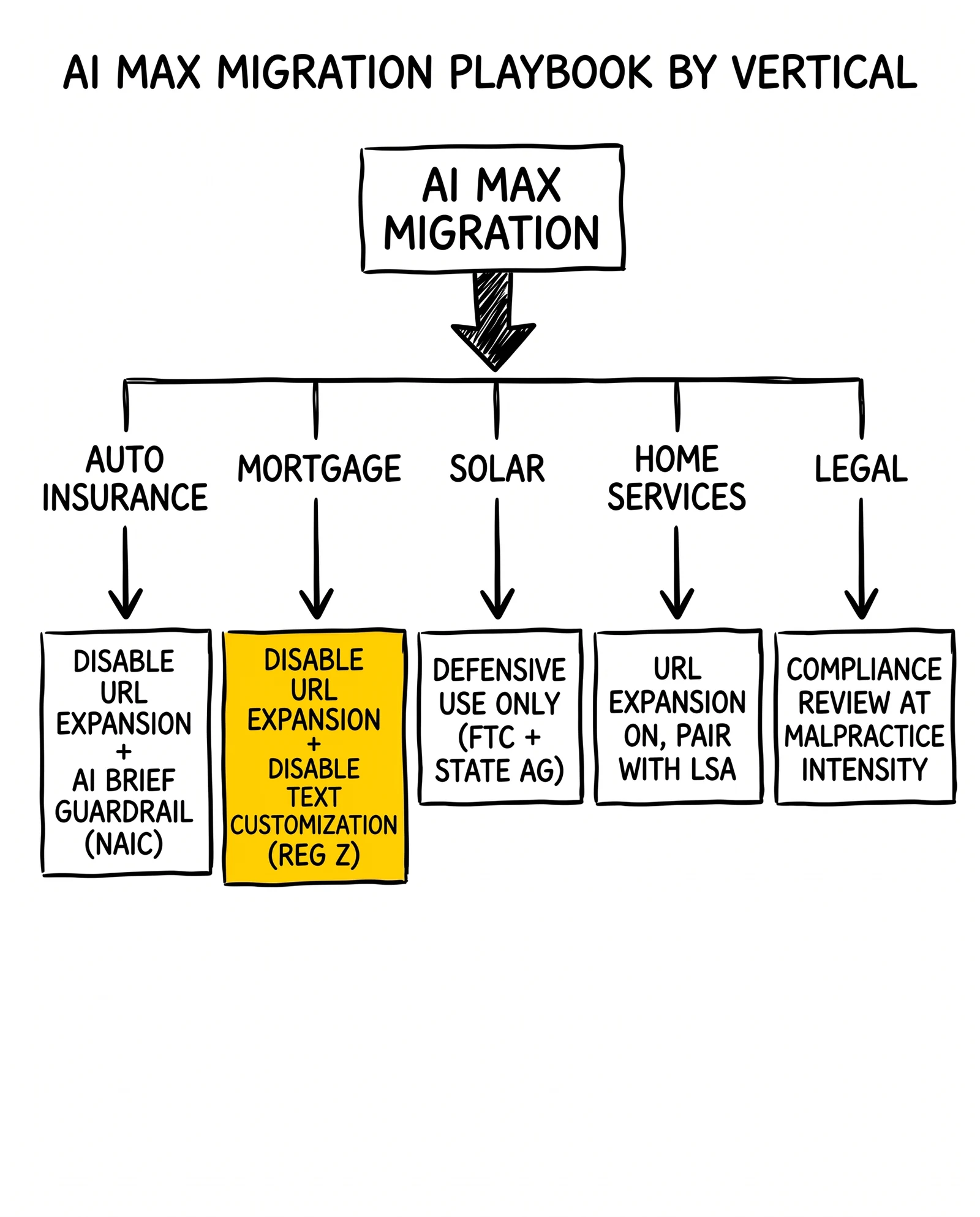
The dual-deadline calendar combined with the URL-expansion compliance surface produces a vertical-specific migration playbook that runs different paths for different lead-gen categories.
For auto insurance, the migration approach should disable URL expansion entirely and maintain an explicit URL allowlist before September 15, 2026 – two weeks ahead of the ACA flip – to allow time for issue discovery and remediation. AI Brief, the Gemini-powered AI Max steering layer Google introduced at Marketing Live, can be configured as a compliance guardrail by pre-loading state-disclosure language and approved vocabulary. The carrier-NAIC audit-trail requirement determines the configuration discipline.
For mortgage, the migration approach should disable text customization in addition to URL expansion. Reg Z trigger-term exposure runs through both routing decisions and headline content. Page-feed targeting paired with hand-reviewed asset rotations preserves compliance posture while accessing some of the AI Max query expansion. The CFPB-to-state-AG enforcement transition under the March 2026 executive order makes the compliance investment particularly important for mortgage operators with multi-state footprints.
For solar, the migration approach should treat AI Max as a defensive tool against AI Mode placement loss rather than as a primary acquisition channel. Brand exclusions, asset-pinning where supported, and a compliance review SLA for any auto-generated copy are the operating disciplines. The MediaAlpha precedent and the stacked FTC plus state AG enforcement environment make aggressive AI Max adoption commercially risky for solar lead aggregators.
For home services, AI Max can run with URL expansion enabled where Local Services Ads (LSA) cannibalization is already absorbing the relevant lower-funnel inventory. The pattern: LSA captures branded and verified-provider inventory; AI Max captures generic-query inventory at the broader match surface. The two campaign types operate complementarily rather than competitively. The compliance overhead is lower than for insurance, mortgage, or solar.
For legal lead generation, the AI Max migration intersects with the AI hallucination sanction risk covered in the AI hallucination legal vertical analysis. AI-generated copy in legal advertising carries the same accuracy risk that has produced six-figure court sanctions in the underlying legal practice. Mass-tort intake operations should treat AI Max copy generation as requiring compliance review at the same intensity as legal-services advertising review.
What Lead Operators Should Do Before September 2026
The action surface is bounded by the September 2026 ACA flip date. Five operator actions track the 90-day pre-deadline window.
First, audit the current campaign mix for ACA and campaign-level broad match exposure. Most lead-gen accounts run broad match plus Smart Bidding as standard configuration. The September flip applies to those accounts. Operators that have not specifically mapped which campaigns will auto-upgrade and which will not should run the audit immediately.
Second, disable final URL expansion for any regulated-vertical campaigns. Insurance, mortgage, solar, healthcare, legal. The default-on URL expansion behavior creates compliance exposure that the standard ad-review process does not catch.
Third, maintain explicit URL allowlists for the campaigns that will auto-upgrade. The allowlist should include only compliance-reviewed landing pages with confirmed TrustedForm or Jornaya SDK coverage. Document the certificate generation testing on each allowlisted page before September.
Fourth, configure AI Brief as a compliance guardrail. Pre-load state disclosure language, vertical-specific approved vocabulary, and account-level blocklists for drift terms. AI Brief was introduced at Google Marketing Live on May 20, 2026 as a Gemini-powered plain-language steering layer for AI Max. The compliance use case is not the primary positioning Google emphasized, but the configuration is operationally available.
Fifth, plan the February 2027 DSA migration on a separate timeline from the September 2026 ACA flip. The two deadlines are not synonymous. Operators with substantial DSA inventory have meaningful additional runway under the June 11 extension. Operators without DSA but with broad-match Smart Bidding face the September deadline regardless. The internal planning conversation should distinguish the two operative dates rather than treat them as a single migration event.
Key Takeaways
- Google originally announced April 15, 2026 that DSAs and ACA and campaign-level broad match would auto-upgrade to AI Max for Search starting September 2026.
- On June 11, 2026, Google extended DSA-specific auto-migration to February 2027. ACA and campaign-level broad match remain on the September 2026 schedule. New DSA creation restored June 15.
- AI Mode placement eligibility (clarified by Ginny Marvin June 10): broad-match Standard Search, AI Max for Search, Performance Max, and Shopping qualify. Exact/phrase-match-only Standard Search does not qualify.
- Google-published AI Max benchmarks: 14% conversion lift at similar CPA, 27% lift for campaigns with >70% exact/phrase match conversions in non-retail, 14% conversion lift from Google tag gateway. Methodology: Google Internal Data, Global, Finance, Jul-Dec 2024 vs Jan-Jun 2025.
- Digital Applied 25.5% AI Mode placement share, 35% CPC premium, 18% engagement lift are third-party agency-blog estimates without disclosed methodology. Not Google-confirmed.
- Final URL expansion creates compliance exposure for insurance (NAIC), mortgage (Reg Z trigger terms), solar (FTC + state AG savings-claim enforcement), healthcare, and legal. Disable for regulated verticals.
- AI Max URL expansion can break TrustedForm and Jornaya certificate generation when routing to non-SDK-instrumented pages. Buyer waterfall economics suffer.
- Vertical playbook: insurance disable URL expansion + AI Brief compliance guardrail; mortgage disable URL expansion AND text customization, page-feed targeting; solar AI Max as defensive tool only; home services AI Max paired with LSA; legal compliance review at legal-services intensity.
- 90-day operator action before September 2026: campaign-mix audit, URL expansion disable for regulated verticals, URL allowlist maintenance with SDK coverage testing, AI Brief compliance configuration, separate February 2027 DSA timeline planning.
Sources
- Google Ads Blog – Dynamic Search Ads are Upgrading to AI Max (April 15, 2026, updated June 11)
- Google Ads Developer Blog – DSA Automigration Delayed to February 2027 (June 11, 2026)
- Google Ads Blog – Google Marketing Live 2026 Search Ads (May 20, 2026)
- Google Ads Blog – AI Max New Features (April 30, 2026)
- Google Ads Help – Ads in AI Overviews
- Google Business Accelerate – Asset Experiments in Performance Max (April 20, 2026)
- Google Business Accelerate – Real-Time Policy Reviews (April 16, 2026)
- Search Engine Land – Google Delays DSA Migration to AI Max (June 12, 2026)
- Search Engine Land – Ginny Marvin Clarifies AI Max and AI Search Ads