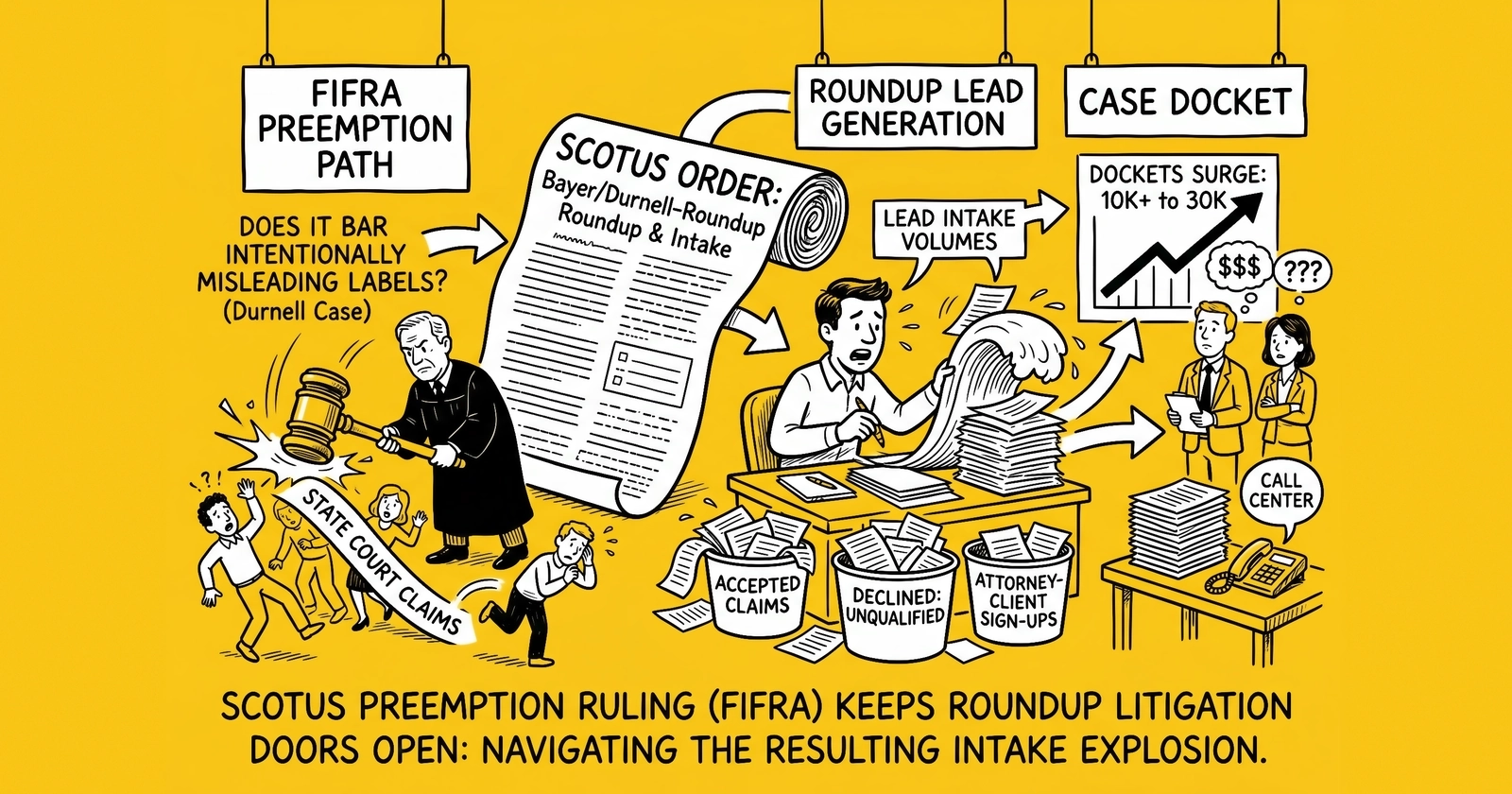
A defendant settles in the shadow of the law it expects – and the law it expects could change in the next two weeks.
The case that decides whether Roundup intake survives 2027
On April 27, 2026, the U.S. Supreme Court heard 75 minutes of oral argument in Monsanto Company v. Durnell, No. 24-1068. The question presented, on certiorari granted January 16: whether the Federal Insecticide, Fungicide, and Rodenticide Act preempts a state-law failure-to-warn claim where the Environmental Protection Agency has not required the warning. Paul D. Clement argued for Monsanto. Ashley C. Keller – whose firm Keller Postman has separately filed objector challenges to the $7.25 billion King v. Monsanto class settlement in Missouri – argued for the respondent. The Solicitor General participated under a motion granted April 17.
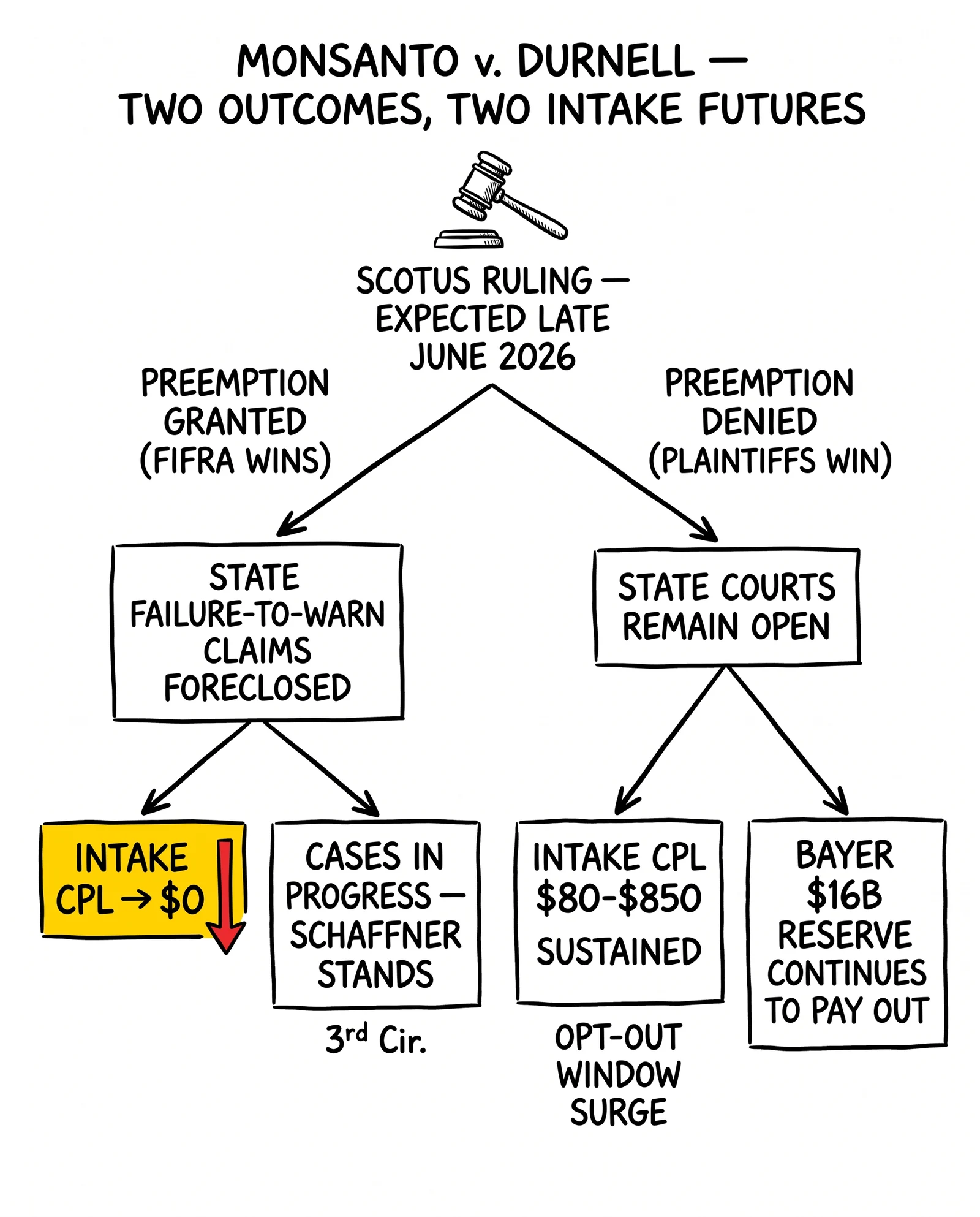
The decision is expected before the Court closes its 2025-2026 term in late June or early July. As of June 25, 2026, no opinion has issued. SCOTUSblog and the Cornell Legal Information Institute both list the case as pending. The timing matters because it collides with the King settlement’s July 9 fairness hearing – a sequencing problem objector firms have called out as constitutionally problematic. The June 4 opt-out deadline closed before plaintiffs could see what SCOTUS will rule, and a $7.25 billion settlement is being finalized in the shadow of a ruling that could move the price either direction.
For mass-tort lead-generation operators, Durnell is the most consequential ruling of the year. Roughly 60,000 to 67,000 Roundup-related cases remain active across federal MDL 2741 in the Northern District of California and state courts nationwide. The dominant litigation theory across that inventory is failure-to-warn – the same theory at issue in Durnell. If the Court rules that FIFRA preempts those claims, the dominant theory collapses. If it rules the other way, the trial pathway holds, and the $7.25 billion settlement becomes a discount to what individual cases might produce. Intake firms running glyphosate campaigns at vendor-attested CPLs of $80 to $200 per qualified lead need to model both scenarios before the opinion drops. Operators that haven’t already are about to learn what unpriced legal risk looks like.
This article walks the operator playbook. The case history through Durnell. The FIFRA preemption doctrine and the Schaffner circuit split. The interaction with the $7.25 billion settlement. The CPL, retainer-to-claim, and contingent-media implications under each ruling. And the 60-day post-decision window where every plaintiff-firm advertising contract gets rewritten.
The case file – from a Missouri verdict to the Supreme Court
The underlying case began in January 2019 when John L. Durnell sued Monsanto Company in Missouri state court. Durnell, a gardener who had used Roundup over decades on his property, alleged that glyphosate exposure caused his non-Hodgkin lymphoma. The complaint included strict liability for failure to warn, defective design, and negligence. The trial court rejected Monsanto’s preemption defense. A jury awarded $1.25 million in compensatory damages in 2023. The Missouri Court of Appeals affirmed.
Monsanto’s certiorari petition arrived at the Supreme Court framed around a circuit split. The Third Circuit’s August 2024 decision in Schaffner v. Monsanto Co., 113 F.4th 364 (3d Cir. 2024), held that FIFRA’s express preemption clause at 7 U.S.C. § 136v(b) bars state-law failure-to-warn claims for products bearing EPA-approved labels. The Ninth Circuit reached the opposite conclusion in the Hardeman appeal – Edwin Hardeman’s $80 million verdict stood – and the Eleventh Circuit aligned with the Ninth in Carson. By the time SCOTUS granted certiorari on January 16, 2026, the split was the only mechanism that would force a resolution.
Oral argument on April 27 ran approximately 75 minutes. Clement framed Durnell’s claim as “preempted twice over” – once by express preemption under § 136v(b), and again by impossibility preemption because EPA had affirmatively considered and rejected cancer warnings on glyphosate products. Keller, for Durnell, leaned on the Court’s 2005 ruling in Bates v. Dow Agrosciences, 544 U.S. 431, which had carved out room for state common-law claims that operate as the functional equivalent of FIFRA misbranding standards. Reporting from C&EN, the New Lede, and SCOTUSblog all noted that justices across the ideological spectrum – Chief Justice Roberts, Justice Gorsuch, Justice Jackson – pressed Monsanto on whether federal regulation displaces every parallel state remedy.
A “no safe bets” read of the argument is the consensus. The case is genuinely too close to call. And the timing of the eventual decision – sometime between June 26 and early July under historical SCOTUS calendar patterns – sits squarely inside the King settlement’s final-approval window. Two tracks, one defendant, and a clock running on both.
How FIFRA preemption actually works – and what changes
FIFRA, at 7 U.S.C. § 136 et seq., governs federal pesticide registration and labeling through the EPA. Section 136v(b) – the express preemption clause – provides that no state “shall impose or continue in effect any requirements for labeling or packaging in addition to or different from those required under this subchapter.” That’s the statutory text Clement built the Monsanto argument on. A state-court jury verdict imposing a duty to add a cancer warning is, the argument runs, a state-imposed labeling requirement different from what EPA has required, and therefore preempted.
The complication is Bates v. Dow Agrosciences. In 2005, the Supreme Court held 7-2 that § 136v(b) does not categorically preempt all state common-law claims involving pesticide labels. A state-law claim survives preemption if it imposes a requirement that is “equivalent to, and fully consistent with” FIFRA’s misbranding standard. Bates split the difference: states cannot impose additional labeling requirements, but states can enforce claims that mirror FIFRA’s own requirements through common-law remedies.
The Durnell question is what to do with that framework in a world where EPA has registered Roundup and approved the label without a cancer warning – and a state court awards damages on the theory that the manufacturer should have included one anyway. Monsanto’s position: that’s “additional or different” labeling, and Bates does not save it. Durnell’s position: the failure-to-warn claim is parallel to FIFRA’s misbranding standard, because FIFRA already prohibits “false or misleading” labeling, and a label omitting a known cancer risk is misleading.
The Schaffner circuit split lays out the two reads. The Third Circuit took Monsanto’s position. The Ninth and Eleventh Circuits took Durnell’s. Whichever way the Court rules, the Roundup litigation reshapes immediately. Outcomes operators should model:
| Scenario | Effect on pending cases | Effect on intake CPL | Effect on $7.25B settlement |
|---|---|---|---|
| Broad preemption ruling for Monsanto | Most pending failure-to-warn theories foreclosed; dismissal motions follow in 30-60 days | CPL collapse 60-90% within 60 days as campaigns pull | Settlement becomes the only path; value to claimants drops |
| Narrow preemption ruling for Monsanto | Some cases survive on design defect, fraud, non-label theories | Mixed CPL – retargeting toward surviving theories | Settlement value moderate compression |
| Narrow ruling against Monsanto | Failure-to-warn survives, with new federal-state coordination doctrine | CPL stable to modest rise | Settlement competes against individual trials |
| Broad ruling against Monsanto, Bates reaffirmed strongly | Full failure-to-warn theory holds; circuit split resolved against industry | CPL stable to modest rise, especially objector-side intake | Settlement effectively becomes a discount on trial value; objector volume rises |
Industry observers – including the Washington Legal Foundation, Earthjustice, and Bergeson & Campbell – read the oral argument as a close call. The Court’s questioning suggested skepticism of broad preemption, but the Court also pressed Durnell on whether the failure-to-warn theory really tracks FIFRA’s misbranding standard or imposes something additional. A narrow ruling either direction is more likely than a broad one. For intake operators, a narrow ruling is the hardest scenario – it requires case-by-case retheorization rather than vertical-wide decisions.
The two tracks – Durnell and King v. Monsanto running in parallel
While the Supreme Court was hearing oral argument in Durnell, the parallel King v. Monsanto class settlement was moving through preliminary approval in Missouri state court. Bayer announced the $7.25 billion structure on February 17, 2026. Judge Timothy J. Boyer of the 22nd Judicial Circuit Court for the City of St. Louis granted preliminary approval on March 4. The written order followed March 9. The structure covers approximately 65,000 pending Roundup claims and pays $6,000 to $165,000 per qualified claimant over 17 to 21 years with declining annual funding caps. Class counsel led by Christopher Seeger receives a reported $675 million fee allocation. Bayer deposited $500 million within 10 days of preliminary approval. The fairness hearing is set for July 9.
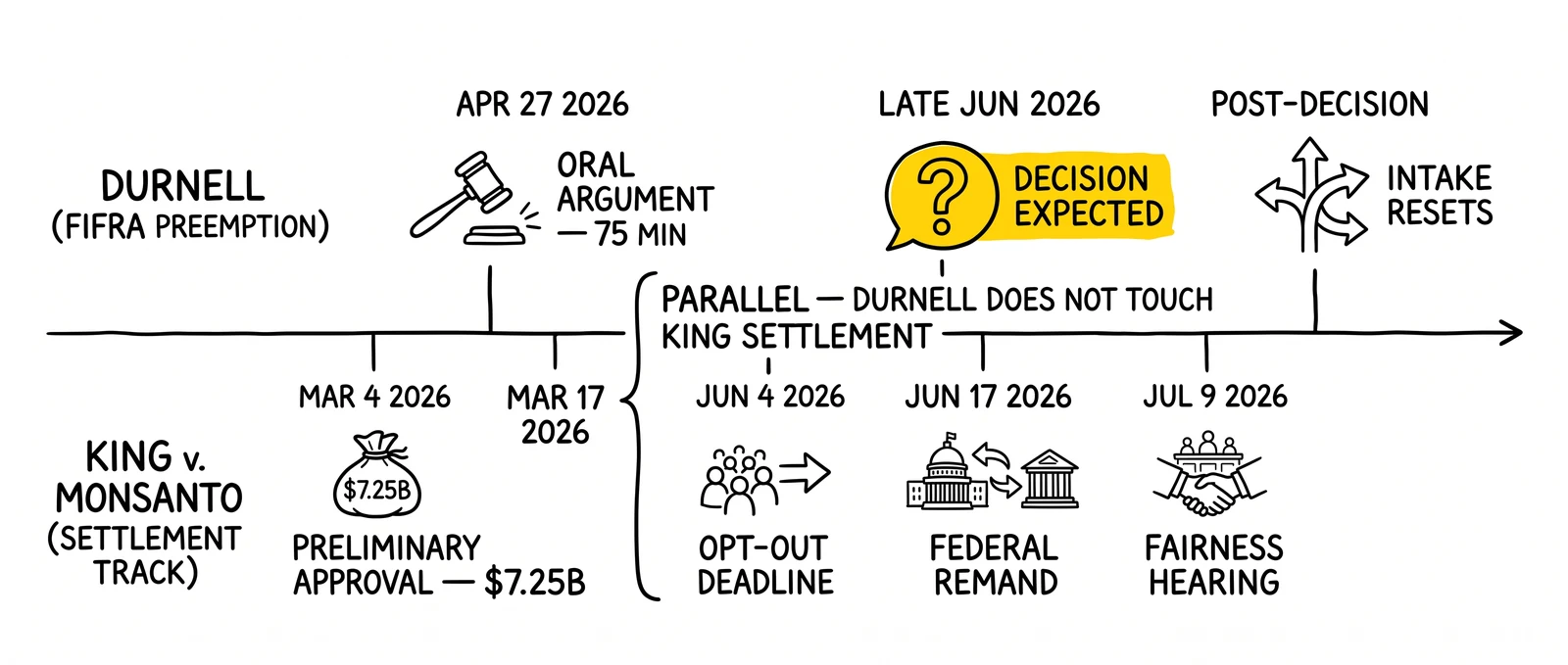
Whiteford & Taylor’s client alert frames the relationship as “two tracks, one defendant.” Bayer offered a price calibrated to the litigation risk under the legal regime that exists when the deal closes. The Durnell ruling moves that regime, and therefore the price.
The interaction:
- If preemption wins broadly: the $7.25 billion looks generous in hindsight. Claimants who opted out of the class to pursue individual trials face dismissal under FIFRA preemption. The class settlement becomes the only viable path, and the structural compromises – the $6,000 to $40,000 residential-user cap, the 21-year payout, the declining funding schedule – bind claimants who have no alternative.
- If preemption loses: the $7.25 billion becomes a steep discount on what individual trials could produce. The Hardeman $80 million verdict, the Pilliod $2 billion verdict reduced to $87 million on appeal, the trial-level verdicts in the $1.5 billion-plus range that get reduced – these remain available to opt-out plaintiffs. Objector firms representing approximately 20,000 plaintiffs that filed delay motions on May 21 have a strong case that the structure undervalues claims.
The sequencing problem is real. The June 4 opt-out deadline passed before the Durnell decision. Class members had to decide whether to stay in the $7.25 billion structure without knowing whether the alternative – individual trial under failure-to-warn – would survive. Keller Postman and Frazer PLC’s objection in Missouri’s 22nd Circuit on May 21 explicitly raises this as a due-process problem. The argument: a class settlement should not be approved when material litigation risk to class members will be resolved within weeks of the opt-out window.
Federal Judge Henry E. Autrey of the Eastern District of Missouri remanded an objector-driven removal attempt back to state court on June 17, 2026. The federal courts and the state courts continue to jockey for power over the procedural posture. For intake operators, the practical effect: the final approval clock is running, the Durnell ruling clock is running, and contingent-media commitments need to account for both.
Mass-tort intake economics – what changes under each scenario
Mass-tort intake is a distinct lead-generation discipline. The math is different from insurance, mortgage, or solar. Higher CPL, lower volume, longer cash conversion, vastly higher per-conversion value. Roundup specifically requires a qualifying non-Hodgkin lymphoma diagnosis – diffuse large B-cell, follicular, marginal zone, mantle cell, and related subtypes – plus documented Roundup exposure history that establishes residential, occupational, or agricultural use with sufficient frequency and duration to support causation.
Vendor-attested CPL data from Mass Tort Ad Agency clusters glyphosate intake at $80 to $200 per qualified lead, with California and Iowa as the highest-value markets given agricultural concentration and jury damages perception. Cost per signed retainer runs $800 to $3,500 across mass torts generally. Retainer-to-claim conversion at tightly targeted occupational-exposure campaigns runs 40 to 60 percent above broad-campaign benchmarks per the same source. None of those figures are FTC or ABA authoritative – they’re industry-vendor data, and operators should treat them as directional rather than benchmark-grade.
The 90-day opt-out sprint window ending June 4 produced its own CPL spike. Vendor reporting cited qualified Roundup CPL into the $600 to $850 range during the sprint as firms refilled pipelines before the deadline closed. The sprint demonstrated something important: Roundup intake responds elastically to event-driven litigation calendars. When something material is happening to the docket, demand spikes and CPL follows. The Durnell decision is the largest such event in 2026.
Pricing model matters. Three structures are in market:
- Pay-per-lead (PPL): the firm pays the marketing partner per qualified inquiry. Conversion risk sits with the law firm. Roundup PPL typically clears at $80 to $200 per qualified lead.
- Pay-per-signed-case (PPSC): the firm pays only when a claimant executes a retainer and meets all qualification criteria. Conversion risk sits with the marketing partner. Roundup PPSC clears at $800 to $3,500 depending on tier qualification.
- Hybrid: a base PPL with a PPSC bonus. Risk shared.
A FIFRA preemption ruling reshapes each model differently. Under broad preemption for Monsanto, PPL contracts run into immediate dispute. The “qualified lead” definition assumed case viability; the ruling moves the goalposts. PPSC contracts collapse because no firm will execute retainers on a foreclosed theory. Hybrid contracts split the loss across both sides. Operators with kill-switch language tied to specific SCOTUS docket events fare best. Operators with rigid take-or-pay language fare worst.
Under a ruling against Monsanto, the math holds. CPL stable to modest rise. Volume stable. The objector-side acquisition motion that targets opt-out clients pursuing individual trials becomes a parallel market. The Keller Postman / Frazer PLC bet on objector economics – that opt-out clients pursued individually will produce larger per-claim outcomes than the class structure’s tier caps – becomes self-fulfilling. Intake firms positioned for that motion clear a separate set of CPLs.
For operators reading Bayer Roundup $7.25B: Mass-Tort Intake CPL Reset alongside this article, the framing distinction is important: that article models the 90-day sprint window through June 4 under the settlement structure as given. This article models what the post-decision landscape looks like and how the settlement structure interacts with SCOTUS. Both economic models are running simultaneously through July.
The plaintiff firms – and where their intake budgets sit
A vertical-wide ruling redistributes media spend across plaintiff firms in predictable ways. The major firm map:
Class counsel side. Christopher Seeger leads class counsel in King v. Monsanto. Seeger Weiss LLP runs national intake on the class-settlement side. Class-counsel firms broadly benefit from a Monsanto-favorable preemption ruling because the settlement structure becomes the only viable path and class-settlement administration replaces individual-trial intake. Marketing motion shifts from inventory acquisition to participation-rate maximization within the existing 65,000 covered claims plus the inflow of future diagnoses.
Individual-trial firms. Wisner Baum is the most-cited individual-trial-verdict firm – R. Brent Wisner served as plaintiffs’ co-lead counsel in Hardeman ($80 million California verdict) and Pilliod ($2 billion verdict, reduced to $87 million on appeal). Beasley Allen, Wallace Miller, Andrus Wagstaff, the Miller Firm, and Watts Guerra carry significant claim inventories. These firms benefit from a Durnell-favorable ruling that preserves failure-to-warn. They face the largest intake-economics collapse under broad preemption.
Confirmed objectors. Keller Postman (Ashley Keller’s firm) and Frazer PLC filed formal objector challenges in Missouri’s 22nd Circuit on May 21, 2026 representing 10 NHL claimants. A separate filing by 14 firms representing approximately 20,000 plaintiffs sought to delay final approval. Objector firms are betting on the high-end of the individual-trial outcome distribution – they want to opt out of the cap structure and pursue trials where verdicts can run an order of magnitude higher.
Adjacent but not confirmed Roundup objectors. Aylstock Witkin Kreis & Overholtz, Onder Law, and similar national mass-tort firms are active across hair relaxer, talc, Camp Lejeune, and Tylenol autism MDLs but are not confirmed as Roundup objectors. Operators allocating media against firm-by-firm objector status should verify before assuming demand stability from these firms specifically.
The plaintiff-firm map matters operationally because intake media flows through firm-level contracts. A campaign that “runs Roundup intake” is actually a portfolio of PPL and PPSC contracts with specific firms. When a SCOTUS ruling changes the underlying litigation theory, contracts re-price firm by firm. Operators who have not mapped their inventory to specific firms by exposure type – class participants vs. opt-outs, individual-trial firms vs. settlement firms – will struggle to re-allocate quickly when the ruling lands.
The 60-day post-decision playbook
When the Durnell opinion drops, the operational window is 30 to 60 days. The decisions that matter:
Media kill-switch language. Pre-committed Q3 media in the $25,000 to $250,000 monthly range should have 48-hour pull-back clauses tied to specific SCOTUS docket events. If the opinion forecloses failure-to-warn, the campaign pauses immediately. If the opinion preserves the theory, the campaign continues at planned spend. Operators without this language pay for inventory the firm cannot use.
Conversion-rate guarantees that float with case viability. Retainer-to-claim conversion guarantees should specify that volume targets reset to zero on a preemption-for-Monsanto ruling. The standard mass-tort marketing contract assumes case viability – when viability disappears, the guarantee becomes either unenforceable or punitive. Specify the renegotiation trigger in advance.
Force-majeure clauses tied to docket events. Pay-per-signed-case agreements should embed a force-majeure provision tied to specific SCOTUS opinion releases. The boilerplate force-majeure language covers natural disasters but typically does not cover legal-regime changes. Add the Durnell decision specifically by docket number.
Diversification across mass-tort verticals. Operators with single-vertical Roundup exposure should diversify in the next 30 days regardless of decision direction. The alternative deployment targets:
- Hair relaxer MDL: approximately 11,371 pending plaintiffs per Lawsuit Information Center June 2026 update, with fact discovery closing June 10. Bellwether trials likely mid-2027. The intake window is open through the next 6 to 12 months.
- Camp Lejeune Justice Act: approximately 407,000 claims with under 1% resolution rate. WaterVerge data shows $571 million paid and $795 million in offers as of April 13, 2026. Intake economics depend on documentation-assistance positioning rather than headline acquisition.
- Talc / ovarian cancer: ongoing post-J&J reorganization litigation with active intake.
- PFAS / forever chemicals: the 3M settlement and ongoing state-AG actions sustain intake demand.
- Tylenol autism: Daubert ruling closed federal MDL theory, but state-court parallel cases continue.
Re-theorize surviving Roundup cases. Under narrow preemption against Roundup, design defect and fraud-based theories survive. Intake firms running glyphosate inventory should work with class counsel and individual-trial firms on whether pivoted-theory cases remain viable. The intake quality criteria change – design defect cases need different documentation than failure-to-warn – and CPL re-prices accordingly.
Operators with TCPA exposure on Roundup outreach. Mass-tort outreach is regulated under the same TCPA framework as other verticals. The McLaughlin v. McKesson 2025 ruling restoring district-court interpretive power over FCC orders, and the Eleventh Circuit’s Insurance Marketing Coalition v. FCC vacatur of the one-to-one consent rule, create a defensible TCPA posture for affiliated-firm consent – but operators should audit before the next intake spike, not during it. Reference TCPA Compliance Guide for Lead Generators for the framework and Multistate AG CID TCPA Enforcement for the state-AG enforcement layer that runs in parallel.
The legal-vertical lead-gen space has its own enforcement risk surface beyond TCPA. The recent wave of AI-hallucination sanctions in legal briefs (covered in AI Hallucination Sanctions in the Legal Vertical) is a tangential reminder that legal-vertical marketing operates under heightened scrutiny. Mass-tort intake firms running AI-generated landing-page copy or AI-drafted intake-form text should audit for hallucinated case citations, fabricated client testimonials, and unsupported damages claims before the Durnell ruling brings additional regulatory attention.
What Bayer’s $16 billion of litigation reserve actually tells you
Bayer has reserved approximately €11.8 billion ($13.9 billion) cumulatively through Q1 2026 against Roundup litigation. Cumulative payments to plaintiffs across prior tranches sit near $11 billion. The August 2025 addition of $1.37 billion to reserves was framed by Bayer as recognition that the federal MDL and state-court inventory required ongoing provisioning. The $7.25 billion King settlement, if approved at the July 9 fairness hearing, would absorb most of the residual unprovisioned exposure.
What that reserve math implies for intake operators: Bayer’s legal posture treats the $7.25 billion as the floor, not the ceiling. The reserve includes provisioning for cases that opt out and proceed to trial. If Durnell preempts failure-to-warn, Bayer’s reserve releases material amounts back to operating earnings. If Durnell preserves failure-to-warn, additional reserve top-ups are likely through 2027 as opt-out cases work through trial schedules.
The publicly reported pending case count fluctuates. Bayer’s most recent disclosures cite approximately 3,903 cases pending in federal MDL 2741 as of May 1, 2026, plus several thousand additional state-court cases – a meaningful drop from the late-2024 federal MDL peak. Plaintiff-side sources cite 60,000 to 67,000 total pending cases across all jurisdictions. The gap between Bayer’s count and plaintiff-side counts reflects how each side categorizes cases that have been filed but not yet docketed, settled-in-principle but not yet dismissed, or held in administrative tolling pending the class structure. Intake operators should track both numbers to model demand.
Independent of the Durnell ruling, plaintiff-firm intake for new Roundup claims continues to clear the market. Drugwatch and Lawsuit Information Center June 2026 updates confirm intake remains open, with firms still building inventories of qualifying claimants. The 90-day sprint window through June 4 pulled forward demand, but new diagnoses of glyphosate-linked NHL continue, and statute-of-limitations clocks vary by state. New intake will continue regardless of Durnell – but the price and conversion economics around that intake reset on the ruling.
Key Takeaways
- Monsanto v. Durnell, No. 24-1068, was argued April 27, 2026 and is expected to be decided by early July 2026. The decision will determine the viability of failure-to-warn theories across approximately 60,000 pending Roundup cases. Intake operators should model both outcomes before the opinion drops.
- The Schaffner v. Monsanto Third Circuit decision created the circuit split SCOTUS took Durnell to resolve. The Third Circuit said FIFRA expressly preempts state-law failure-to-warn claims; the Ninth and Eleventh Circuits said the opposite. A narrow ruling either direction is more likely than a broad one based on oral-argument signals.
- The $7.25 billion King v. Monsanto class settlement runs in parallel. Preliminarily approved March 4, opt-out deadline closed June 4, fairness hearing July 9. The settlement was priced under the litigation regime that exists when the deal closes – Durnell moves that regime, and therefore the price.
- Vendor-attested Roundup CPL ran $80 to $200 per qualified lead pre-sprint, spiking to $600 to $850 during the 90-day opt-out sprint window ending June 4. Post-Durnell economics depend on the ruling: collapse 60-90% under broad preemption for Monsanto; stable to modest rise under a ruling preserving failure-to-warn.
- Pay-per-lead, pay-per-signed-case, and hybrid contracts re-price differently under each scenario. Operators with kill-switch language tied to specific SCOTUS docket events fare best. Operators with rigid take-or-pay language fare worst.
- Plaintiff-firm exposure splits along class counsel (Seeger Weiss), individual-trial firms (Wisner Baum, Beasley Allen, Wallace Miller, Andrus Wagstaff, Miller Firm, Watts Guerra), and confirmed objectors (Keller Postman, Frazer PLC). Intake media flows through firm-level contracts that re-price firm by firm.
- Diversification matters more than directional bet. Operators with single-vertical Roundup exposure should diversify into hair relaxer (11,371 plaintiffs, fact discovery closing June 10), Camp Lejeune (407K claims, under 1% resolution), talc, PFAS, or other active mass-tort verticals regardless of how Durnell resolves.
- Bayer’s €11.8 billion ($13.9 billion) cumulative Roundup reserve and the $7.25 billion King settlement structure imply the reserve treats the settlement as the floor. A preemption ruling releases material reserve back to earnings; a ruling preserving claims drives additional reserve top-ups through 2027.
- TCPA and AI-hallucination compliance risks compound under heightened regulatory scrutiny. Intake firms should audit consent architecture, affiliated-firm consent under McLaughlin v. McKesson, and AI-generated landing-page copy before the Durnell ruling brings additional attention to the legal vertical.
Sources
- Monsanto Company v. Durnell, No. 24-1068 – U.S. Supreme Court Docket
- Monsanto Company v. Durnell (24-1068) – SCOTUSblog Case File
- Justices debate who gets to decide that pesticide labels need a cancer warning – SCOTUSblog, April 27, 2026
- State and federal courts jockey for power in the Roundup case – SCOTUSblog, May 2026
- Monsanto Company v. Durnell – Cornell Legal Information Institute Supreme Court Bulletin
- Roundup at SCOTUS: How Durnell Sets the Settlement Price – Whiteford Taylor Preston Client Alert
- What to Expect at Oral Argument in Monsanto Company v. Durnell – Earthjustice, April 2026
- Supreme Court Grapples with Roundup, Federal Preemption, and the Limits of EPA Authority – Bergeson & Campbell, P.C.
- Supreme Court hears Bayer Roundup liability case with billions at stake – C&EN, April 2026
- Bayer Wins Preliminary Court Approval for $7.25 Billion Roundup Settlement – Bloomberg, March 4, 2026
- Judge Gives Preliminary Approval to $7.25 Billion Roundup Settlement – Drugwatch, March 4, 2026
- Roundup Settlement Opt-Out Deadline Is Days Away, But the Legal Fight Is Far From Over – Drugwatch, May 29, 2026
- Federal judge sends $7.25B Roundup settlement back to Missouri state court – Missouri Lawyers Media, June 17, 2026
- Bayer’s proposed Roundup settlement violates Constitution, new legal filing claims – Investigate Midwest, May 26, 2026
- Managing the Roundup Litigation – Bayer Global
- Roundup Glyphosate Cases in 2026: Intake Strategy for Plaintiff Law Firms – Mass Tort Ad Agency
- Mass Tort Lead Generation: What Plaintiff Firms Need to Know in 2026 – Mass Tort Ad Agency, June 17, 2026
- Roundup Lawsuit Mass Tort Case Leads: 2026 Guide – Lawfold
- Roundup Lawsuit MDL 2741 June 2026 Update – MDL Update
- Roundup Lawsuit June 2026 Update – Lawsuit Information Center
Frequently Asked Questions
What is Monsanto v. Durnell and why does it matter for mass-tort lead generation?
Monsanto v. Durnell, No. 24-1068, is the Supreme Court case argued April 27, 2026 on whether the Federal Insecticide, Fungicide, and Rodenticide Act preempts state-law failure-to-warn claims against pesticide manufacturers when EPA has not required the warning. The case originated from John Durnell’s 2019 Missouri state-court suit that produced a $1.25 million verdict in 2023. The decision matters for lead generation because more than 60,000 Roundup-related claims remain active across the federal MDL 2741 and state courts. A ruling for Monsanto on preemption would foreclose the failure-to-warn theory that powers most pending Roundup cases and collapse plaintiff-firm intake demand. A ruling against Monsanto preserves the trial pathway and sustains intake volume through 2027.
When will the Supreme Court issue the Durnell decision?
The decision is expected before the Court closes its 2025-2026 term in late June or early July 2026. Oral argument occurred April 27, 2026 with Paul D. Clement arguing for Monsanto and Ashley C. Keller arguing for Durnell. The Solicitor General also participated under a motion granted April 17. SCOTUSblog and Cornell Legal Information Institute both list the case as pending as of June 25, 2026. The timing collides with the King v. Monsanto class settlement’s July 9 fairness hearing – a sequencing problem objector firms have called out as constitutionally problematic because the June 4 opt-out deadline passed before plaintiffs could see the decision.
What is FIFRA preemption and how does the Third Circuit’s Schaffner decision factor in?
The Federal Insecticide, Fungicide, and Rodenticide Act, 7 U.S.C. § 136 et seq., regulates pesticide registration and labeling through the EPA. The express preemption clause at 7 U.S.C. § 136v(b) bars states from imposing any labeling requirement different from the federal scheme. The Third Circuit held in Schaffner v. Monsanto Co., 113 F.4th 364 (3d Cir. 2024), that FIFRA expressly preempts state-law failure-to-warn claims for products bearing EPA-approved labels. The Ninth Circuit’s Hardeman decision and the Eleventh Circuit’s Carson decision held the opposite. The circuit split is exactly what SCOTUS took the Durnell case to resolve. The Court’s 2005 Bates v. Dow Agrosciences ruling allowed common-law claims if they served as the functional equivalent of FIFRA misbranding standards.
How would a preemption ruling for Monsanto affect Roundup intake CPL?
A ruling that FIFRA preempts state-law failure-to-warn claims forecloses the dominant litigation theory in Roundup cases. Pending cases that have not progressed to other theories – defective design, breach of warranty, negligent misrepresentation independent of the label – face immediate dismissal motions. Intake firms running glyphosate campaigns at the $80 to $200 CPL range vendor-attested by Mass Tort Ad Agency would see retainer-to-claim conversion collapse as case viability narrows. Operators with pre-committed media should expect a 60 to 90 percent CPL spend reduction within 30 to 60 days of the ruling. Affiliate networks selling Roundup inventory on a pay-per-signed-case basis would pull the campaign entirely.
How would a preemption ruling against Monsanto affect intake economics?
A ruling preserving state-law failure-to-warn claims supercharges objector-firm economics because the individual-trial-verdict pathway remains viable. The Hardeman $80 million California verdict, the Pilliod $2 billion verdict reduced to $87 million on appeal, and trial outcomes in the $1.5 billion-plus range that get reduced post-verdict define the alternative-to-settlement math objector firms are betting on. Intake CPL would hold at current levels or rise modestly as Keller Postman, Frazer PLC, and the 14 firms representing 20,000 plaintiffs that filed delay motions on May 21 reactivate marketing. Affiliate marketplaces would extend Roundup campaigns through 2027.
What is the $7.25 billion King v. Monsanto settlement and how does it interact with the SCOTUS case?
Bayer announced the $7.25 billion class settlement on February 17, 2026 in Randall King, et al. v. Monsanto Company, No. 2622-CC00325, in the Missouri 22nd Judicial Circuit. Judge Timothy J. Boyer granted preliminary approval March 4, with written order March 9. The structure pays $6,000 to $165,000 per qualified claimant over 17 to 21 years with declining annual funding caps. The opt-out deadline ran through June 4 and the fairness hearing is set for July 9. The Whiteford & Taylor analysis describes the relationship as “two tracks, one defendant”: Bayer offered a price calibrated to litigation risk under the prevailing legal regime, and the Durnell ruling moves that price point.
Which plaintiff law firms drive Roundup intake and which are objectors?
Class counsel in the King settlement is led by Christopher Seeger, with reported $675 million class-counsel fee allocation. Wisner Baum is the most-named individual-trial-verdict firm – R. Brent Wisner served as plaintiffs’ co-lead counsel in the Hardeman and Pilliod verdicts. Beasley Allen, Wallace Miller, Andrus Wagstaff, the Miller Firm, and Watts Guerra carry significant claim inventories. Objector firms confirmed in court filings are Keller Postman and Frazer PLC, who filed a formal objection in Missouri’s 22nd Circuit on May 21, 2026 representing 10 NHL claimants. A separate filing by 14 firms representing approximately 20,000 plaintiffs sought to delay approval. Aylstock Witkin Kreis & Overholtz and Onder Law are active across multiple mass-tort dockets but are not confirmed Roundup objectors as of publication.
What does Roundup intake look like operationally – qualification, CPL, and retainer-to-claim?
Roundup intake requires a qualifying NHL diagnosis (non-Hodgkin lymphoma, including diffuse large B-cell, follicular, marginal zone, mantle cell, and related subtypes) plus documented Roundup exposure history. Documented exposure typically means residential, occupational, or agricultural use with frequency and duration sufficient to establish causation. Mass Tort Ad Agency cites a qualified-lead CPL range of $80 to $200 with California and Iowa as the highest-value markets given agricultural concentration. Cost per signed retainer typically runs $800 to $3,500. Retainer-to-claim conversion at 40 to 60 percent above broad-campaign benchmarks is the cited spread for tightly targeted occupational-exposure campaigns. Pay-per-lead, pay-per-signed-case, and hybrid pricing models are all in market.
What is the operator playbook for the 60-day window after the Durnell decision lands?
Operators running glyphosate inventory should pre-position media contracts with kill-switch language tied to the SCOTUS opinion publication date. Three buckets matter. Pre-committed Q3 media in the $25,000 to $250,000 monthly range should have a 48-hour pull-back clause. Retainer-to-claim conversion rate guarantees from media partners should specify that volume targets reset to zero on a preemption-for-Monsanto ruling. Pay-per-signed-case agreements should embed a force-majeure provision tied to the SCOTUS docket. The 30 to 60 days following the ruling will determine whether plaintiff firms continue Roundup spend, redirect to hair relaxer or Tylenol autism MDLs, or shut down the vertical entirely. Operators with single-vertical Roundup exposure should diversify in the next 30 days regardless of decision direction.