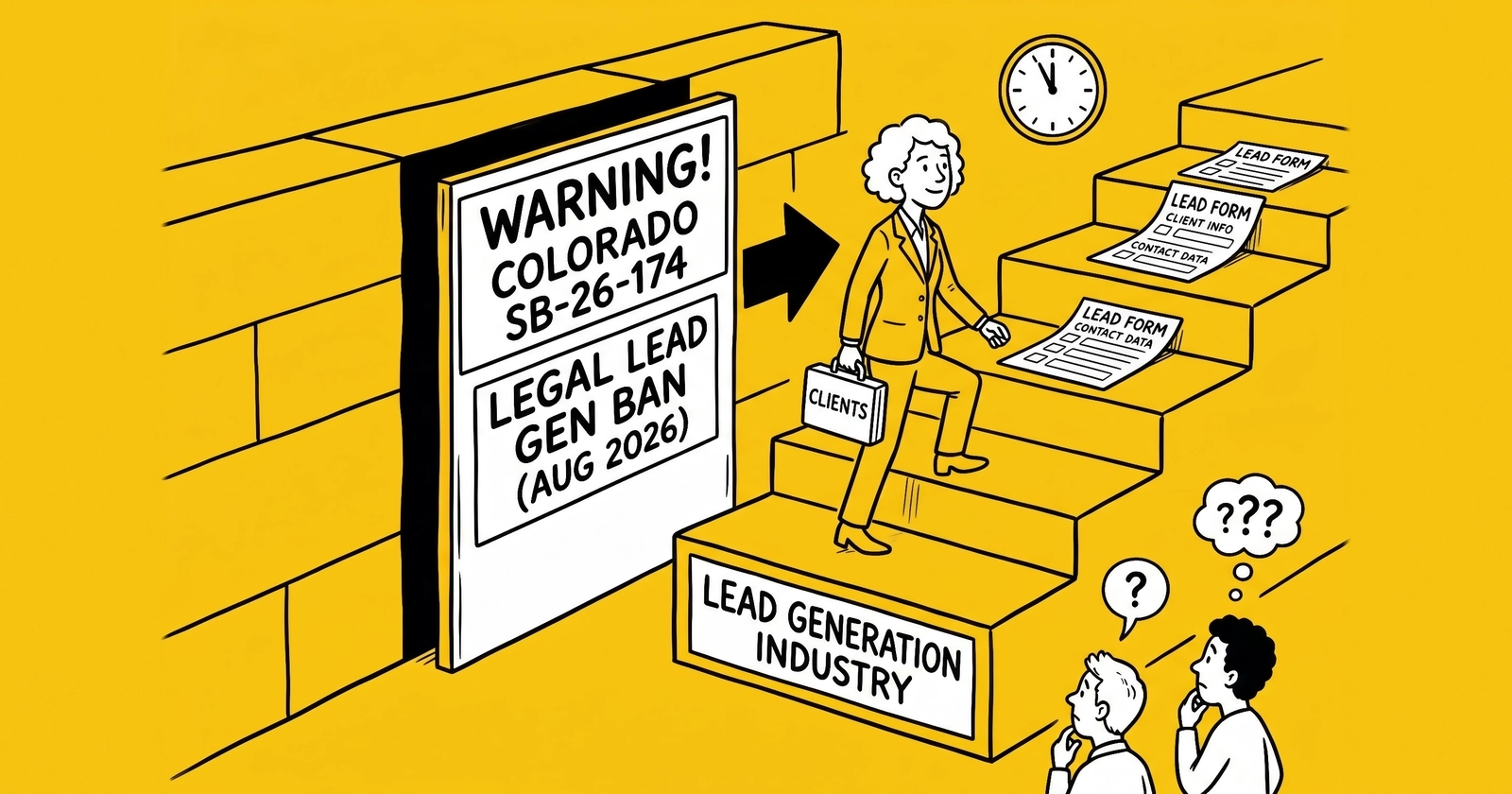
Colorado made the third-party legal-lead business a deceptive trade practice on June 3, 2026 – and the enforcement clock starts in roughly five weeks.
The Statute, the Calendar, and the Operator Problem
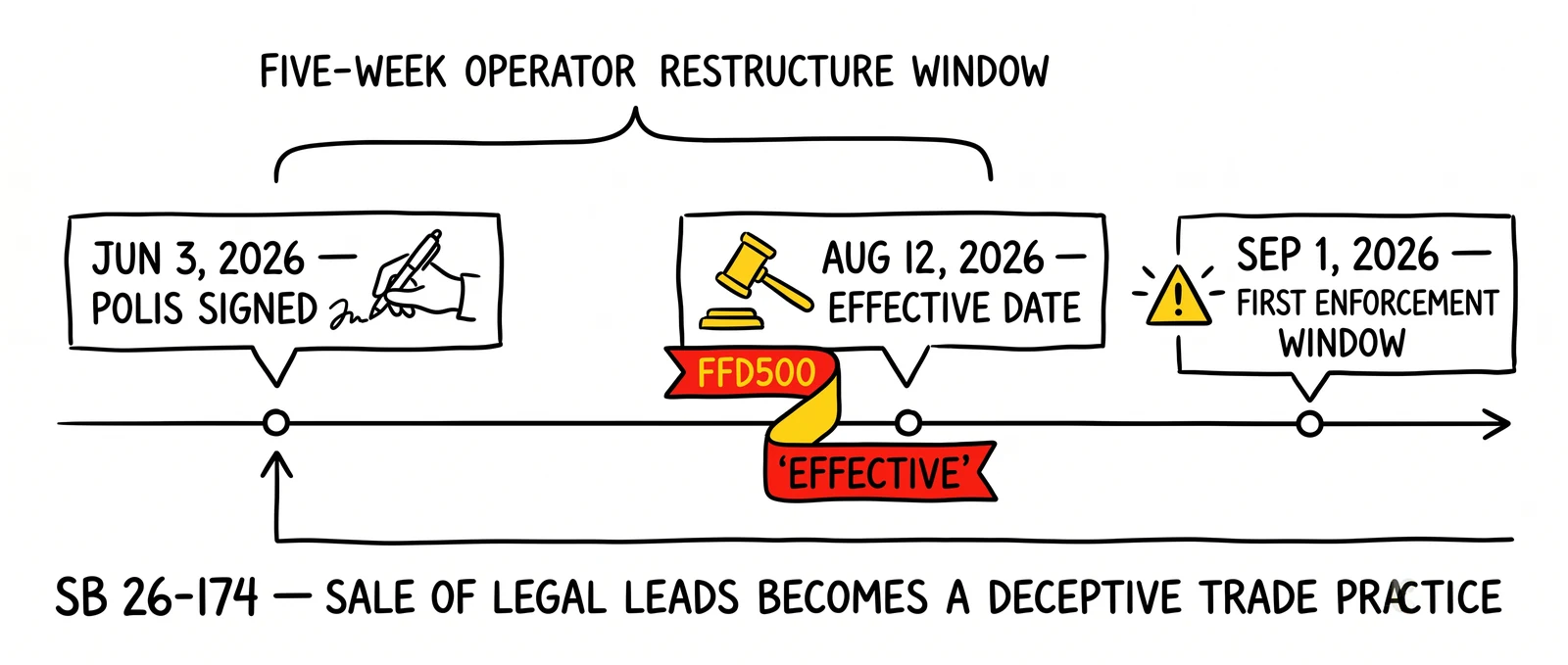
Colorado Senate Bill 26-174, titled Prohibit Lead Generation Legal Marketing, was signed by Governor Jared Polis on June 3, 2026 and takes effect August 12, 2026. The Second Regular Session of the Seventy-fifth General Assembly adjourned sine die on May 13, 2026. The bill carried no safety clause. Under Colorado’s default rule, statutes enacted without a safety clause become effective ninety days after adjournment – which lands on the August 12 date that the entire legal lead-generation vertical has now committed to memory.
The bill’s prime Senate sponsor is Senator Dylan Roberts. The prime House sponsors are Representatives Michael Carter and Matt Soper, with Representative Lorena García as an additional sponsor. The bipartisan sponsor mix telegraphs the political durability of the rule – this is not a partisan curiosity that flips with the next election cycle. It is the first state-level recodification of an entire lead-generation vertical from “regulated commercial practice” to “deceptive trade practice” in the modern era of attorney advertising regulation.
Operators selling legal leads into Colorado attorneys, law firms, and licensed legal paraprofessionals have roughly five weeks from this article’s publication date to restructure intake architecture, attribution, buyer panels, and consumer-facing landing pages. After August 12, the enforcement surface includes the Colorado Attorney General, the state’s district attorneys, and any Colorado resident with $10,000 of statutory damages and attorneys’ fees on the table.
The structural problem is not the penalty math. The structural problem is that the statute targets the business model itself. Operators cannot remediate by adding disclosures or tightening consent. The statute restricts who can solicit, and it requires that whoever does solicit must be either the attorney themselves, the attorney’s clearly-identified agent, or a nonprofit legal services organization. The third-party intermediary model – unbranded landing page, undifferentiated intake form, multi-firm distribution downstream – is the model that the rule kills.
What “Lead Generation Legal Marketing” Means Under the Statute
The bill defines lead generation legal marketing as any form of marketing in which an attorney, law firm, or licensed legal paraprofessional pays money or other compensation to a third party to receive information about a potential client or case. The information may include the potential client’s contact information or information about the potential client’s legal issue or case.
The definition is broad on purpose. It catches:
- Pay-per-lead arrangements where attorneys buy individual signed retainers or qualified inquiries
- Pay-per-call arrangements where attorneys buy live transferred consumer calls
- Subscription models where attorneys buy access to a stream of inquiries
- Auction-based marketplaces where attorneys bid on consumer-submitted intake forms
- Ping-post architectures where consumer information is offered to multiple attorney buyers
- Mass-tort intake aggregation where signed retainers or qualified inquiries are sold to plaintiff firms
- White-label landing pages built and operated by lead-gen agencies on behalf of multiple attorney clients
What the definition does not reach is marketing in which the attorney pays for a service that does not deliver consumer information. Pure SEO services, content marketing retainers, paid search management agencies, and traditional media placement remain outside the statute’s reach because the attorney is paying for marketing labor and creative output, not for delivered consumer leads.
The statute creates three permitted-activity carve-outs. Marketing is allowed only when conducted by a person authorized by the Colorado Supreme Court to practice law in Colorado, when conducted by a person working on behalf of such an authorized practitioner provided the practitioner is clearly identified in every advertisement, marketing material, information, or resource, or when conducted by a nonprofit organization that engages in legal services.
The middle carve-out is the operative one for commercial operators. It is also the one that gets misread most often. The carve-out is not a safe harbor for lead-generation companies that simply add an attorney’s name somewhere in their terms of service. The statute requires clear identification in every advertisement and every material. The agency relationship implied by “working on behalf of” carries fiduciary connotations that an arms-length lead-buyer relationship does not satisfy. Operators counting on this carve-out for their existing book of Colorado business need a complete restructuring, not a disclaimer revision.
The Penalty Stack: Civil, Private, Criminal
Civil penalties under the Colorado Consumer Protection Act framework run up to $20,000 per violation. The penalty ceiling increases to $50,000 per violation when the deceptive practice is committed against an elderly person – a definition that under existing Colorado consumer-protection enforcement reaches consumers age 60 and older. The Colorado Attorney General and the state’s district attorneys hold the public enforcement authority. They can also pursue injunctive relief and restitution alongside the civil penalty.
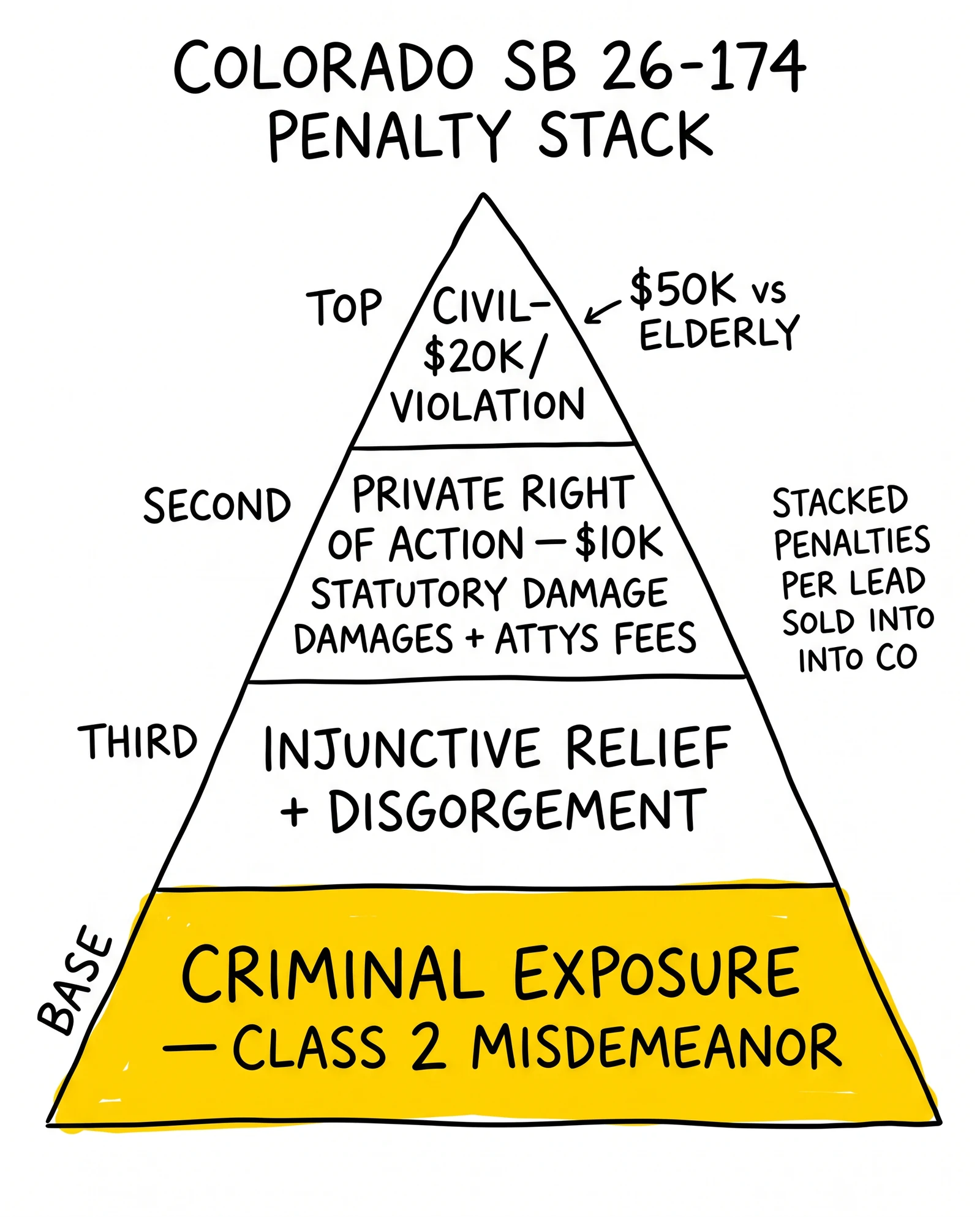
The private right of action is the operator-killer detail. Any Colorado resident who is the target of a violation can recover statutory damages of $10,000 per violation plus reasonable attorneys’ fees and costs. The $10,000 floor is recoverable without proof of actual damages. The attorneys’ fees provision is one-way fee-shifting – plaintiff recovers if successful, defendant does not recover if plaintiff loses. This is the same architecture that turned the federal Telephone Consumer Protection Act into a multi-thousand-case-per-year cottage industry for the plaintiff bar. Colorado has now bolted the same incentive structure onto its legal lead-generation rule.
Criminal exposure is layered separately. The bill contemplates that conduct meeting the elements of fraud, criminal impersonation, or other Colorado criminal statutes can be charged independently. An unbranded intake call center that holds itself out as connected to “Colorado Legal Services” or that uses a Colorado attorney’s name without authorization to convert inbound calls is exposed to criminal impersonation charges in addition to civil enforcement.
The penalty math compounds against operators selling at volume. A mid-sized personal-injury aggregator delivering 100 leads per week into Colorado attorney buyers, with each lead-sale potentially constituting a separate violation against the consumer whose information was sold, faces theoretical exposure of $5.2 million per year in private-right-of-action damages before considering AG enforcement. The theoretical ceiling is unlikely to materialize as actual exposure in year one – plaintiff firms need to build the case template first – but it is the structural ceiling the operator is now operating under.
How SB 26-174 Reshapes the Colorado Legal-Lead Funnel
The Colorado legal-lead funnel before August 12, 2026 looks like every other state’s funnel. Consumer-facing landing pages aggregate inquiries through paid search, organic search, social media, and direct-to-consumer broadcast media. Forms collect contact and case detail. Intake call centers screen and qualify. Inquiries get distributed to attorney buyers through ping-post or batch delivery. Pricing runs $80 to $200 for filtered personal-injury inquiries on the low end, $400 to $800 for qualified mass-tort intake, and into the four figures for signed retainers in premium dockets. The site has covered the legal lead compliance baseline by state and the mass-tort intake economics that determine where the volume concentrates.
After August 12, 2026, the funnel for Colorado consumer inquiries has to compress. Each restructuring path carries operational consequences:
Path 1: Per-attorney branded landing pages
The cleanest restructuring is operator-built landing pages, each branded to a single Colorado attorney or firm, operated under explicit agency arrangements with that attorney. The attorney is clearly identified at the top of the page, in the form’s submission language, in the call center’s intake script, and in the post-submission confirmation. The operator is paid for marketing services rendered to that single attorney, not for delivered consumer leads sold downstream.
The operational consequence is that every Colorado attorney buyer requires their own landing page. The economics that made aggregation work – one landing page collecting inquiries that get distributed to dozens of attorney buyers – disappear. Customer acquisition cost rises substantially. Smaller attorney buyers may find the math no longer works at the volumes they need.
Path 2: Nonprofit referral routing
The third carve-out permits nonprofit organizations that engage in legal services to operate without the per-attorney identification requirement. The Colorado Bar Association’s lawyer referral service and county-level pro bono organizations operate inside this carve-out. Commercial operators cannot simply incorporate as a nonprofit to qualify – Colorado nonprofit corporate law and the bar’s own oversight requirements impose substantive constraints on operations, governance, and revenue. The carve-out exists to protect existing public-interest infrastructure, not to provide a commercial workaround.
Path 3: Attorney-employee in-house intake
Some Colorado attorneys may move historically-outsourced intake in-house, hiring W-2 employees who operate the marketing and intake function under direct attorney supervision. The advertising the W-2 employee runs is the attorney’s advertising, not the third-party’s. This restructuring preserves consumer-facing intake flow but transfers the operational cost from variable lead-purchase expense to fixed payroll expense. It also restricts the attorney to the volume their in-house operation can generate, foreclosing the network economics of aggregator panels.
Path 4: Geographic exit
The structural answer for many operators is to drop Colorado from the buyer panel and the consumer-facing geographic targeting. The operator continues running the same intake architecture in 49 other states. Colorado consumers searching for legal help are routed to existing Colorado attorney buyers’ own properties via organic search, or to nonprofit referral routes, or to the gap. Personal injury and mass-tort firms in Colorado lose access to the aggregated lead supply they have been buying. The cost-per-acquired-client rises for Colorado attorneys. The aggregator preserves its compliance posture in every other state.
The path each operator takes turns on their book mix. A national aggregator with Colorado representing 2% of revenue exits Colorado. A specialized Colorado-focused agency with 80% of revenue tied to Colorado attorney buyers restructures into per-attorney agency arrangements. Mass-tort intake operators with Colorado plaintiff firms in the buyer panel face the most painful restructuring because the docket economics depend on aggregation across thousands of Colorado plaintiffs whose information cannot be sold downstream after August 12.
Mass-Tort Intake Faces the Hardest Restructuring
Mass-tort intake is the vertical where SB 26-174 hits hardest. The business model is structurally dependent on third-party aggregation. A Roundup intake operation collects consumer inquiries through unbranded landing pages targeting non-Hodgkin lymphoma patients who used glyphosate products. A hair relaxer intake operation collects inquiries from women diagnosed with uterine, endometrial, or ovarian cancer. The aggregator screens for qualification, builds the medical-records package, and sells signed retainers or qualified inquiries to plaintiff firms participating in the relevant MDL or bellwether calendar. Colorado plaintiff firms are buyers in these networks alongside firms in every other state.
The Bayer Roundup $7.25 billion preliminary approval drove a 90-day CPL spike across the spring 2026 acquisition sprint, with qualified intake routinely priced at $600 to $850 per signed retainer per industry vendor commentary. After August 12, Colorado consumers cannot be inside that aggregated supply chain. The unbranded Roundup landing page violates the statute regardless of whether the lead is being sold to Colorado plaintiff firms or to firms in California or Missouri – the statutory definition reaches the consumer’s transaction with the lead-generation operator, not the geographic destination of the sale.
Mass-tort intake operators have three structural options for Colorado consumer flow. The first is to route Colorado consumer inquiries to specific Colorado plaintiff firms with whom the operator has agency arrangements, with each firm identified in the consumer-facing materials. The economics depend on how many Colorado mass-tort plaintiff firms agree to that structure and what aggregate Colorado volume the operator can capture for each agency partner. The second is to operate Colorado intake under a nonprofit structure tied to specific medical-injury support organizations. The third is to abandon Colorado consumer acquisition for the affected dockets and concede that Colorado mass-tort claimants find counsel through Colorado plaintiff firms’ own marketing.
The CPL implications track the restructuring. National Roundup CPL absorbs Colorado-segment cost increases or shrinks the qualified volume by the Colorado share. Operators serving the hair relaxer MDL face the same math. Camp Lejeune intake, where Colorado-resident veterans represent a smaller fraction of the qualified pool but a meaningful one, also restructures. The article on mass-tort lead generation economics covers the baseline CPL math the restructuring works against.
Personal Injury Intake and the Bait-and-Switch Concern
The legislative history of SB 26-174 makes clear that the rule was crafted specifically to address consumer-protection complaints about personal-injury lead generation. Senate committee testimony, captured in the Citizen Portal record of the hearing, described the statute as targeting a growing practice in which injured Coloradans searching for legal help are routed to lead-generation companies that misrepresent who they are. The recurring patterns the sponsors identified: bait-and-switch arrangements where the consumer believes they are speaking with a specific advertised firm but are routed to whichever attorney pays the highest fee, impersonation of attorneys or law firms by call-center intake staff, and the sale of single consumer inquiries to multiple firms without the consumer’s knowledge.
Personal injury intake operators serving Colorado markets had developed the practice patterns the rule is built to stop. The standard motor-vehicle-accident intake architecture runs a generic landing page – often using URLs like “CoaccidentHelp.com” or “1800-Hurt-Help” – collecting injured-party inquiries that get distributed to ten or more attorney buyers in ping-post fashion. Each buyer rejects or accepts based on internal qualification. The first acceptor wins the lead. The consumer who submitted the inquiry rarely knows which firm bought their information until the inbound call arrives.
After August 12, that architecture is per-se illegal in Colorado. The landing page must identify which attorney or firm is being promoted. The intake script must identify which attorney or firm is being represented. The submission must be to a single firm, not to a marketplace of bidders. If the consumer submits a form that mentions “Smith & Associates,” the call back must come from Smith & Associates – not from Jones Law Group whose ping won the auction.
The compliance cost for personal-injury intake operators is structural. The ping-post architecture for Colorado has to be dismantled. The unbranded landing-page network has to be replaced with per-attorney branded pages or shut down. The intake call centers serving Colorado have to be reorganized to ensure every consumer interaction identifies a specific attorney. Many of these adjustments require contractual restructuring with attorney buyers – moving from per-lead pricing to flat-rate marketing service fees, with all the attendant attribution and budgeting consequences.
The interaction with TCPA compliance compounds the restructuring. The TCPA compliance baseline for lead generators requires Prior Express Written Consent that specifically identifies the seller obtaining consent. Operators running ping-post for personal-injury intake have historically structured PEWC language to cover the universe of potential buyers – “by submitting this form you consent to be contacted by Smith & Associates, Jones Law Group, Brown PLLC, and our other attorney partners about your case.” After August 12, that multi-seller consent architecture inside Colorado conflicts with SB 26-174’s identification requirement. Each Colorado inquiry needs single-attorney consent flow.
The ABA Model Rule 7.2 Interaction
ABA Model Rule 7.2 has been the foundational national framework for attorney advertising since the rule’s modern revision. The rule permits a lawyer to communicate information regarding the lawyer’s services through any media. It prohibits a lawyer from compensating, giving, or promising anything of value to a person for recommending the lawyer’s services – but Comment 5 to the rule specifically permits paying for lead-generation services, including internet-based client leads, as long as the lead generator does not recommend the lawyer, payment complies with Rule 1.5(e) on fee division and Rule 5.4 on professional independence, and the lead generator’s communications comply with Rule 7.1’s prohibition on false or misleading statements.
Colorado adopted ABA Model Rule 7.2 in modified form as Colorado Rule of Professional Conduct 7.2. Colorado already imposes a stricter version of the rule than most states: pure referral fees between lawyers are banned outright, and fee divisions under Rule 1.5(d) must be either proportional to work performed or based on joint responsibility for the engagement.
SB 26-174 is not a replacement for Rule 7.2. It operates in parallel. An attorney’s compliance with Rule 7.2 – paying a lead generator that does not recommend the lawyer, with payment that satisfies fee-division rules, and with communications that satisfy Rule 7.1 – does not provide a safe harbor against the consumer protection statute. The statute applies to the lead generator’s conduct as a deceptive trade practice, regardless of whether the attorney’s payment to the lead generator was professionally compliant. An attorney can be in perfect Rule 7.2 compliance and still face the secondary consequence that their lead-generation supplier is operating illegally in Colorado.
The attorney’s secondary exposure runs through several channels. A Colorado attorney who continues to buy leads from an aggregator that is violating SB 26-174 may face attorney-discipline exposure under Rule 8.4(a) for assisting another’s violation of professional conduct rules. Colorado consumer-protection actions against the lead generator can name the attorney-buyers as participants in the deceptive practice. Private plaintiffs bringing $10,000 statutory damage claims against the lead generator can join the attorney-buyer who paid for the consumer’s information. The defense posture for an attorney buyer is not simply “I bought leads in good faith.” The structural problem is that after August 12, 2026, good faith no longer attaches to the purchase of leads in Colorado.
This is the inverse of the AI hallucination sanctions wave hitting the legal vertical – there, the technology produced the misconduct, and discipline followed individual attorneys. Here, the conduct is structurally embedded in the lead-buyer’s purchasing decision, and discipline can follow every attorney who continues to participate in the supply chain after the effective date.
State-by-State Comparison: Where Colorado Sits in the Enforcement Hierarchy
Colorado’s enforcement architecture under SB 26-174 sits inside a small but growing group of state-level legal-marketing rules that operate outside the ABA Model Rule 7.2 framework. Texas, Florida, and California provide the comparative benchmarks.
Texas barratry law, codified at Texas Penal Code §§ 38.12 and Texas Government Code § 82.0651, is a criminal statute that prohibits case running, capping, and solicitation by intermediaries. Penalties run as criminal misdemeanors and felonies depending on the conduct. The statute predates the modern lead-generation industry and was originally drafted to address ambulance-chasing intermediaries in personal-injury cases. Texas has prosecuted barratry cases against intermediaries who pay runners to solicit accident victims at hospitals and accident scenes. The Texas framework reaches some lead-generation conduct but operates primarily through criminal channels.
Florida Bar Rule 4-7.18 imposes a 30-day cooling-off period before a lawyer or anyone acting on a lawyer’s behalf may solicit professional employment from an accident victim or their family. Florida also prohibits in-person solicitation in connection with motor-vehicle accidents until 30 days after the incident. The Florida framework targets the timing and modality of solicitation rather than the business model of lead aggregation. Florida lead-gen operators serving plaintiff firms structure their intake delays accordingly.
California Business and Professions Code § 6151-6154 prohibits runners and cappers, defined as any person who acts as agent or runner for an attorney for the purpose of soliciting business. California has prosecuted lead generation companies under these statutes when the prosecution can establish the agency relationship between the lead generator and the attorney recipient. The California framework reaches some lead-generation conduct but requires the prosecution to prove the agency element.
Colorado SB 26-174 is distinctive on three dimensions. First, it operates through the consumer protection statute rather than the criminal code or the bar discipline system. Civil and private enforcement are the primary channels, with criminal exposure as a layer-on. Second, the $10,000 private right of action creates plaintiff-bar enforcement incentive that the Texas, Florida, and California frameworks lack. Third, the statute targets the lead-generation business model itself rather than the timing, modality, or agency relationship of solicitation. The combination produces the most operator-aggressive single-state legal-marketing rule enacted to date.
Operators monitoring multistate enforcement patterns should expect the Colorado framework to be the template other states copy. The combination of consumer-protection-act enforcement, private right of action with statutory damages, and a business-model-targeting definition is the design that produces both regulatory bite and political durability. Operators should not assume Colorado is an outlier – they should assume Colorado is the first.
What Operators Should Do Before August 12, 2026
The restructuring checklist for operators selling legal leads with any Colorado exposure runs across five workstreams, each requiring action before the effective date.
Geographic and buyer-panel audit. Pull the volume share that Colorado consumers represent in each campaign. Pull the share of revenue that Colorado attorney buyers represent across the buyer panel. Categorize verticals by exposure – personal injury, mass tort, lemon law, workers’ compensation, bankruptcy, family law, estate planning. The dollar exposure determines the restructuring path.
Landing-page audit. Catalog every consumer-facing landing page that targets Colorado consumers, including geo-targeted variants. Identify which pages reference specific Colorado attorneys or firms and which pages are unbranded or branded to the lead-generation entity. Unbranded pages targeting Colorado consumers cannot survive in their current form.
Consent and intake audit. Audit PEWC language for Colorado inquiries to determine whether the consent flow identifies a specific attorney recipient or contemplates multi-firm distribution. The TCPA architecture has to be reworked alongside the SB 26-174 restructuring to ensure both consent and identification operate on a single-attorney basis for Colorado consumers.
Buyer contract restructuring. Existing buyer agreements with Colorado attorneys typically run as per-lead pricing arrangements with the lead generator as independent contractor. SB 26-174’s permitted-activities carve-out for agents working on behalf of clearly-identified attorneys reads more naturally as a principal-agent relationship than as an arms-length lead sale. Operators need to evaluate whether their existing buyer contracts can be amended to reflect the agency relationship or whether new contractual structures are required. Many attorney buyers will resist agency relationships because of the fiduciary and supervisory obligations they impose under Rule 5.3.
Compliance documentation. The private right of action means operators should expect plaintiff demands within 90 days of the effective date. Documentation of compliance posture – agency contracts, landing page screenshots, intake script revisions, consent flow records – needs to be in place and retrievable before any enforcement action arises. The same documentation discipline that drives TCPA defense applies here with the additional twist that the statute is brand new and no defense templates exist yet.
The window between the article’s publication date and August 12, 2026 is narrow. Operators who wait for additional guidance from the Colorado AG, additional industry analysis from the bar associations, or the first enforcement actions to land are operating on a timeline that does not exist. The compliance restructuring needs to be in production by July 31, 2026 at the latest to provide a working buffer before enforcement begins.
Key Takeaways
- Colorado SB 26-174 makes the sale of legal lead generation services a deceptive trade practice effective August 12, 2026, with civil penalties up to $20,000 per violation, $50,000 against elderly persons, $10,000 private right of action with attorneys’ fees, and criminal exposure layered on top.
- The statute targets the third-party brokerage business model itself, not just the marketing communications – meaning operators cannot remediate by adding disclosures or tightening PEWC language.
- The permitted-activities carve-out for “agents working on behalf of clearly identified attorneys” requires every advertisement and material to identify the specific attorney being promoted, dismantling the unbranded landing page and ping-post architectures that dominate personal-injury and mass-tort intake.
- Mass-tort intake operators face the hardest restructuring because the docket economics depend on aggregation across thousands of Colorado consumers whose information cannot be sold downstream after the effective date.
- Personal-injury intake operators must restructure single Colorado intake flows from multi-buyer ping-post auctions to single-attorney agency arrangements before August 12 or exit Colorado consumer targeting entirely.
- ABA Model Rule 7.2 compliance does not provide a safe harbor – attorneys complying with their professional conduct obligations still face secondary exposure under SB 26-174 if their lead suppliers operate the prohibited business model in Colorado.
- The $10,000 private right of action plus one-way fee-shifting replicates the TCPA enforcement architecture that turned that statute into a multi-thousand-case-per-year industry – operators should expect plaintiff demands within 90 days of the effective date.
- Colorado is the template state for legal-lead consumer-protection enforcement, not an outlier – operators should treat the restructuring as the first wave of a national pattern, not as a Colorado-specific carve-out.
- Operators with substantial Colorado exposure need restructuring in production by July 31, 2026 to provide a working buffer; operators with marginal Colorado exposure should evaluate geographic exit as the lower-cost compliance path.
- The compliance documentation discipline that drives TCPA defense applies here with no defense templates yet in existence – operators who wait for the first enforcement actions to land are operating on a timeline that does not exist.
Sources
- Colorado General Assembly – SB26-174 Prohibit Lead Generation Legal Marketing (Bill Page)
- Colorado General Assembly – SB 26-174 Enrolled Bill Text (PDF)
- Klein Moynihan Turco – Is Legal Lead Generation Finished? (David Klein, June 2026)
- LegiScan – Colorado SB174 2026 Regular Session Enrolled
- Colorado Governor Polis – Action on Bills, June 3, 2026
- Colorado Bar Association – Colorado Rules of Professional Conduct
- ABA Model Rule 7.2 – Communications Concerning a Lawyer’s Services: Specific Rules (Comment)
- C.R.S. 6-1-105 – Colorado Consumer Protection Act Deceptive Trade Practices (FindLaw)
- Herrick K. Lidstone – 2026 Legislation Directly Affecting Colorado Attorneys (SSRN)
- Citizen Portal – Senate committee advances bill to ban deceptive legal lead-generation marketing
- Colorado Bar Association – Formal Ethics Opinion 106 on Referral Fees and Networking Organizations
- TrackBill – SB174 Colorado 2026 Prohibit Lead Generation Legal Marketing