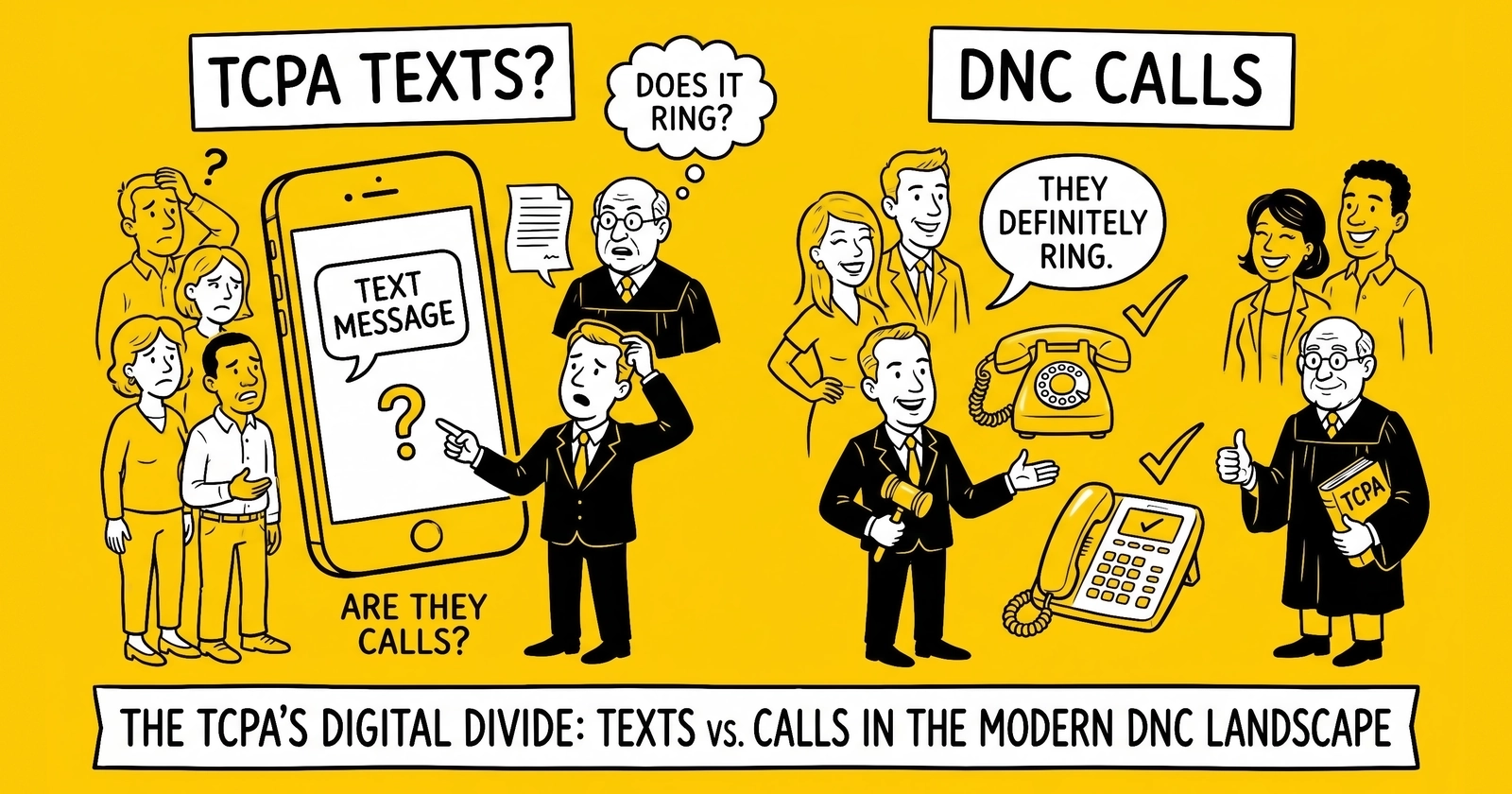
A fourth federal district court has ruled inside three months that the TCPA’s Do-Not-Call private right of action under 47 U.S.C. § 227(c)(5) does not reach text messages. The Irvin v. Sonic decision out of the Northern District of Georgia consolidates a line of cases – Stockdale, both Radvansky rulings, and James v. Smarter Contact – that together represent the cleanest doctrinal opening operators have had in a decade. The Eleventh Circuit will decide whether the rule becomes binding across three of the highest-density TCPA filing states. Whatever happens on appeal, the practical compliance posture for SMS-DNC has already shifted.
A Fourth Court, Three Months, and a Compliance Thesis Under Strain
On April 20, 2026, Judge Leigh Martin May of the Northern District of Georgia issued the fourth federal district-court decision in three months holding that the private right of action created by 47 U.S.C. § 227(c)(5) does not extend to text messages. Irvin v. Sonic Industries Services, LLC, No. 3:25-cv-00242-LMM, 2026 WL 1098403 (N.D. Ga. Apr. 20, 2026), joined a line that began with Radvansky v. Kendo Holdings in February 2026, continued through Radvansky v. 1-800-Flowers.com days later, expanded to the Northern District of Ohio in Stockdale v. Skymount Property Group, 2026 WL 591842 (N.D. Ohio Mar. 3, 2026), and reached the Middle District of Florida in James v. Smarter Contact, LLC, 2026 WL 879244 (M.D. Fla. Mar. 31, 2026). Five district courts. Three federal districts. One coherent statutory reading.
The reading is straightforward. Section 227(c) of the TCPA, by its text, addresses regulations protecting “the privacy rights of residential telephone subscribers” against unwanted “telephone solicitations” delivered as “telephone calls.” The private right of action under § 227(c)(5) extends to persons who have “received more than one telephone call within any 12-month period.” Each of the five district court rulings concluded – applying ordinary statutory interpretation post-Loper Bright – that the FCC’s 2003 administrative extension of “call” to include “text message” was a regulatory reading the statute does not support. After McLaughlin Chiropractic Associates v. McKesson Corp., 145 S. Ct. 2006 (2025) – which confirmed that federal district courts owe no deference to FCC orders interpreting the TCPA – that administrative reading no longer commands judicial deference.
For lead-generation operators, the practical question is not whether the doctrinal reading is correct as a matter of statutory interpretation. The question is what the new line of cases means for compliance posture, settlement reserves, vendor architecture, and the next twelve months of class-action exposure. The framework most operators built around § 227(c) assumed texts and calls travelled together as a single regulatory object. That assumption was load-bearing. It is no longer load-bearing in four federal districts. The Eleventh Circuit will decide, on the Radvansky v. Kendo appeal, whether the rule becomes binding across Florida, Georgia, and Alabama – three of the highest-density TCPA filing states in the country.
This analysis works through the doctrinal arc, the four cases, the appellate posture, the settlement-economics implications, and the surviving state mini-TCPA exposure surface that operators should now treat as the load-bearing layer of their SMS compliance architecture. Within the broader 2025-2026 TCPA case-law cluster, this is the texts-versus-calls private-right-of-action split – distinct from the Illinois SMS ATDS reasoning in the Rabbit v. Rohrman ruling, the emergency-exception fact pattern in Davis v. HealthPlex, and the click-consent-form-audit doctrine in Dahdah v. Rocket Mortgage. Each case-cluster decision touches a different layer of the TCPA stack; the four-court line covered here is specifically about whether § 227(c)(5)‘s private cause of action reaches SMS at all.
What § 227(c)(5) Actually Says – and Why the FCC Read It Differently for Twenty-Three Years
The statutory text matters. Reading it cold, without the accumulated overlay of FCC orders, makes the district-court arguments easier to follow.
Section 227(c) is titled “Protection of subscriber privacy rights.” Subsection (c)(1) directs the FCC to “initiate a rulemaking proceeding concerning the need to protect residential telephone subscribers’ privacy rights to avoid receiving telephone solicitations to which they object.” Subsection (c)(2) requires the FCC to “compare and evaluate alternative methods and procedures (including the use of electronic databases […] industry-based or company-specific ‘do not call’ systems, and any other alternatives, individually or in combination) for their effectiveness in protecting such privacy rights.” Subsection (c)(3) authorizes the FCC to require “the establishment and operation of a single national database to compile a list of telephone numbers of residential subscribers who object to receiving telephone solicitations.” Subsection (c)(5) creates the private right of action: “A person who has received more than one telephone call within any 12-month period by or on behalf of the same entity in violation of the regulations prescribed under this subsection may […] bring [an action].”
Throughout, the statute uses three terms: “residential telephone subscribers,” “telephone solicitations,” and “telephone calls.” The TCPA’s definitions section, 47 U.S.C. § 227(a), defines “telephone solicitation” as “the initiation of a telephone call or message for the purpose of encouraging the purchase or rental of, or investment in, property, goods, or services.” A 2003 FCC Report and Order – the first comprehensive TCPA rulemaking after the statute’s expansion that year – concluded that “calls” included “text messages” because text messages were transmitted to telephone numbers. That interpretation has been the operating assumption for every TCPA-DNC compliance program since.
The five district-court rulings of 2026 do not contest that text messages are transmitted to telephone numbers. They contest a different proposition: that the FCC’s 2003 interpretation of “call” to include “text message,” in the specific context of § 227(c) and its private right of action, is consistent with the statutory text after Loper Bright removed Chevron deference. The courts’ reading, in summary form: § 227(c) repeatedly uses “telephone call,” “telephone solicitation,” and “residential telephone subscribers.” The text protects against telephone calls. A text message is not a telephone call within the ordinary meaning of the term. Congress could have written § 227(c) to cover text messages – Congress wrote § 227(b), the autodialer provision, in language broader than § 227(c) – and chose not to.
The argument is not novel. It surfaced in scattered decisions before 2024 and was generally rejected because of Chevron deference to the FCC’s 2003 interpretation. Loper Bright removed Chevron deference. McLaughlin confirmed that the removal applied to FCC orders interpreting the TCPA. The 2026 cases are the first wave of district courts taking up the argument seriously.
What § 227(b) does and how it differs
The structural argument the courts are running rests partly on the contrast with § 227(b), the autodialer provision. Section 227(b) prohibits “any call (other than a call made for emergency purposes or made with the prior express consent of the called party) using any automatic telephone dialing system or an artificial or prerecorded voice […] to any telephone number assigned to a paging service, cellular telephone service, specialized mobile radio service, or other radio common carrier service, or any service for which the called party is charged for the call, unless such call is made solely to collect a debt owed to or guaranteed by the United States.” The breadth here is intentional: “any call […] to any telephone number assigned to a […] cellular telephone service.”
Texts to cell phones plainly fall within § 227(b)‘s broader prohibition – and the courts in the 2026 line of cases have been careful to note that their § 227(c) holdings do not affect § 227(b) liability for unconsented automated texts. The autodialer regime survives. What does not survive, in these districts, is the separate Do-Not-Call private right of action being applied to texts.
For operators, this is a critical distinction. An operator running texts through an autodialer to a cell phone without prior express written consent still has full § 227(b) exposure – including statutory damages of $500 to $1,500 per text. What the four cases foreclose is the second, layered claim that the same texts also violated § 227(c) because the recipient’s number was on the National Do-Not-Call Registry. That second claim was the volume driver in many SMS-DNC class actions.
The Four Decisions, in Order
The courts that produced this line did not coordinate. The cases proceeded on their own dockets, with their own factual records, and reached the same conclusion by independent paths. That convergence is part of what makes the line doctrinally durable.
Radvansky v. Kendo Holdings (N.D. Ga., February 12, 2026)
The first ruling came in a Northern District of Georgia case involving a beauty-products retailer’s text-marketing program. The plaintiff alleged repeated SMS solicitations to a number on the National Do-Not-Call Registry and brought claims under both § 227(b) and § 227(c)(5). The court allowed the § 227(b) claim to proceed and dismissed the § 227(c)(5) claim, holding that the private right of action under § 227(c)(5) reaches only telephone calls. The opinion engaged the FCC’s 2003 interpretation directly, concluded that Loper Bright and McLaughlin required independent statutory analysis, and read § 227(c) as a privacy regime addressed to voice-call solicitation rather than to all forms of telephone-number-routed communication. The defendant moved to certify the question for interlocutory appeal; the plaintiff appealed to the Eleventh Circuit shortly thereafter. The appeal is the case that will determine whether the no-private-right-of-action rule binds federal district courts across Florida, Georgia, and Alabama.
Radvansky v. 1-800-Flowers.com (N.D. Ga., February 17, 2026, 2026 WL 456919)
Five days after the Kendo Holdings ruling, a different Northern District of Georgia judge reached the same conclusion in a parallel case involving the same plaintiff and a different defendant. The 1-800-Flowers ruling cited Kendo Holdings and added independent textual analysis of § 227(c). It is the most-cited authority in the subsequent line because it consolidated the textual argument into a publishable form and clarified that the holding extended to commercial SMS solicitations generally, not only to retail-marketing texts.
Stockdale v. Skymount Property Group (N.D. Ohio, March 3, 2026, 2026 WL 591842)
The Northern District of Ohio became the second federal district to adopt the no-private-right-of-action rule three weeks after Radvansky. Stockdale involved a real-estate solicitation campaign delivered via SMS. The court’s opinion is the most extended of the four on the textual analysis, walking through the use of “call” and “telephone call” across § 227(c) and contrasting them with § 227(b)‘s broader formulation. The opinion has been cited in subsequent briefs across the country as the most thorough treatment of the question. Its location in the Sixth Circuit means an eventual appellate decision in that circuit could create a separate appellate-level holding parallel to whatever the Eleventh Circuit produces in Radvansky.
James v. Smarter Contact, LLC (M.D. Fla., March 31, 2026, 2026 WL 879244)
The Middle District of Florida is one of the highest-volume TCPA filing venues in the country. When James v. Smarter Contact came down at the end of March, the case extended the rule into a district where SMS-DNC class actions had accounted for a substantial share of the filings tracked through 2025. The Smarter Contact ruling cited Stockdale, Radvansky-Kendo, and Radvansky-1800Flowers, and added independent analysis of why the FCC’s 2003 interpretation was not entitled to deference under McLaughlin. The decision is also notable for explicitly addressing – and declining to follow – earlier district-court rulings that had reached the opposite conclusion before Loper Bright.
Irvin v. Sonic Industries Services, LLC (N.D. Ga., April 20, 2026, 2026 WL 1098403)
The fourth published ruling came back to the Northern District of Georgia and arose from Sonic Drive-In’s SMS marketing program. The opinion is the shortest of the four, primarily because it cites the prior three and adopts their reasoning. Its significance is procedural: it is a third Northern District of Georgia ruling on the same question, all reaching the same conclusion. By the time the Eleventh Circuit hears Radvansky-Kendo, the entire trial bench in the Northern District of Georgia will have aligned around the no-private-right-of-action rule. That alignment is part of why the Eleventh Circuit appeal carries the weight it does. An affirmance is not merely a single-court rule. It is ratification of a district-wide consensus.
The Doctrinal Arc: Loper Bright, McLaughlin, and the FCC’s “Delete, Delete, Delete” Posture
These cases did not arrive in a vacuum. They came at the end of a two-year doctrinal sequence in administrative law that progressively reduced the deference federal courts owe to FCC orders interpreting the TCPA. Understanding that sequence is what makes the cases legible as something other than four trial judges arriving at an idiosyncratic reading.
Loper Bright, June 2024
The Supreme Court’s decision in Loper Bright Enterprises v. Raimondo, 144 S. Ct. 2244 (2024), overruled Chevron U.S.A. Inc. v. NRDC, 467 U.S. 837 (1984), and held that federal courts may not defer to an executive agency’s interpretation of the law simply because the underlying statute is ambiguous. Statutory interpretation is, the Court held, a judicial function, and the Administrative Procedure Act requires courts to exercise that function independently. The decision’s downstream effect on every regulatory regime built on agency-interpretation deference was foreseeable, and the TCPA – with its decades of FCC interpretive overlays on a brief statutory text – was identified within months as one of the regimes most exposed to judicial reinterpretation.
McLaughlin, June 2025
A year after Loper Bright, the Court decided McLaughlin Chiropractic Associates v. McKesson Corp., 145 S. Ct. 2006 (2025). The McLaughlin question was specific: does the Hobbs Act prevent federal district courts from independently interpreting TCPA provisions when an FCC order has already interpreted them? The Court held that it does not. District courts owe no deference to FCC interpretive orders in TCPA cases. That holding was the proximate enabler of the 2026 line of cases – without McLaughlin, district courts would have been bound (or at least heavily persuaded) by the FCC’s 2003 interpretation of “call” to include “text message” regardless of Loper Bright.
McLaughlin closed the loop. By June 2025, the doctrinal pieces required for a serious district-court reinterpretation of § 227(c) text coverage were in place. The first published district-court ruling came eight months later. The line of four cases over the subsequent ten weeks is the predictable result.
The FCC’s “Delete, Delete, Delete” posture
Running parallel to the doctrinal shift is a regulatory shift. The FCC under its 2025-2026 chair launched a “Delete, Delete, Delete” deregulatory initiative – a Notice of Proposed Rulemaking and broader rulemaking posture signaling rollback of expansive TCPA-adjacent interpretations. The most-discussed elements of the posture are the rollback of the one-to-one consent rule and the reconsideration of the 2003 text-as-call interpretation. The FCC has not yet formally repudiated the 2003 interpretation; it has signaled that it is open to doing so.
For operators reading the doctrinal landscape, the FCC’s posture matters because it reduces the probability of a regulatory pushback against the district-court line. In a different administrative environment, the 2003 interpretation might have been re-promulgated through formal rulemaking – restoring its persuasive weight even after McLaughlin. The current FCC is not going to do that. The line of cases is therefore likely to consolidate rather than face counter-pressure from administrative repromulgation.
That does not mean the line consolidates everywhere. Other federal districts will reach different conclusions. The Ninth Circuit, the Third Circuit, and the Second Circuit have not yet engaged the question, and circuits with stronger pro-consumer TCPA traditions may interpret § 227(c) more expansively. The result is the realistic prospect of a circuit split that reaches the Supreme Court – but that endgame is two to four years out, and the immediate operating window favors operators in the four districts that have ruled.
What This Means for the $6.6 Million Average TCPA Settlement
TCPA litigation is a settlement business. Through October 2025, federal courts saw 1,807 TCPA class actions filed – a 97 percent year-over-year increase. The average settlement of cases that did not dismiss on the pleadings ran approximately $6.6 million. A substantial share of that volume was driven by SMS-DNC claims under § 227(c)(5), with named-plaintiff plaintiffs alleging multiple texts to numbers on the National Do-Not-Call Registry and seeking $500 per violation, trebled to $1,500 for willful violations.
The five-district line of cases changes the settlement-economics math for SMS-DNC claims in three ways.
First: dismissals on the pleadings become available
In any of the four districts that have ruled, a defendant in an SMS-DNC class action can move to dismiss the § 227(c)(5) claim on the pleadings. The motion costs perhaps $25,000 in defense legal fees, runs on a sixty-to-ninety-day timeline, and – under existing precedent within those districts – has a meaningful probability of success. That is a different posture than the pre-2026 default, in which an SMS-DNC class action proceeded through certification and into settlement negotiations on the assumption that the plaintiff’s § 227(c) theory was at least colorable.
The shift in motion-to-dismiss probability changes the value of the case to the plaintiff at every stage. A plaintiff whose theory faces a meaningful dismissal probability cannot demand the same settlement value as a plaintiff whose theory was assumed valid. Defense counsel in these districts now have leverage they did not have a year ago.
Second: the surviving § 227(b) claim has a different damages profile
When the § 227(c) claim is dismissed and the § 227(b) claim survives, the case looks different. Section 227(b) requires proof of an autodialer or prerecorded message; § 227(c) requires only the number’s presence on the DNC Registry and proof of two solicitations within twelve months. The pleading burden is higher for § 227(b), and the autodialer-definition fight after Facebook v. Duguid, 141 S. Ct. 1163 (2021), has narrowed the scope of what counts as an automatic telephone dialing system. Some defendants whose SMS programs were exposed under § 227(c) are not exposed under § 227(b) because their dialing platform does not meet the post-Duguid ATDS definition.
For those defendants, the four-court line is not just a settlement-leverage shift. It is a complete defense to a substantial share of their SMS class-action exposure. The remaining exposure is to autodialer-program plaintiffs and to state-law claims, neither of which carries the same volume profile as the pre-2026 § 227(c) class action.
Third: settlement reserves recalibrate
Public-company SMS-marketing operators who carry TCPA litigation reserves on their balance sheets are recalibrating those reserves now. The recalibration is not a wholesale write-down – there is real appellate and cross-district risk – but it is a meaningful adjustment in the discount rate applied to expected SMS-DNC exposure. For operators in the four districts, the discount rate has steepened. For operators in districts that have not yet engaged the question, the discount rate is unchanged but the variance has widened.
The downstream effect on settlement negotiations is already visible in trade-press reporting. Defense counsel in pending SMS-DNC matters in the four districts are pressing for dismissals. Plaintiff counsel are racing to settle before the line of cases consolidates further. Cases that would have settled at $4 million to $8 million in 2025 are settling at $1 million to $3 million in early 2026, or being dismissed outright. The market is repricing in real time.
The Eleventh Circuit Posture: Why the Radvansky Appeal Is the Whole Game
The Radvansky-Kendo appeal to the Eleventh Circuit is the case most likely to convert the trial-court line into a binding appellate rule. The procedural posture matters.
The appeal arises from a district-court dismissal of a § 227(c)(5) claim. The plaintiff appeals. The Eleventh Circuit hears the appeal de novo on the legal question: does § 227(c)(5)‘s private right of action extend to text messages? An affirmance would make the no-private-right-of-action rule binding on every federal district court in Florida, Georgia, and Alabama – three of the most TCPA-active states in the country. A reversal would resurrect the pre-2026 rule in those districts. A circuit split – the Eleventh Circuit affirming while another circuit disagrees – is the path to Supreme Court review.
The legal question on appeal
The question presented, in its sharpest form: after Loper Bright and McLaughlin, does the FCC’s 2003 administrative interpretation of “call” to include “text message” survive independent judicial review of § 227(c)? The plaintiff will argue that the 2003 interpretation reflects a reasonable reading of the statutory text – that “telephone call” can encompass any communication routed to a telephone number, that the FCC’s contemporaneous understanding of telecommunications technology supports the broader reading, and that the Skidmore deference framework (which survived Loper Bright) gives the FCC’s interpretation persuasive weight. The defendant will argue that the statutory text uses “telephone call” in a sense that ordinary English speakers would understand to exclude text messages, that § 227(b)‘s broader formulation demonstrates Congress could have written § 227(c) more broadly and chose not to, and that Skidmore deference does not extend to readings that contradict ordinary statutory meaning.
Predictions on the merits are speculative. The Eleventh Circuit’s recent TCPA jurisprudence has trended toward narrower readings of consumer-protection provisions. The panel composition will matter. The briefing – both party briefing and amicus participation – will likely be extensive given the stakes.
Timeline expectations
The Radvansky-Kendo appeal was filed in early 2026 after the February district-court ruling. Eleventh Circuit briefing schedules typically run six to nine months from notice of appeal to oral argument. Decision after argument typically takes another four to nine months. A best-estimate timeline puts oral argument in late 2026 and a decision in mid-2027. Operators planning around the appellate outcome should plan around that timeline rather than expecting a near-term resolution.
In the meantime, the four trial-court rulings continue to operate as persuasive authority in their districts and as references in litigation in adjacent districts. Other federal districts – particularly in the Sixth Circuit (where Stockdale will be persuasive on a broader basis) and in the Ninth Circuit (where the question has not yet been engaged) – will likely produce additional rulings through 2026. The line of cases is going to expand before the Eleventh Circuit speaks.
Other appellate scenarios
The Radvansky-Kendo appeal is the most advanced. It is not the only appellate scenario. The defendant in Stockdale-Skymount has signaled potential interlocutory appeal to the Sixth Circuit. The James-Smarter Contact decision is appealable to the Eleventh Circuit, providing a parallel vehicle. The Radvansky-1-800-Flowers ruling is also subject to appellate review. The likely sequence is that the Eleventh Circuit speaks first – probably on consolidated appeals from Radvansky-Kendo and one or both of the other Northern District of Georgia rulings – followed by the Sixth Circuit, followed by whichever circuit produces the next district-court ruling.
The endgame, three to five years out, is either a Supreme Court resolution of a circuit split or an FCC formal rulemaking that re-promulgates the 2003 interpretation through statutorily-grounded rulemaking. Neither endgame is imminent. The operating window in 2026-2027 is the trial-court line and the first appellate decisions.
State Mini-TCPAs: The Surviving Exposure Surface
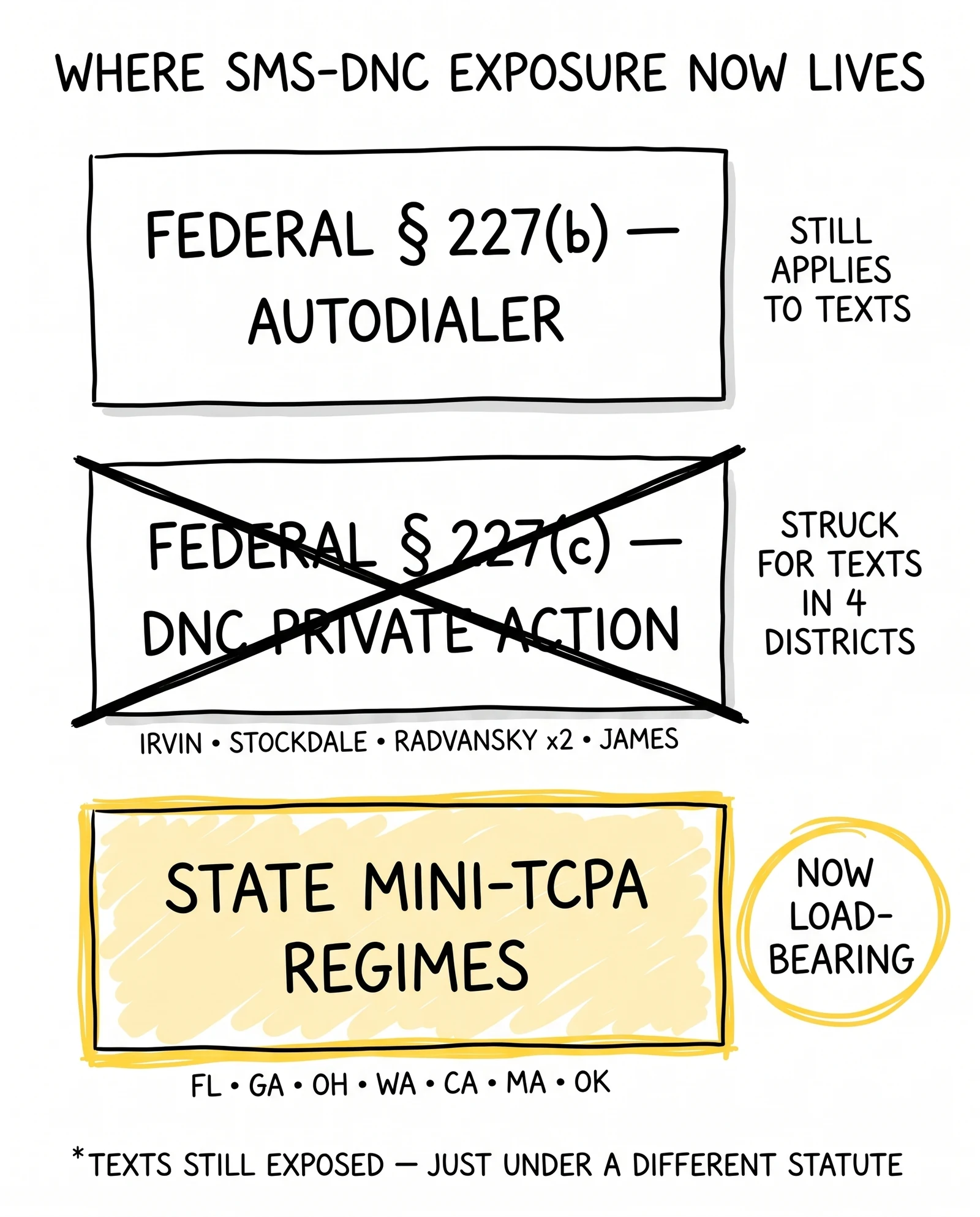
Federal § 227(c) exposure for SMS is shrinking. State-level exposure is not. For operators reading the new doctrinal landscape, the most consequential strategic response is to recognize that state mini-TCPA statutes – which the federal cases do not affect – now carry a higher share of the total SMS compliance exposure than they did in 2025.
Florida Telephone Solicitation Act
Florida’s FTSA, codified at Fla. Stat. § 501.059, is the highest-volume state TCPA-adjacent litigation surface in the country. The statute provides $500 per violation in actual or statutory damages and $1,500 per violation for willful violations, mirroring the federal TCPA structure. FTSA’s coverage of SMS solicitations is explicit in the statute and was not affected by the 2023 Florida legislative reform that narrowed certain other elements of the FTSA cause of action. An operator running an SMS marketing program to Florida-resident consumers – which most national operators do – has full FTSA exposure regardless of the federal § 227(c) doctrinal shift.
The practical implication: a class action that would previously have been brought as a § 227(c)(5) federal class action against a Florida defendant or for conduct directed at Florida residents can now be re-cast as an FTSA class action with substantially the same damages exposure. Plaintiff firms in the FTSA bar – which is well-established and well-resourced – are already pivoting toward FTSA as the primary vehicle for SMS class actions involving Florida-touch conduct.
Oklahoma Telephone Solicitation Act
OTSA, codified at Okla. Stat. tit. 15, § 775C.1, is the second-most-active state mini-TCPA. Its statutory damages framework mirrors FTSA at $500 per violation and $1,500 for willful violations. OTSA includes a two-year written-consent retention requirement that, in practice, has been the most common compliance failure point for class-action defendants. A significant share of OTSA cases settle on the consent-retention question rather than the underlying solicitation question.
For SMS operators, OTSA exposure is meaningful even if the operator’s primary marketing is not Oklahoma-focused. OTSA’s reach extends to any solicitation directed at an Oklahoma resident, which means national SMS programs that include Oklahoma area codes carry OTSA exposure. The two-year retention requirement is the practical compliance challenge: operators must retain prior-express-written-consent records for two years, in a form that demonstrates the consent was obtained for the specific solicitation. That requirement intersects with the operator’s consent documentation retention architecture in ways that most platforms have not fully reconciled.
Maryland Stop the Spam Calls Act of 2023 (SB 90)
Maryland’s SB 90 creates a comprehensive mini-TCPA framework with two distinct compliance pressure points for SMS programs. The first is the call-time window: SB 90 imposes an 8 a.m. to 8 p.m. window on solicitation contacts, which applies to SMS as well as voice. Operators running multi-state SMS programs must integrate Maryland’s window with the broader patchwork of state-by-state call-time restrictions that governs national programs. The second is the prior-express-written-consent requirement and Private Right of Action, which together create FTSA-style class-action exposure for Maryland-touch conduct.
SB 90 took effect in late 2023 and produced its first wave of class actions through 2024-2025. The federal § 227(c) shift makes Maryland’s framework more attractive to plaintiff firms looking for state-law alternatives to the shrinking federal claim.
Other state frameworks
Beyond FTSA, OTSA, and SB 90, the state mini-TCPA landscape includes Washington’s CEMA, Connecticut’s recent statutory amendments, Massachusetts’s evolving framework, and the older Pennsylvania Telemarketer Registration Act. Each carries its own private right of action, its own statutory damages, and its own consent and retention requirements. The cumulative effect is that an operator running a national SMS program faces a compliance surface that is not uniform – and that surface, taken as a whole, is now larger relative to the surviving federal § 227(c) exposure than it was a year ago.
The operator implication: state mini-TCPA compliance becomes the load-bearing layer of SMS compliance architecture. Federal § 227(c) compliance does not disappear – outside the four districts, it continues to operate as before – but its relative weight in the compliance program shifts downward, and the relative weight of state-by-state compliance shifts upward. Operators whose compliance programs are built around a federal-first, state-as-overlay architecture should re-examine that architecture against the new exposure profile.
The Approaches That Will Underperform This Cycle
Three responses to the four-court line are visible in early industry chatter. Each will produce worse outcomes than its proponents expect, and the reasons are worth being explicit about.
The first is the assume-it-gets-reversed posture. The argument runs that the Eleventh Circuit is unlikely to affirm Radvansky, that the cases are statutory-interpretation outliers, and that the right operating posture is to continue running SMS programs under pre-2026 § 227(c) compliance assumptions. The argument has some force on the merits – appellate reversal is a real possibility – but it underestimates the value of the operating window even if reversal eventually comes. Between now and the Eleventh Circuit decision (mid-2027 at earliest), defendants in the four districts have meaningful motion-to-dismiss leverage. Operators who fail to capture that leverage in active litigation are leaving settlement value on the table.
The second is the all-or-nothing posture. Some operators read the four cases as a complete defense to SMS-DNC exposure and conclude that they can deprioritize SMS-DNC compliance generally. The conclusion is wrong on two grounds. First, the cases apply only to the federal § 227(c)(5) private right of action – they do not affect § 227(b), state mini-TCPAs, or FCC enforcement actions. Second, even within the four districts, the holdings dismiss the private right of action without addressing the underlying regulatory prohibition. Operators who treat SMS-DNC compliance as obsolete are creating exposure that cuts across multiple parallel claim vectors. The right posture is selective: capture the dismissal leverage where it exists, while maintaining substantive compliance everywhere else.
The third is the reactive-only posture. This is the response of operators who plan to wait for the Eleventh Circuit decision before changing anything. The problem is that the SMS compliance architecture takes months to redesign, and the operating window in 2026-2027 rewards operators who position now rather than after the appellate outcome. The reactive operator will arrive at the Eleventh Circuit decision either with a compliance architecture that does not fit the new doctrinal landscape (if the decision affirms) or with one that did not capture the operating-window leverage (if the decision reverses). Either outcome is suboptimal versus the operator who adjusts now.
The common pattern across these three approaches is the same: each underestimates the rate at which the litigation market is repricing in response to the four-court line, and each fails to recognize that the doctrinal shift is already producing operational consequences regardless of the appellate timeline.
The Strategic Reframe: Three Principles for the Re-Priced SMS Compliance Architecture
The right response to the four-court line starts from a different premise. SMS-DNC compliance is no longer a single regulatory object governed by a unified federal framework. It is a multi-jurisdictional patchwork in which federal § 227(c) coverage is contested in four districts, untouched in others, and likely to be appellate-resolved on a two-to-four-year timeline. Three principles flow from that premise.
Principle one: separate federal-DNC scrub matches from state-DNC scrub matches
In the legacy compliance architecture, the SMS-scrubbing layer of the operator’s stack treated National Do-Not-Call Registry matches and state-DNC matches as a single compliance object. A number flagged as on the federal DNC was treated as off-limits regardless of the state-law overlay; a number flagged as on a state DNC was treated as off-limits regardless of the federal-law overlay. Functionally, the two flags were merged into a single “DNC” attribute that gated SMS sends.
In the re-priced architecture, that merger is no longer optimal. The federal § 227(c) flag – in the four districts – does not produce a private right of action for SMS. The state-DNC flag (where a state operates its own DNC list, as Florida and several other states do) does. An operator that treats the two flags as a single attribute cannot preserve the operating-window leverage in the four districts. The right architecture separates the two flags, allows the operator’s litigation defense to invoke the federal-only-DNC-match defense in the four districts, and maintains state-DNC compliance everywhere.
This is not a trivial re-vendor. The SMS-scrubbing architecture across federal and state DNCs typically uses a unified gate. Splitting the gate into federal and state components requires schema changes in the consent-record store, in the SMS-send pipeline, and in the litigation-defense documentation flow. The build is a thirty-to-sixty-day engineering effort plus a compliance review. Operators who complete the build before competitors do have a defense posture in the four districts that competitors cannot match.
Principle two: maintain dual-rail consent documentation
The legacy consent architecture documented prior express written consent for SMS as a single record per consumer per program. The federal § 227(b) requirements drove the documentation standard, and state mini-TCPA requirements were treated as an overlay rather than a primary driver.
In the re-priced architecture, the state mini-TCPA requirements become primary. FTSA, OTSA, and SB 90 each have their own consent-language requirements, retention requirements, and audit-trail requirements. An operator running a national SMS program needs consent documentation that satisfies the most stringent of those requirements – which is generally OTSA’s two-year retention with full prior-express-written-consent specificity – rather than the lowest-common-denominator federal § 227(b) standard.
The dual-rail architecture does both: it maintains the federal-standard documentation for § 227(b) defense (which still applies everywhere) and adds the state-standard documentation for state mini-TCPA defense (which is now the dominant exposure surface). The documentation runs in parallel rather than as a single record, and the retrieval logic at litigation time pulls the relevant rail depending on the claim. This is more documentation overhead than the legacy architecture, but the operator-grade consent documentation framework was already moving in this direction for unrelated reasons. The four-court line accelerates the shift.
Principle three: re-tier litigation reserves by jurisdiction
The legacy litigation-reserve methodology applied a single discount rate to expected SMS-DNC exposure across all jurisdictions. The methodology was reasonable when the federal § 227(c) framework was uniform; it is no longer optimal in the post-2026 landscape.
The re-priced reserve methodology applies different discount rates to different jurisdictions. In the four districts that have ruled – and in adjacent districts where the rulings are persuasive – the discount rate steepens substantially because motion-to-dismiss probability is now meaningful. In other federal districts, the discount rate shifts modestly to reflect the cross-district persuasive value of the four rulings. In state mini-TCPA jurisdictions, the discount rate is unchanged (or steepens modestly to reflect plaintiff-firm pivot from federal to state claims). The net effect on aggregate reserves depends on the operator’s exposure profile, but the directional move is to reduce federal-district reserves and increase state-jurisdiction reserves.
For public-company operators, the re-tiering is also a financial-disclosure question. SEC-reporting companies whose TCPA reserves are material to their financial statements need to disclose the doctrinal change and its expected effect on reserves. The disclosure is not optional, and the auditing process around the disclosure can run through the year-end reporting cycle.
The result of the three principles, taken together, is a compliance architecture that is structurally more complex than what most operators run today and that captures the operating-window leverage created by the four-court line. The build is non-trivial. The operators who complete it before the rest of the market catches up will run a settlement-economics advantage of the kind that compounds over multiple litigation cycles.
Implementation Reality: The Ninety-Day Move and the One-Hundred-Eighty-Day Build
The strategic reframe is straightforward. The implementation is not.
The ninety-day move
The most time-sensitive item is the SMS-scrubbing logic. Operators in the four districts who are currently litigating SMS-DNC class actions need defense counsel to invoke the federal-only-DNC-match argument now. That requires the operator’s compliance documentation to support the argument – specifically, documentation showing that the operator’s SMS-send logic was federal-DNC-aware and state-DNC-aware separately. Operators whose documentation merges the two cannot run the defense cleanly.
The ninety-day move is to:
- Audit the SMS-scrubbing vendor’s logic to confirm whether federal and state DNC matches are tracked separately or merged
- Where the matches are merged, request the vendor to produce historical records that disambiguate them retrospectively where possible
- Update the prospective scrubbing logic to track federal and state matches separately on a forward basis
- Brief defense counsel on the documentation that supports the federal-only-DNC-match defense in active litigation
- Identify pending matters where the four-court line creates motion-to-dismiss leverage and instruct counsel accordingly
For most operators, the ninety-day move is an audit and instruction exercise rather than a code build. The code build comes later.
The one-hundred-eighty-day build
The longer build covers the architectural changes:
| Phase | Duration | Key Activities |
|---|---|---|
| Federal/state DNC scrub split | 30–60 days | Schema changes; vendor re-vendor or re-configuration; QA on historical and prospective records |
| Consent documentation re-architecture | 45–90 days | Dual-rail consent capture; OTSA-grade retention; FTSA-specific language; SB 90 window logic |
| Litigation reserve re-tier | 30–45 days | Jurisdiction-specific discount rates; disclosure language for SEC-reporting operators; audit walkthrough |
| Compliance review and counsel sign-off | 14–21 days | External counsel review of new architecture; review of disclosure language |
| Buyer / partner communication | 30–45 days | Communicate architectural changes to lead-buying partners; renegotiate indemnification language where exposure profile shifts |
| Total elapsed time | 5–7 months | Conservative estimate for a national SMS operator without prior dual-rail architecture |
Source: Composite of operator timelines reported through Q1 2026 and litigation-defense counsel guidance
The timeline is achievable for operators who start in Q2 2026. Operators who delay until after the Eleventh Circuit decision will compress the timeline against an appellate-outcome window that itself is only one input into the architecture’s design.
Common obstacles
Three obstacles consistently slow these implementations beyond the nominal timeline.
The first is vendor fragmentation. Most operators use multiple SMS-scrubbing vendors, multiple consent-capture vendors, and multiple message-delivery platforms. Coordinating the architectural change across the vendor stack requires a project-management overhead that operators frequently underestimate. The operators who finish on time are those who designate a single accountable owner for the cross-vendor build.
The second is the documentation gap for historical records. Most operators’ historical SMS-scrub records do not disambiguate federal-DNC matches from state-DNC matches because the legacy architecture merged them. Reconstructing the disambiguation retrospectively is sometimes possible (if the underlying scrub-vendor records preserved the source-flag attribute) and sometimes not (if the records collapsed the attribute at the merge point). Where reconstruction is impossible, the operator’s defense in pending matters is weaker than where it is possible. The audit step in the ninety-day move surfaces this constraint.
The third is the buyer-side communication. Lead-buying partners – particularly insurance carriers, mortgage lenders, and financial-services companies – often have their own indemnification structures that allocate TCPA litigation exposure between the buyer and the lead supplier. The four-court line shifts the underlying exposure profile, which can affect the indemnification calculus. Operators who renegotiate cleanly capture better economic terms; operators who leave the indemnification language unchanged may carry exposure that does not match the new architecture.
The implementation is hard. The operators who complete it before the rest of the market repositions will run a litigation-defense posture that competitors cannot match for at least two years.
Future Implications: The Three-Year Trajectory of TCPA-SMS Litigation
The four-court line is the first event in a multi-year sequence. The shape of the sequence is reasonably predictable from the structure of the doctrinal arc and the litigation market.
In the next twelve months, the line of cases will expand. Additional district courts in the Sixth and Eleventh Circuits will likely engage the question and most will reach the same conclusion. Districts in the Ninth Circuit will engage the question for the first time, with outcomes harder to predict. By Q1 2027, the count of district-court rulings will be in the high single digits or low double digits, with most reaching the no-private-right-of-action conclusion.
In the next eighteen months, the Eleventh Circuit will issue its decision in Radvansky-Kendo. An affirmance produces a binding rule across Florida, Georgia, and Alabama and accelerates the consolidation. A reversal restores the pre-2026 federal default in those districts but does not undo the rulings in the Sixth Circuit, which will continue to operate as persuasive authority in their districts. Either way, by mid-2027, the federal landscape will be clearer than it is today.
In the next twenty-four to thirty-six months, the Supreme Court may take a circuit-split case. The procedural conditions for cert – circuit split, interpretive importance, pending FCC rulemaking – would be present if the Eleventh Circuit affirms and a different circuit reverses. The Court has shown willingness to take TCPA cases (Duguid, McLaughlin) and the underlying statutory-interpretation question is exactly the kind of case it favors. Predicting Supreme Court outcomes is speculative; predicting that the question will reach the Court in some form by 2029 is reasonable.
The longer-term shift is the rebalancing of federal and state TCPA exposure. Even if the four-court line is reversed at every appellate level, the litigation market has now learned that the federal § 227(c) framework can be challenged. Plaintiff firms will continue to develop state mini-TCPA claims as a hedge against federal-claim risk, and defendants will continue to invest in defenses that work across both federal and state frameworks. The TCPA bar of 2029 will be different from the TCPA bar of 2024 regardless of which way the appellate decisions resolve.
For operators, the strategic implication is to design the SMS compliance architecture for a multi-source exposure landscape rather than a single-source one. An architecture that separates federal and state compliance, that maintains dual-rail consent documentation, and that re-tiers litigation reserves by jurisdiction is more durable across the appellate scenarios than an architecture optimized for any single doctrinal outcome.
Key Takeaways
The four-court line – Irvin v. Sonic, Stockdale v. Skymount, both Radvansky decisions, and James v. Smarter Contact – represents the cleanest doctrinal opening for SMS-DNC defendants in a decade and creates immediate operating-window leverage in four federal districts. The line consolidates a textual reading of § 227(c) that Loper Bright and McLaughlin enabled by removing Chevron deference to the FCC’s 2003 text-as-call interpretation.
The operating window is real but bounded. The Eleventh Circuit will hear Radvansky-Kendo on a timeline that points to a mid-2027 decision. Until then, defendants in the four districts have meaningful motion-to-dismiss leverage on § 227(c)(5) claims – but § 227(b) autodialer exposure, FCC enforcement exposure, and state mini-TCPA exposure all survive.
The settlement-economics math is repricing in real time. Cases that would have settled at $4 million to $8 million in 2025 are settling at $1 million to $3 million or being dismissed in early 2026 in the four districts. Public-company operators are recalibrating litigation reserves; plaintiff firms are racing to settle pending matters before the line consolidates further.
State mini-TCPAs become the load-bearing exposure surface as federal § 227(c) shrinks. FTSA’s $500/$1,500-per-violation framework, OTSA’s two-year written-consent retention requirement, and Maryland SB 90’s 8 a.m. to 8 p.m. window plus Private Right of Action together carry a higher share of the total SMS-compliance exposure than they did in 2025. National SMS operators should expect plaintiff-firm pivot toward state-law claims through 2026-2027.
Three approaches will underperform: the assume-it-gets-reversed posture (cedes operating-window leverage), the all-or-nothing posture (creates exposure across parallel claim vectors), and the reactive-only posture (arrives at the appellate decision with the wrong architecture).
The right architecture separates federal-DNC scrub matches from state-DNC scrub matches in the SMS-send pipeline, maintains dual-rail consent documentation that satisfies the most stringent state mini-TCPA standard, and re-tiers litigation reserves by jurisdiction. The build is a five-to-seven-month engineering and compliance effort for a national SMS operator without prior dual-rail infrastructure.
The ninety-day move is to audit SMS-scrubbing logic, brief defense counsel in active litigation on the federal-only-DNC-match defense, and identify pending matters where the four-court line creates motion-to-dismiss leverage. The one-hundred-eighty-day build is the architectural re-vendor across scrubbing, consent documentation, and reserve methodology.
The three-year trajectory points to expansion of the trial-court line through 2026, the Eleventh Circuit decision in mid-2027, a possible Supreme Court resolution by 2029, and a permanent rebalancing of federal and state TCPA exposure regardless of appellate outcomes. Operators who design the SMS compliance architecture for a multi-source exposure landscape will run more durable defenses than operators who optimize for any single doctrinal scenario.
Frequently Asked Questions
What did Irvin v. Sonic actually hold?
The Northern District of Georgia held in Irvin v. Sonic Industries Services, LLC, No. 3:25-cv-00242-LMM, 2026 WL 1098403 (N.D. Ga. Apr. 20, 2026), that the private right of action created by 47 U.S.C. § 227(c)(5) does not extend to text messages. The court read § 227(c)‘s repeated use of “telephone call,” “telephone solicitation,” and “residential telephone subscribers” as limiting the private cause of action to voice-call solicitation, declining to follow the FCC’s 2003 administrative interpretation of “call” as including “text message.” The opinion adopted the reasoning of three prior 2026 rulings – Stockdale v. Skymount, Radvansky v. 1-800-Flowers.com, and Radvansky v. Kendo Holdings – and added Sonic’s case as the fourth published decision in the line within three months. The ruling does not affect § 227(b) autodialer claims, state mini-TCPA claims, or FCC enforcement actions; it specifically forecloses the federal § 227(c)(5) private cause of action for SMS recipients in that district.
Why is this happening now and not five years ago?
The doctrinal pieces required for this line of cases came into place sequentially. Loper Bright Enterprises v. Raimondo, 144 S. Ct. 2244 (2024), overruled Chevron and removed agency-interpretation deference. McLaughlin Chiropractic Associates v. McKesson Corp., 145 S. Ct. 2006 (2025), confirmed that federal district courts owe no deference to FCC orders interpreting the TCPA. Together, those rulings removed the administrative-law obstacles to district-court reinterpretation of § 227(c). Before Loper Bright, district courts were generally bound by the FCC’s 2003 interpretation under Chevron. After McLaughlin, the deference question is closed – district courts read the statute independently. The 2026 line of cases is the first wave of district courts taking up the textual argument seriously after the doctrinal pieces fell into place.
Does this affect § 227(b) autodialer claims?
No. The four cases address only § 227(c)(5)‘s private right of action for Do-Not-Call Registry violations. Section 227(b), the autodialer provision, prohibits any call (including text messages, under uncontested precedent) made using an automatic telephone dialing system or artificial/prerecorded voice to a cell phone without prior express consent. Section 227(b) uses broader language than § 227(c) and the courts in the 2026 line of cases have been explicit that their § 227(c) holdings do not affect § 227(b) liability. An operator running unconsented automated texts to cell phones still has full § 227(b) exposure – including statutory damages of $500 to $1,500 per text – and the statutory autodialer-definition fight after Facebook v. Duguid, 141 S. Ct. 1163 (2021), continues to operate as the primary defense vector for § 227(b) claims.
What is the Eleventh Circuit going to decide and when?
The Radvansky v. Kendo Holdings appeal is the case most likely to convert the trial-court line into a binding appellate rule. The legal question on appeal is whether § 227(c)(5)‘s private right of action extends to text messages after Loper Bright and McLaughlin. An affirmance would make the no-private-right-of-action rule binding on every federal district court in Florida, Georgia, and Alabama. A reversal would resurrect the pre-2026 rule in those districts. A circuit split – Eleventh Circuit affirming while another circuit disagrees – would set up Supreme Court review. Best-estimate timeline: oral argument in late 2026, decision in mid-2027. Predictions on the merits are speculative; the Eleventh Circuit’s recent TCPA jurisprudence has trended toward narrower readings of consumer-protection provisions, but panel composition and amicus briefing will matter.
How does this affect the $6.6 million average TCPA settlement?
The five-district line of cases changes settlement-economics math for SMS-DNC claims in three ways. Defendants in the four districts can now move to dismiss § 227(c)(5) claims on the pleadings with meaningful probability of success, changing the value of the case at every settlement stage. Surviving § 227(b) claims have a higher pleading burden and a narrower scope after Duguid, foreclosing some defendants’ exposure entirely. Settlement reserves are recalibrating in real time, with cases that would have settled at $4 million to $8 million in 2025 settling at $1 million to $3 million or being dismissed outright in early 2026. The aggregate effect on the industry-wide $6.6 million average settlement depends on how the line of cases consolidates, but the directional move is downward in the four districts and stable-to-modestly-downward elsewhere as plaintiff firms reprice expected outcomes.
What about state mini-TCPA exposure?
State mini-TCPA exposure is unaffected by the federal § 227(c) line of cases. FTSA, OTSA, Maryland SB 90, and the other state frameworks each have their own private rights of action and continue to operate as they did before 2026. The practical effect of the federal shift is that plaintiff firms are pivoting toward state-law claims as a hedge against federal-claim risk, which means national SMS operators face higher state-jurisdiction exposure relative to federal exposure in 2026-2027 than they did in 2025. FTSA at $500/$1,500 per violation, OTSA’s two-year written-consent retention requirement, and Maryland SB 90’s 8 a.m. to 8 p.m. window plus PRA are now the load-bearing exposure surface for SMS programs that touch those states’ residents. The operator-grade DNC compliance framework needs to weight these state requirements more heavily than the federal-overlay framing of pre-2026 architectures.
Should an operator change its SMS-DNC scrubbing logic now?
Yes – selectively. The most time-sensitive change is to ensure that the SMS-scrubbing vendor tracks federal-DNC matches separately from state-DNC matches, rather than merging them into a single attribute. The merge architecture cannot support the federal-only-DNC-match defense in the four districts, even where that defense is available on the merits. Operators should audit their scrubbing vendor’s logic now, request retrospective disambiguation of historical records where possible, and update prospective logic to maintain the separation. The audit and update is a thirty-to-sixty-day engineering effort. Operators in active SMS-DNC litigation in the four districts should also brief defense counsel on the federal-only-DNC-match argument and instruct counsel to invoke it in motion practice. The detailed operator guide to federal and state DNC scrubbing walks through the architectural options.
How do class-action and individual TCPA claim postures shift?
The four-court line affects class-action postures more than individual-claim postures. Class actions under § 227(c)(5) typically aggregate hundreds or thousands of named-plaintiff text recipients, and the dismissal of the underlying claim eliminates the class. Individual claims under § 227(c)(5) face the same dismissal in the four districts, but the per-claim economics are different – a single plaintiff seeking $1,500 in willful damages does not produce the same defense-leverage dynamic as a class with aggregate exposure in the millions. The class-action versus individual claim posture analysis in TCPA litigation is shifting in real time as plaintiff firms reassess which claims to bring and which to settle. Operators with active class-action exposure in the four districts have the strongest immediate leverage; operators with primarily individual-claim exposure have a smaller but non-trivial benefit.
What about arbitration clauses?
Arbitration clauses continue to operate as a separate defense layer that is not directly affected by the § 227(c) doctrinal shift. An operator whose SMS sign-up flow includes a mandatory arbitration clause with a class-action waiver can still invoke that clause to compel individual arbitration of TCPA claims, regardless of whether the underlying claim survives the four-court line. The interaction between the doctrinal shift and arbitration is that the shift reduces the value of the underlying claim, which can affect the arbitration-cost calculus for plaintiff firms. The arbitration clauses as TCPA protection framework remains available regardless of the § 227(c) doctrinal trajectory, and operators who have not implemented arbitration architecture should consider it as a complementary defense layer rather than a substitute for the federal-DNC-match logic.
What does the FCC’s “Delete, Delete, Delete” posture mean for this?
The FCC’s deregulatory posture under its 2025-2026 chair reduces the probability of administrative pushback against the four-court line. The FCC has signaled openness to revisiting the 2003 text-as-call interpretation but has not formally repudiated it. In a different administrative environment, the FCC might have re-promulgated the 2003 interpretation through formal rulemaking – restoring its persuasive weight under post-Loper Bright frameworks like Skidmore deference. The current FCC is unlikely to do that. The practical effect is that the line of cases is more likely to consolidate without administrative counter-pressure than under a more interventionist FCC. The “Delete, Delete, Delete” posture also signals broader rollback of expansive TCPA-adjacent interpretations, which is a separate but related operating-environment shift.
Does this affect the one-to-one consent rule?
The one-to-one consent rule – the FCC’s 2024 requirement that prior express written consent must be specific to a single seller rather than aggregated across multiple sellers – is a separate regulatory question from the § 227(c) text-coverage question. The four-court line does not directly affect the one-to-one rule. However, both questions are being reconsidered in the broader doctrinal environment created by Loper Bright and McLaughlin, and the FCC’s “Delete, Delete, Delete” posture has signaled potential rollback of the one-to-one rule alongside reconsideration of the text-as-call interpretation. Operators tracking the doctrinal landscape should expect both questions to evolve in parallel through 2026-2027, with the one-to-one rule’s resolution likely coming through FCC rulemaking action and the § 227(c) text-coverage resolution coming through appellate litigation.
What is the Monday move for an SMS operator reading this article?
The Monday move is an audit. Specifically: ask the SMS-scrubbing vendor whether the platform tracks federal-DNC matches separately from state-DNC matches. If the answer is no, instruct the vendor to update the architecture to track them separately on a prospective basis and to disambiguate historical records where possible. If active SMS-DNC litigation is pending in the Northern District of Georgia, the Northern District of Ohio, or the Middle District of Florida, brief defense counsel on the federal-only-DNC-match defense and instruct counsel to invoke it in motion practice. If the operator’s litigation reserves are material to financial reporting, raise the doctrinal shift with finance and audit counsel for the next reporting cycle. None of these moves require the appellate outcome to be known. They are operating-window moves that capture the leverage created by the four-court line on a near-term timeline.
Sources
Tier 1: Primary Court Decisions and Statutory Authority
-
Irvin v. Sonic Industries Services, LLC, No. 3:25-cv-00242-LMM, 2026 WL 1098403 (N.D. Ga. Apr. 20, 2026)
-
Stockdale v. Skymount Property Group, 2026 WL 591842 (N.D. Ohio Mar. 3, 2026)
2a. Justia, Stockdale v. Skymount Property Group, LLC et al., No. 1:25-cv-01282 (N.D. Ohio), Document 29 – Memorandum of Opinion and Order granting Motion to Dismiss (Judge Patricia A. Gaughan, March 3, 2026), accessed April 2026 – https://law.justia.com/cases/federal/district-courts/ohio/ohndce/1:2025cv01282/318524/29/
-
Radvansky v. 1-800-Flowers.com, 2026 WL 456919 (N.D. Ga. Feb. 17, 2026)
-
Radvansky v. Kendo Holdings, (N.D. Ga. Feb. 12, 2026), on appeal to 11th Cir.
-
James v. Smarter Contact, LLC, 2026 WL 879244 (M.D. Fla. Mar. 31, 2026)
-
Loper Bright Enterprises v. Raimondo, 144 S. Ct. 2244 (2024)
-
McLaughlin Chiropractic Associates v. McKesson Corp., 145 S. Ct. 2006 (2025)
-
Facebook, Inc. v. Duguid, 141 S. Ct. 1163 (2021)
-
47 U.S.C. § 227(c) – Telephone Consumer Protection Act, Protection of Subscriber Privacy Rights
-
47 U.S.C. § 227(b) – Telephone Consumer Protection Act, Restrictions on the Use of Automated Telephone Equipment
-
Fla. Stat. § 501.059 – Florida Telephone Solicitation Act (FTSA)
-
Okla. Stat. tit. 15, § 775C.1 – Oklahoma Telephone Solicitation Act (OTSA)
-
Maryland Stop the Spam Calls Act of 2023 (SB 90)
Tier 2: Established TCPA Practitioner Coverage
-
TCPA Blog, “Courts in Eleventh Circuit Find No Private Right of Action Under 227(c) for Texts,” 2026 – https://tcpablog.com/2026/courts-in-eleventh-circuit-find-no-private-right-of-action-under-227c-for-texts/
-
National Law Review, “Texts Not Calls – Another Georgia District Court Finds Section 227(c) Does Not Apply,” 2026 – https://natlawreview.com/article/texts-not-calls-another-georgia-district-court-finds-section-227c-does-not-apply
-
Kelley Drye, “TCPA Tracker – March-April 2026,” 2026 – https://www.kelleydrye.com/viewpoints/newsletters/tcpa-tracker/tcpa-tracker-march-april-2026
-
Greenspoon Marder LLP (GMLaw), “Federal Court Says TCPA’s Do-Not-Call Provision Does Not Cover Texts,” 2026 – https://www.gmlaw.com/news/federal-court-says-tcpas-do-not-call-provision-does-not-cover-texts/
Tier 3: Industry and Vendor Statements
-
Federal Communications Commission, Report and Order, In the Matter of Rules and Regulations Implementing the Telephone Consumer Protection Act of 1991, 18 FCC Rcd 14014 (2003)
-
Federal Communications Commission, “Delete, Delete, Delete” NPRM materials, 2025-2026
-
Federal Trade Commission and Federal Communications Commission, National Do-Not-Call Registry program documentation
Tier 4: Supporting Industry Commentary
-
WebRecon LLC, TCPA Class Action Filing Statistics, 2025 – annual report citing 1,807 TCPA class actions filed through October 2025
-
ISO Claim Search and TCPA settlement-tracking publications, 2024-2025 – composite data on $6.6 million average settlement value for resolved TCPA class actions
Closing
The four-court line will be remembered for the wrong reason. The headlines have framed it as a defendant-friendly statutory-interpretation outlier or as a temporary doctrinal accident waiting to be reversed on appeal. That framing misses what actually happened. The structural event is the rebalancing of federal and state TCPA exposure that follows from removing administrative-law deference to a twenty-three-year-old FCC interpretation, and the operational event is the immediate motion-to-dismiss leverage in four federal districts that will not wait for the Eleventh Circuit to speak. SMS operators who treat the line as a temporary anomaly will spend 2026-2027 paying settlements that operators in the same districts no longer pay. SMS operators who treat the line as a compliance-architecture reset – separating federal-DNC scrub matches from state-DNC matches, building dual-rail consent documentation, re-tiering litigation reserves by jurisdiction – will run a defense posture that competitors cannot match through the appellate cycle. The decision about which group to be in is being made now, in the next ninety days of audits and the next one hundred and eighty days of build. There is no comfortable third option.
Court rulings, regulatory developments, and TCPA litigation statistics reflect publicly reported conditions through April 28, 2026. The doctrinal landscape is in active development; the Eleventh Circuit appeal in Radvansky v. Kendo Holdings, additional district-court rulings, and FCC rulemaking developments will continue to shape the operating environment. This article provides general industry analysis and does not constitute legal advice. Consult qualified TCPA counsel for specific compliance questions related to SMS-DNC scrubbing, multi-jurisdictional consent architecture, litigation reserves, or active matters in the four federal districts.