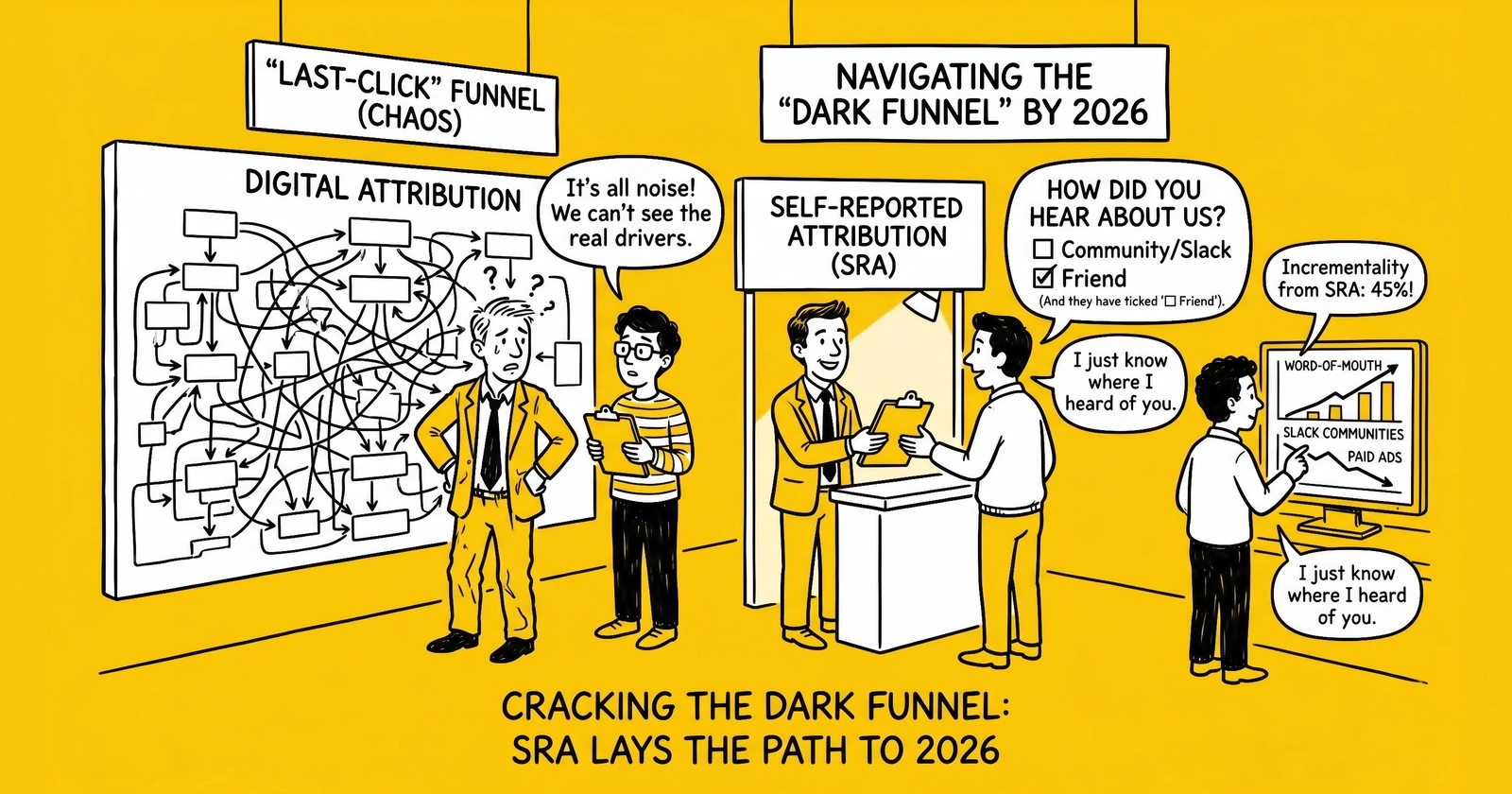
Multi-touch attribution survived the cookieless transition by accident; what finally retires it is a single quarter of measurement data that nobody disputes.
January 20, 2026 – The Day Someone Named the Problem
Jeff Pedowitz published The Death of Marketing Attribution and What Replaces It on the Pedowitz Group blog on January 20, 2026. The post did not contain a finding nobody had observed. It contained the first dated, named, citable thesis that the measurement establishment had structurally broken, and it pulled together the dispersed evidence into a single argument. Within ten weeks the manifesto appeared in attribution coverage from Dreamdata, HockeyStack, Geisheker, Similarweb, and a dozen smaller analyst voices. Forrester’s April 27 GTM Singularity report referenced the underlying shift without naming Pedowitz; Haus’s May 19 measurement-trust survey took the practitioner-side temperature; Google Marketing Live’s May 20 announcement closed the technical loop. Anyone watching the trade-press timeline could date the multi-touch attribution category to its last quarter.
Chris Walker had been arguing the same conclusion publicly since 2022, first from Refine Labs and after 2024 from Passetto, but the dated 2026 manifesto belongs to Pedowitz. That detail matters because the industry’s reflex when citing the manifesto has been to attribute it to Walker – a misattribution worth correcting before it ossifies. Walker is the long-time co-traveler. Pedowitz is the author of the January 20 post.
The lead-generation translation arrives with a sharper edge than the SaaS B2B framing the manifesto used. Every cost-per-lead benchmark, every earnings-per-lead bid floor, every buyer-waterfall ranking in ping-post depends on attribution. When the attribution is, per the data Refine Labs has been publishing since October 2024, wrong by an order of magnitude in specific channel categories, every CPL conversation downstream of it inherits the error. The article that follows walks through what the data actually says, what is replacing the multi-touch stack, and where lead-gen operators sit inside the rebuild.
What Refine Labs Actually Found – And Why The Gap Persists
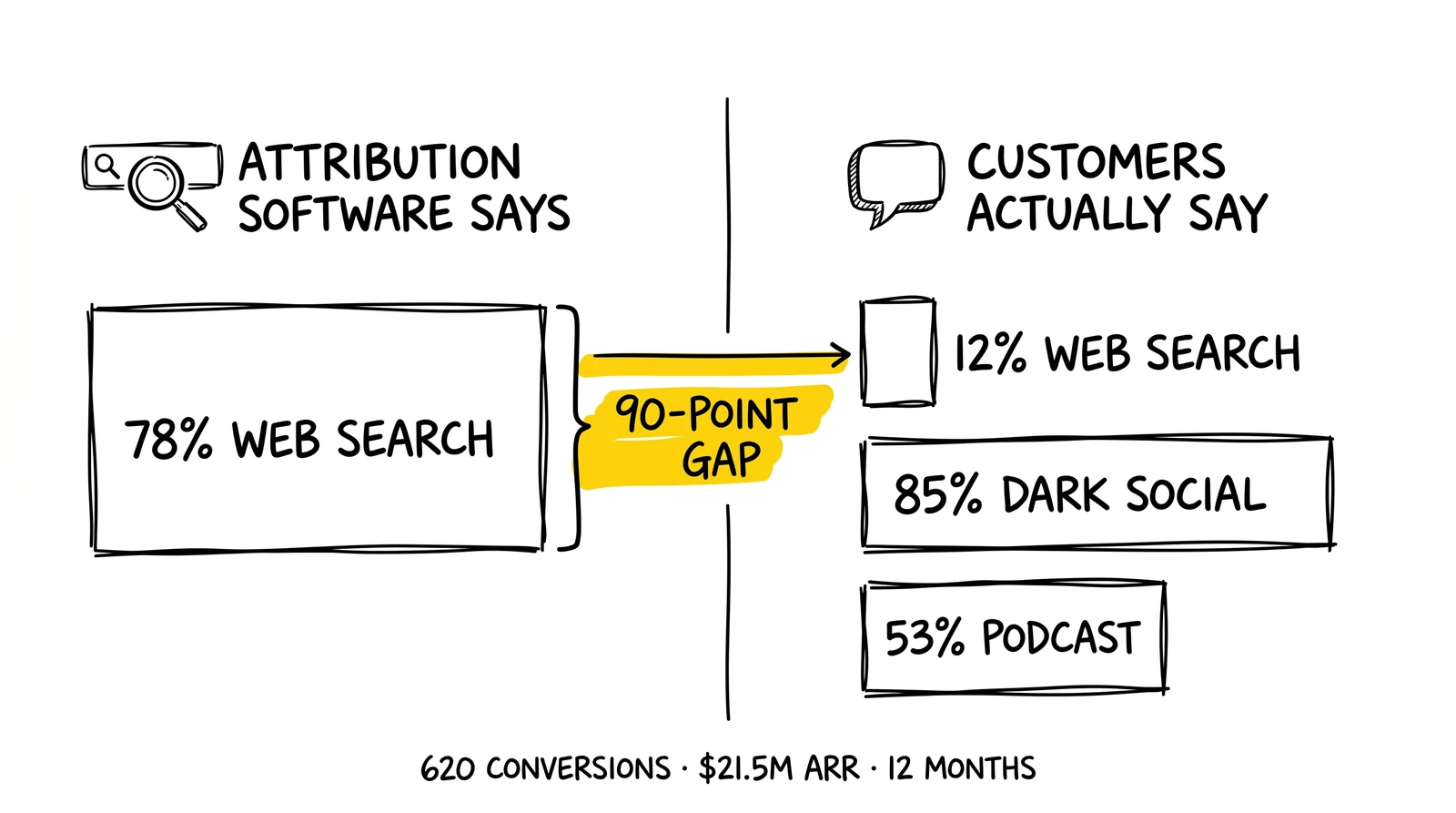
The most-cited 2026 evidence base predates the Pedowitz manifesto. Refine Labs published The Attribution Mirage on October 15, 2024, drawn from a 12-month observation window covering 620 converted customers and $21.5 million in annual recurring revenue. The methodology paired deterministic attribution software output against a structured customer-side self-report survey administered after conversion. The discrepancies were not small.
Refine Labs’ attribution software, configured per vendor defaults, identified web search as the source of 78 percent of converted customers. The same customers, asked directly, attributed only 12 percent of their journeys to web search. The headline gap is a 90-percentage-point measurement error against a single channel.
The pattern repeated across channels. Podcast attribution showed 53 percent self-reported contribution against effectively zero software contribution – deterministic tracking cannot capture a podcast listen because the listen does not produce a captured click. Eighty-five percent of all converted customers self-reported dark social as a meaningful touch on their path to purchase. The category includes Slack direct messages, WhatsApp group chats, peer-to-peer email forwards, podcast in-show mentions, conference hallway conversations, and increasingly AI-search summaries that surface a brand without producing a referrer.
Gartner’s research on B2B journey completion frames the same point at a higher altitude. Seventy to eighty percent of B2B buying activity occurs before the buyer engages with a vendor sales rep. The attribution stack was designed to measure the last 20 to 30 percent – the portion of the journey that touches an instrumented channel. The first 70 to 80 percent has always been dark; the cookieless transition merely revealed how much of even the back half of the funnel was being inferred rather than observed.
The structural reason the gap persists is mechanical. Deterministic tracking requires that the conversion event be tied back to a captured identifier – a third-party cookie, a click ID, a first-party login event, or an authenticated session. Cookie-less environments lose third-party identifiers by definition. iOS App Tracking Transparency stopped MAID matching at the consent gate four years ago, with global opt-in rates stuck near 25 percent across the period. Meta disclosed in its Q4 2021 earnings call that ATT cost the company $10 billion in 2022 revenue, a number that has only grown as Apple expanded the framework. Google’s April 22, 2025 announcement that Chrome would adopt a user-choice rather than a hard-deprecation model for third-party cookies did not restore the deterministic stack – it left individual sites to negotiate with each browser session.
For lead-generation operators, the implication compounds across two dimensions. First, the share of buyer activity the attribution stack cannot see has grown; second, the share it can see arrives stripped of the cross-domain identifiers that historically connected upstream awareness to downstream conversion. A 2024 multi-touch model fed by 2026 signal produces outputs that look the same on the dashboard but are systematically wrong.
The Pedowitz manifesto did not break the multi-touch stack. It named the break that the underlying measurement data had already documented.
The 6sense Day-1 Shortlist Data – Why Out-Of-Shortlist Spend Is Sunk Cost
6sense published the 2025 Buyer Experience Report on November 12, 2025, drawing on intent data across the platform’s customer base. Three findings reframe the lead-generation budget allocation conversation.
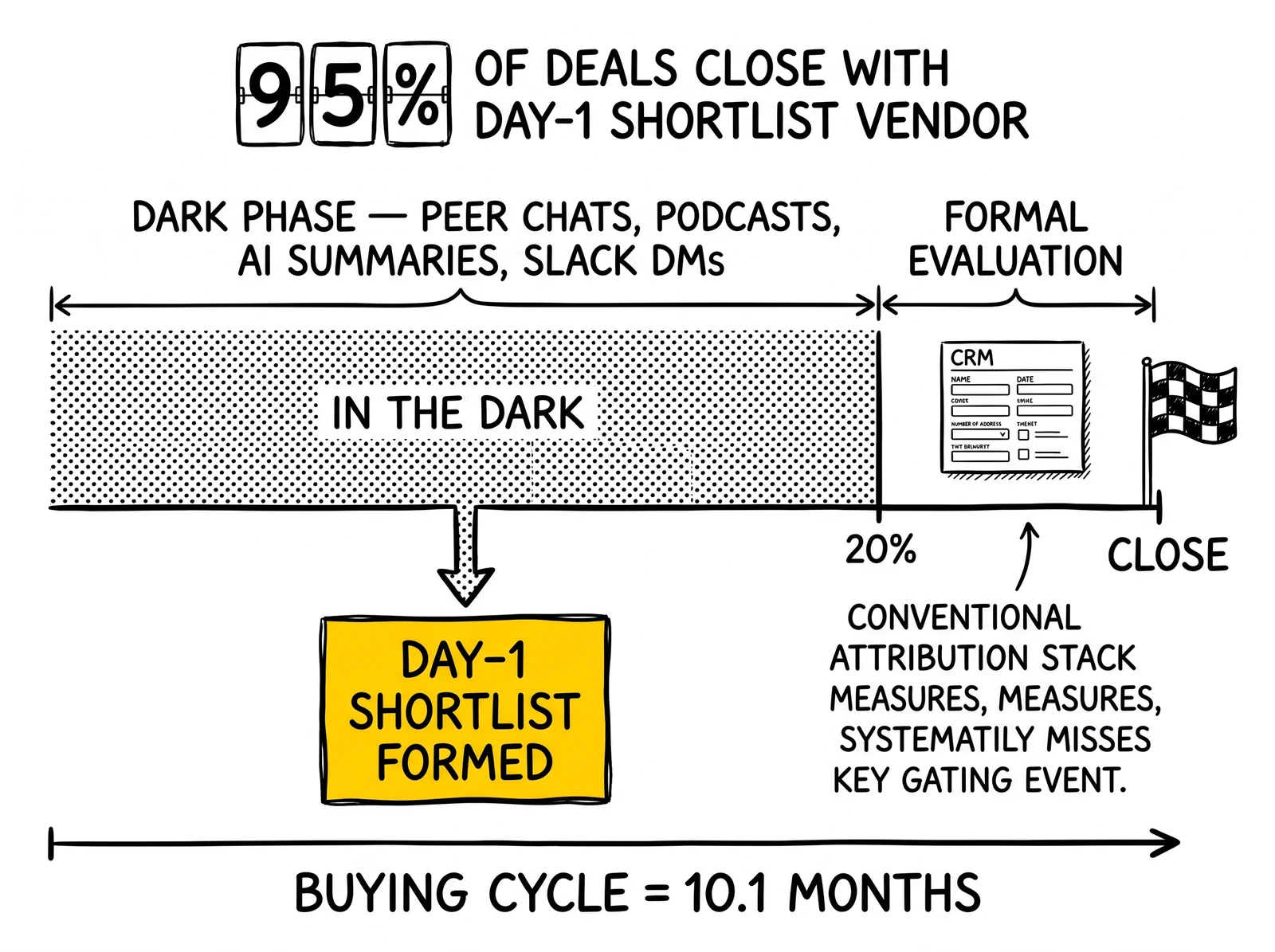
Sixty percent of B2B buying journeys are, by 6sense’s tracking, “in the dark” – buyers research vendors without revealing themselves on instrumented surfaces. The average buying cycle has compressed to 10.1 months, down from 11.3 in the prior year. And the dispositive finding: 95 percent of B2B deals close with vendors that were already on the buyer’s shortlist when formal evaluation began.
The implication for lead-gen budget allocation runs deep. If 95 percent of deals close from a pre-formed shortlist, every dollar spent acquiring net-new attention from accounts that lack any prior brand consideration has a statistical ceiling of roughly five percent of closed-won revenue. The math holds across volume scale – adding more out-of-shortlist impressions, clicks, or form fills does not change the underlying conversion ceiling, because the gating event is shortlist inclusion, which happens months earlier and inside channels the lead-gen stack cannot directly buy.
The analytical reframe is uncomfortable for performance-marketing teams that have measured the wrong endpoint. Optimization against cost-per-lead inside a buying-cycle window of three months systematically misallocates against a 10.1-month buying-cycle reality. The optimization metric and the buyer’s actual decision cadence are running on different clocks.
For lead-gen aggregators specifically, the 6sense finding sets a separate problem. An aggregator-sourced lead carries near-zero shortlist information. The aggregator does not know whether the buyer’s name was on the lender’s, carrier’s, or installer’s mental shortlist before the comparison-site form fired. The buyer-side waterfall accepting the lead therefore cannot rank submissions by shortlist position – only by surrogate signals that approximate it. The structural advantage shifts toward owned-brand acquisition, where the buyer knows the lead because the brand built awareness directly.
The compressed buying cycle also reshapes urgency. A 10.1-month average means many buyers complete the dark phase well before they touch any tracked surface. The conversion event when it arrives is the result of months of unobserved evaluation. The marketing organization’s lever in that environment is not the conversion event but the conditions that put the brand on the Day-1 shortlist eleven months earlier – which is a brand-awareness lever, not a performance-marketing lever, and which the conventional attribution stack systematically undervalues because it never sees the originating touch.
The 6sense finding lands on the lead-gen economy with a different vector than it lands on enterprise software. The performance-marketing dollar still works, but its job description has changed. It must reinforce shortlist position for accounts already aware; it cannot create shortlist position de novo at scale, no matter how aggressively the bid ladder rises.
What Is Replacing Multi-Touch – The 2026 Attribution Stack
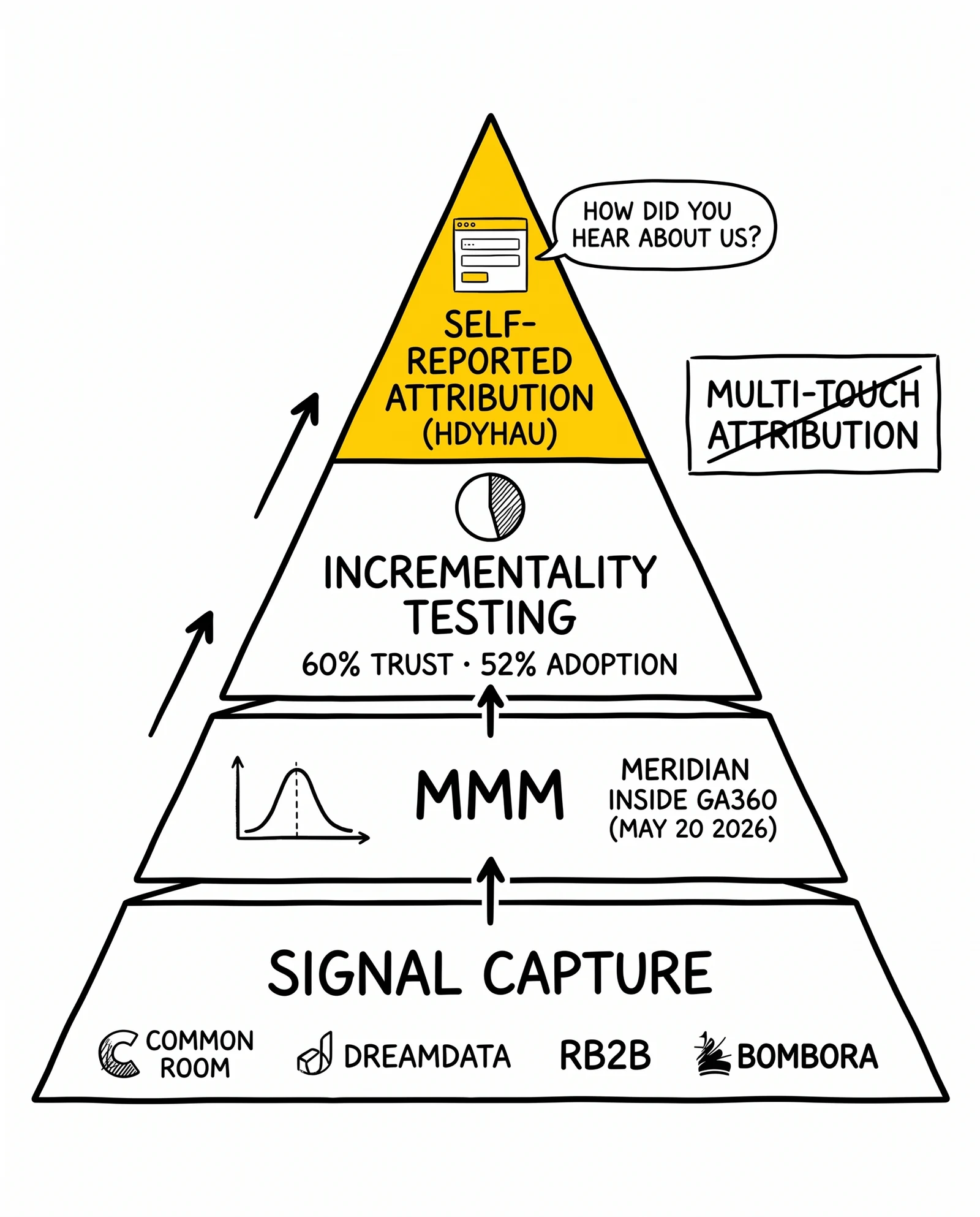
The 2026 replacement is not a single tool. It is a four-part stack, each component well-documented and each addressing a specific failure mode of multi-touch.
The first component is self-reported attribution, also called HDYHAU after the question it asks: How Did You Hear About Us. Recast formalized the modern HDYHAU framework on May 31, 2023, treating it as a primary methodology rather than a secondary signal. The implementation is computationally trivial – a single open-text field on the post-conversion thank-you page or in the first onboarding email. Refine Labs’ validation work showed that a hybrid model combining deterministic attribution with HDYHAU survey data recovers 70 percent or more of the channel attribution signal the deterministic-only model misses. The marginal cost of implementation is, effectively, zero. The instrumentation is a form field.
The second component is incrementality testing. eMarketer and TransUnion’s July 2025 joint survey found 52 percent of US marketers now use incrementality testing – a category that was negligible five years ago and that has consolidated as the most-trusted measurement method in the practitioner cohort. Haus published May 19, 2026 research showing 60 percent of marketers most-trust incrementality, against 40 percent for media mix modeling and 37 percent for in-platform attribution. The methodology – comparing converted outcomes between an exposed cohort and a withheld holdout – produces causal claims the correlation-based stack cannot match. Recast launched the GeoLift incrementality product on a September 2025 timeline. Geographic holdout tests, withheld-segment experiments, and ghost-bid auctions are now standard performance-team instruments in the same way A/B tests became standard a decade ago.
The third component is media mix modeling. eMarketer reported on October 17, 2025 that 46.9 percent of US marketers plan to invest in MMM in the next 12 months. Google open-sourced its Meridian Bayesian MMM framework on January 29, 2025; the Scenario Planner add-on launched on February 19, 2026; and at Google Marketing Live on May 20, 2026 the company announced Meridian’s integration into GA360 alongside Qualified Future Conversions. The structural significance of the GA360 integration is that Bayesian MMM was previously a vendor-budget conversation at the $50,000-per-month-and-up tier – Recast, Mass Analytics, and equivalents had captured the mid-market. Meridian inside GA360 means lead-generation buyers running at mid-market scale now have an accessible MMM inside the analytics they already pay for, eliminating a previously meaningful vendor line item and democratizing the technique.
The fourth component is signal capture. Common Room launched its Signal Platform on April 11, 2024 and shipped the RoomieAI generative copilot later that year. Dreamdata maintains an updated dark-funnel resource refreshed through March 2026. The category extends to RB2B-style person-level visitor identification, third-party intent data from Bombora and 6sense, and the emerging deanonymization stack that the Adobe AI traffic conversion data suggests will only intensify as AI-referred traffic shifts the mix of identifiable visits. Signal capture is the only component that requires meaningful operational investment, because it depends on integrating multiple data sources into a unified actionable layer.
What is notably absent from the 2026 replacement stack is deterministic multi-touch. The 2026 IAB State of Data Outlook finding that 75 percent of buy-side respondents say their attribution stack is underperforming is the practitioner-side confirmation that the analytical case against MTA has finally translated into operational displacement. The technique persists in dashboards because the platforms that sell it have not retired the feature, not because the practitioners using it consider the output reliable.
The Lead-Gen Aggregator Self-Attribution Gap
The dark-funnel shift rewards owned-brand acquisition and punishes pure-play aggregators in a structural way the broader B2B coverage has not analyzed. The mechanism is direct: a pay-per-lead aggregator buyer cannot run HDYHAU because the buyer has no relationship with the lead pre-conversion. The lead arrived through a comparison-site form. The buyer has neither the permission nor the operational opportunity to survey the lead about how the lead discovered the buyer’s brand – the lead did not discover the buyer’s brand; the lead discovered a comparison site, and the buyer purchased the resulting submission.
The economic implication compounds across two distinct timeframes. In the short term, lead-gen buyers running owned-brand acquisition alongside aggregator-sourced acquisition will see the self-reported attribution data point sharply favor the owned-brand cohort, simply because the data is collectible only on that side. In the medium term, the data asymmetry shifts CFO-level conversations toward owned-brand budget reallocation. Aggregator buyers who never modeled the attribution gap into their unit economics will face budget defense problems against a category that produces measurably-richer data signal.
The aggregator-side response options exist but are narrower. Pure-play ping-post operators can develop shortlist-score surrogates – brand-search ratio per submitted lead, repeat-visitor identification across the consent-capture stack, third-party intent overlays via Bombora or 6sense – that approximate where the lead sat on the buyer’s Day-1 shortlist. The surrogate signals do not replace direct HDYHAU data, but they recover a portion of the measurement gap. Whether the surrogate stack justifies its operational cost depends on the buyer-side procurement maturity. Aggregators selling into MediaAlpha-style enterprise carriers face a higher buyer-side data-literacy bar than aggregators selling into long-tail brokers.
A second option is to negotiate downstream attribution access as a contractual term. Some buyer waterfalls already share conversion metadata back to the originating aggregator on a delayed basis to support quality control. Extending the delayed-feedback loop to include HDYHAU-style attribution data would let aggregators improve traffic-quality routing over time. The practical obstacle is buyer reluctance – sharing the attribution data exposes the buyer’s own demand-generation gaps and creates negotiating leverage for the aggregator on subsequent pricing.
The cross-link to existing site coverage is the exclusive-versus-shared leads economics framework, which already explored how exclusive leads price at a premium because the conversion data flows back cleanly. The 2026 dark-funnel shift extends that premium logic to attribution clarity more broadly. Exclusive-lead structures preserve more of the attribution signal because only one buyer touches the converted lead.
The summary verdict is analytical inference rather than reported fact, but the directional logic is hard to contest. The 2026 attribution shift is structurally net-bullish for owned-brand acquisition and net-bearish for pure-play aggregators that cannot survey their downstream conversions. The exact CPL impact varies by vertical, by buyer sophistication, and by the aggregator’s ability to develop shortlist-score surrogates fast enough to keep pace with buyer data expectations.
TCPA Plus HDYHAU – The Double-Duty Form Field
The lead-generation-economy frame surfaces an insight the broader attribution coverage misses. The same open-text HDYHAU field that captures self-reported attribution also strengthens TCPA consent documentation when stored alongside the consent timestamp. Under TCPA jurisprudence the buyer must demonstrate that consent was free, informed, and traceable. A customer-volunteered phrase such as “I heard about you on the Acquired podcast” attached to the consent record provides documentary depth the consent capture alone does not produce.
The Sixth Circuit’s January 26, 2026 ruling in Dahdah v. Rocket Mortgage elevated form architecture to the load-bearing element of TCPA arbitration defense. The four-factor conspicuousness test – notice placement, button proximity, visual conspicuousness, dynamic scrolling – already shifted the engineering accountability for compliance toward the form-design surface. A post-conversion HDYHAU field stored with the consent metadata extends that defense surface without adding friction at the conversion event.
The implementation discipline matters. The HDYHAU field must be optional, must sit on the post-conversion screen rather than the conversion form itself, must accept open-text input without controlled-vocabulary forcing, and must be stored with a timestamp aligned to the consent record. Pre-conversion HDYHAU fields hurt form conversion rate by 8 to 15 percent in vendor-side optimization data; post-conversion HDYHAU fields capture roughly 35 to 55 percent of converted users, with no measurable upstream conversion impact. The structural arithmetic favors post-conversion placement.
Most lead-generation operations have not implemented HDYHAU as a TCPA-hardening play. The combined attribution-plus-compliance value sits on the table because the engineering team owning consent capture and the marketing team owning attribution rarely talk to each other about the same form. The opportunity is concrete: a single optional post-conversion text field, stored in the consent log, recovers attribution signal the multi-touch stack cannot capture and hardens TCPA documentation the consent record alone leaves thin.
The cross-link to TCPA consent capture protocols covers the regulatory mechanics. The 2026 attribution conversation simply adds the second use case for the same field.
Meridian-In-GA360 Reshapes Mid-Market Lead-Gen Vendor Budgets
The May 20, 2026 announcement that Google Meridian’s Bayesian MMM moved inside GA360 alongside Qualified Future Conversions is the single most consequential vendor-budget event in the 2026 attribution reset. Until that announcement, Bayesian MMM was a vendor-budget conversation that mid-market lead-generation buyers could not realistically enter. Recast started at $50,000 per month for serious deployments; Mass Analytics, OAK, and the consulting-led MMM shops priced higher. The accessible-MMM tier was effectively non-existent.
Meridian inside GA360 changes that calculus. GA360 is already paid for by mid-market lead-gen operations running at scale – the analytics platform that surfaces channel performance, conversion paths, and audience composition. Adding Bayesian MMM to that surface, at no incremental cost beyond the existing GA360 subscription, removes the vendor budget question that had previously kept mid-market operators dependent on in-platform attribution they did not fully trust.
The strategic implication for vendor selection runs two directions. First, lead-gen vendors that priced themselves against the absence of accessible MMM face renewed price pressure. Buyers running Meridian holdouts will surface incrementality data the vendor-side measurement narrative cannot reconcile. Second, the broader vendor cohort selling against Facebook and Google for paid acquisition cannot survive incrementality testing the way performance brands can. The same lift testing that legitimizes brand-building spend exposes lead-gen vendors as zero-incremental in many configurations.
The pattern in Haus’s May 19, 2026 trust data confirms the direction. Sixty percent of marketers most-trust incrementality testing. That trust translates into vendor-selection criteria. Lead-gen vendors that cannot demonstrate incremental contribution against a controlled holdout face a vendor-selection bar most cannot meet, particularly in channels where the vendor’s primary value proposition was reach or volume rather than causal lift.
The Forrester research that anchored the GTM Singularity pre-funnel demand analysis projected a 20 to 30 percent pre-funnel demand contraction as AI-search intercepts buyer research. Meridian inside GA360 surfaces that contraction at the vendor-by-vendor level for the first time. The vendors that cannot demonstrate incremental contribution during a quarter of contracting denominators will see their budget allocations cut.
The vendor consolidation that follows is predictable in shape, harder to forecast in timing. Some categories – programmatic display, certain types of paid social, retargeting against high-overlap audiences – will see double-digit budget cuts within four quarters as incrementality testing surfaces their zero-or-near-zero lift. Others – branded search, retention nurture, partner channel – will see budget defense improve as their genuine causal contribution becomes legible. The replacement stack is not just a measurement upgrade. It is a vendor sortation event.
What Lead Operators Should Do In The Next 90 Days
The action surface is concrete and time-bounded. Six steps map the implementation arc for lead-generation operators positioned at different points in the value chain.
First, add a post-conversion HDYHAU field. Optional, open-text, stored with the consent timestamp. The engineering effort is one sprint. The attribution value compounds across all subsequent measurement work, and the TCPA-defense value lands inside the same field.
Second, run a Meridian-in-GA360 pilot if conversion volume supports it. Bayesian MMM produces unstable estimates below roughly 50,000 monthly conversions; mid-market operators above that threshold have a clean entry point at zero incremental cost. The pilot should focus on a single high-spend channel pair – typically paid search against paid social – to surface the lift comparison the in-platform attribution cannot produce.
Third, pressure-test current multi-touch attribution dependencies with a parallel self-reported attribution analysis on a 90-day converted-customer cohort. The exercise will surface the magnitude of the attribution gap the operation is currently operating against. The Refine Labs 90 percent gap is a population-level finding; the operation-level gap may be larger or smaller depending on channel mix and customer profile. Either way, knowing the number changes budget-defense conversations.
Fourth, develop shortlist-score surrogates for the ping-post side of operations. Brand-search ratio per submitted lead, repeat-visitor identification across the consent-capture stack, third-party intent data overlays from Bombora or 6sense. The surrogate stack is not free, but the alternative – pricing aggregator leads against carriers that increasingly demand shortlist-quality signal – is worse.
Fifth, audit incrementality vulnerability. If a meaningful portion of paid budget is paid-search retargeting against branded queries or paid social against pre-existing customer audiences, those channels are first-in-line for incrementality holdouts that will produce uncomfortable findings. The defensive posture is to run the holdout internally before a buyer-side procurement team or CFO runs it externally.
Sixth, instrument the Day-1 shortlist surface. The 6sense finding that 95 percent of deals close with shortlisted vendors means lead-gen budget must shift toward shortlist-building activities – branded content, partner channels, podcast presence, third-party reviews – that the conventional attribution stack systematically undervalues. The budget shift is uncomfortable for performance teams measured on quarterly conversion volume. The data justification is unambiguous.
The 90-day window is tight but achievable. The Pedowitz manifesto landed five months ago. The Meridian-in-GA360 announcement landed five weeks ago. The window between “the analytical case is settled” and “the budget-defense bar has reset” is closing fast. Operators who arrive at Q4 2026 planning conversations with implemented HDYHAU, a Meridian pilot, and a shortlist-score surrogate will defend their budgets against the new measurement standard. Operators who arrive defending multi-touch outputs will lose ground.
What Changes For Lead Buyers
The buyer-side mirror to the operator analysis runs through the same logic from the opposite direction. If the dark funnel is real and shortlist position is dispositive, lead buyers – lenders, carriers, installers, attorneys, contractors – face a sharper version of the same measurement reset.
The conventional buyer-side framing has been to measure lead quality through CPL, conversion rate, and downstream economics. The 2026 reset adds a fourth dimension: shortlist-position approximation. A lead from an aggregator with no shortlist-position signal is structurally less valuable than a lead with even a directional shortlist indicator, because the closing-rate ceiling depends on the buyer’s prior brand position.
Buyers should ask their aggregator partners three questions. Does the aggregator capture or pass any signal indicating prior brand exposure or research? Does the aggregator collect any self-reported attribution data post-conversion? And what shortlist-score surrogate stack does the aggregator currently run, or plan to run?
The procurement-side implication is that aggregator selection criteria should expand to include data sophistication, not just CPL benchmark and conversion rate. Aggregators with deeper attribution-signal capture will price higher; the question is whether the price premium is justified by the buyer’s own attribution-data needs.
For buyers with internal incrementality capacity, running a holdout against a low-priority lead source is the cleanest test. The output will surface whether the lead source is producing incremental conversions or merely capturing demand the buyer would have closed through its own channels. The finding informs both the renewal conversation and the budget allocation for the following year.
The conversation buyers should not have is the volume-CPL conversation in isolation. The 2026 measurement stack has moved past it.
Key Takeaways
- Jeff Pedowitz published the dated 2026 attribution manifesto on January 20, 2026, not Chris Walker. Attribute correctly; Walker is the long-time co-traveler whose work the manifesto builds on.
- Refine Labs measured a 90-percentage-point gap between software-reported and customer-self-reported attribution against web search across a 12-month, 620-conversion, $21.5M ARR study. The replacement stack starts here.
- 6sense found 95 percent of B2B deals close with Day-1 shortlist vendors. Out-of-shortlist net-new acquisition has a structural conversion ceiling no spend increase can break.
- The 2026 replacement stack is four parts: self-reported attribution (HDYHAU), incrementality testing (52 percent adoption, 60 percent trust), MMM (Meridian inside GA360 since May 20), and signal capture (Common Room, Dreamdata, RB2B-style). Multi-touch is not in the stack.
- Google Meridian inside GA360 eliminates the mid-market MMM vendor budget question. Operators above 50,000 monthly conversions have an accessible Bayesian MMM at zero incremental cost.
- HDYHAU is a two-for-one for lead-gen operators: it captures attribution data multi-touch misses and hardens TCPA consent documentation against the Dahdah click-wrap framework. Most operations have not implemented it.
- Lead-gen aggregators face a structural self-attribution gap. Buyers cannot survey leads they did not generate. The 2026 shift is net-bullish for owned-brand acquisition and net-bearish for pure-play ping-post arbitrage.
- Lead buyers should ask aggregators three questions: prior brand exposure signal, post-conversion attribution capture, and shortlist-score surrogate stack. The aggregator-selection criteria for 2026 procurement extend beyond CPL and conversion rate.
- Incrementality testing is the vendor-selection test of 2026. Vendors that cannot demonstrate incremental contribution against a controlled holdout face budget cuts the in-platform attribution narrative cannot reverse.
Sources
- Pedowitz Group – The Death of Marketing Attribution and What Replaces It (January 20, 2026)
- Refine Labs – The Attribution Mirage (October 15, 2024)
- Refine Labs – Hybrid Attribution Framework (April 7, 2023)
- 6sense – 2025 Buyer Experience Report (November 12, 2025)
- eMarketer – Incrementality Takes Center Stage (July 2025)
- eMarketer – Marketers Double Down on MMM (October 17, 2025)
- eMarketer – Incrementality Testing Earns Marketers’ Top Trust (May 19, 2026)
- TransUnion – New Research Reveals Marketers’ Confidence in Measurement Has Stalled (October 21, 2025)
- Google – Meridian Marketing Mix Model Open to Everyone (January 29, 2025)
- PPC Land – Google’s Meridian Gets a Scenario Planner (February 19, 2026)
- AdMeasurementWeekly – Google Marketing Live 2026: Meridian + GA360 + Qualified Future Conversions (May 20, 2026)
- Common Room – Capture Every Signal, Everywhere (April 11, 2024)