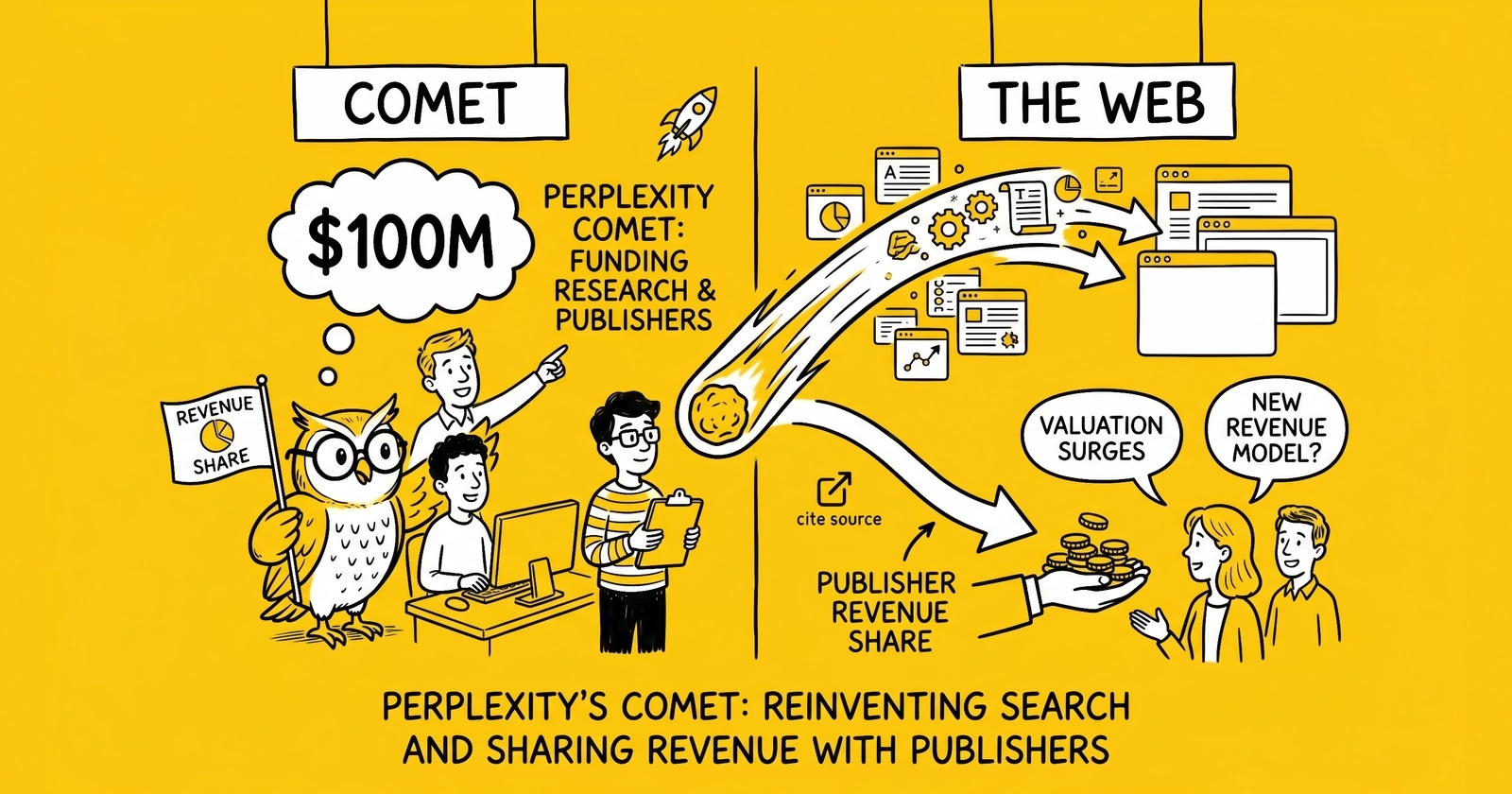
Perplexity raised roughly $200 million at a $20 billion valuation in early June 2026 and the capital lands on top of an already-running publisher economy: the Comet Plus subscription, announced August 25, 2025, that pays 80 percent of revenue to publishers across three traffic categories – human visits, search citations, and agent actions – out of an initial $42.5 million pool. For lead-gen publishers, this is the first AI-search payout model with disclosed economics.
A $200 Million Round Strapped to a Publisher-Revenue Engine
The Information reported on June 5, 2026 that Perplexity closed a fresh financing round of approximately $200 million at a valuation near $20 billion. Yahoo Finance and Tech Funding News followed within hours with confirmation drawn from Perplexity’s investor materials and cap-table reporting. Tracxn’s funding-history record places Perplexity’s cumulative funding at roughly $1.72 billion across eleven rounds, with NVIDIA, IVP, NEA, SoftBank Vision Fund 2, Databricks, Bessemer Venture Partners, Accel and Jeff Bezos on the cap table alongside angels including Elad Gil, Nat Friedman and Dylan Field. Public reporting on Perplexity’s annual recurring revenue puts the ARR run-rate near or above $200 million as of June 2026, up from $150 million reported a month earlier – a doubling cadence that has reset financing-market patience for the company.
What the headline figures obscure is that the capital does not buy a search-traffic acquisition push. It buys the next eighteen months of the Comet browser strategy. Comet shipped in July 2025 to Perplexity’s $200-a-month Max subscribers, went free worldwide on October 2, 2025, and reached approximately 3 million monthly active users by Q1 2026 per Similarweb. ChatGPT Atlas, OpenAI’s competing agentic browser launched in late 2025, sits ahead at more than 5 million monthly active users. The agentic-browser category combined cleared 10 million monthly actives in early 2026. The $200 million is the working capital for closing – or not closing – that gap before Atlas locks in mindshare in the way Chrome locked in mindshare against Internet Explorer in the late 2000s.
Strap that capital flow to the publisher monetization rail that Perplexity announced ten months earlier and the picture changes. Comet Plus, the $5-per-month subscription announced August 25, 2025, pays 80 percent of subscription revenue to participating publishers against an initial $42.5 million pool. The publishers covered at launch – CNN, Condé Nast across The New Yorker, Wired, Architectural Digest, Vanity Fair and Vogue, Fortune, the Washington Post, the Los Angeles Times, Le Monde and Le Figaro – represent the first major AI-search distribution deal with a disclosed economic split. The $42.5 million pool is small relative to the digital-news ad market. The mechanism it codifies is not. For lead-gen publishers, the mechanism is the news.
The Three Traffic Types Inside the Comet Plus Pool
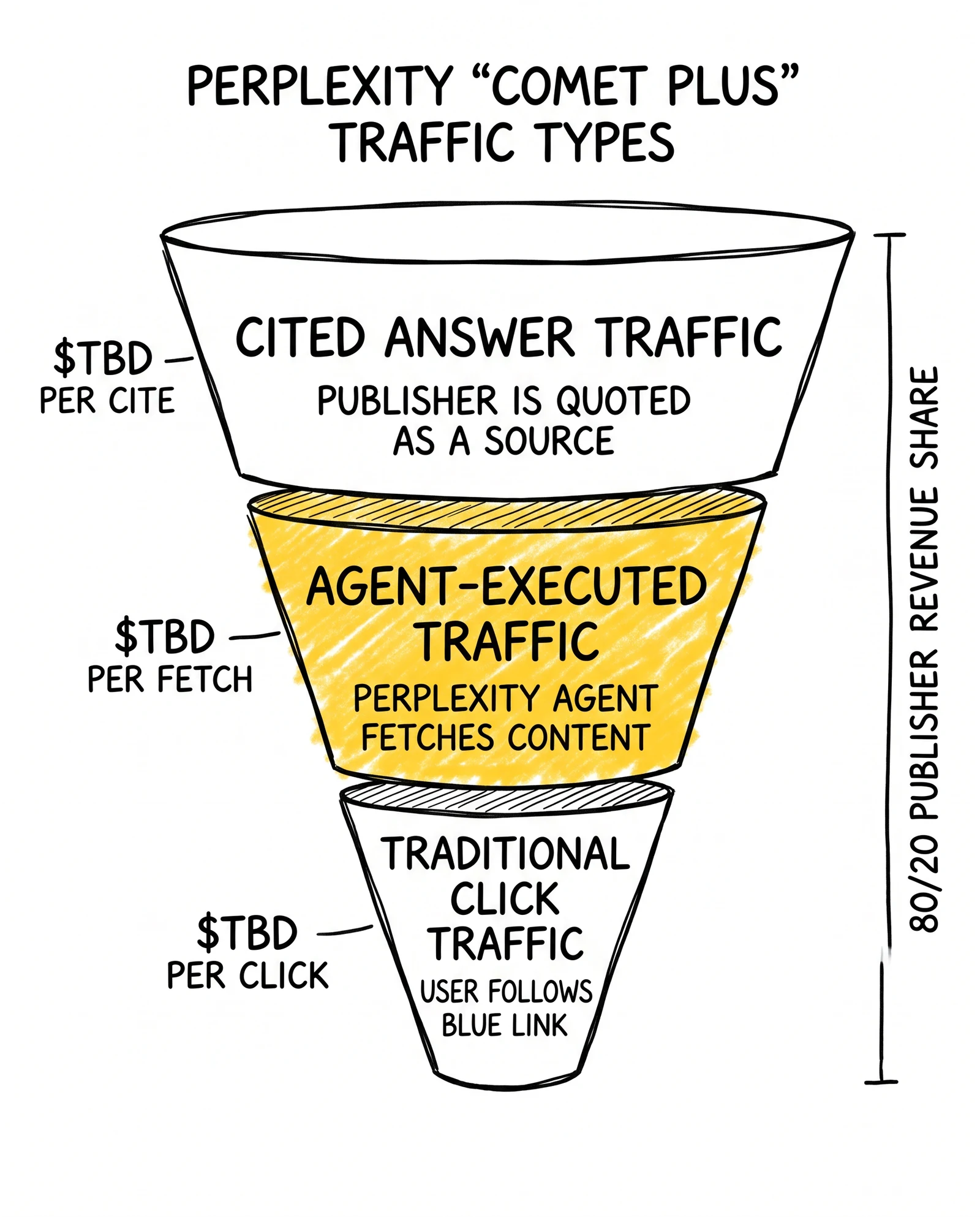
Comet Plus is described by Perplexity as the first compensation model that allocates revenue to publishing partners based on three internet traffic types: human visits, search citations, and agent actions. Each category is doing economic work that traditional CPC, CPL and programmatic display do not capture.
Human visits. A standard referral click counted in GA4 with perplexity.ai as source and referral as medium, per MarTech’s GA4 tracking writeup for Comet and Atlas. The visit produces a normal page view that the publisher can already monetize through display, affiliate, or a captured lead form. The Comet Plus addition is that the visit also accrues a share of the pool.
Search citations. A Perplexity-rendered answer that cites the publisher’s content in its citation list. The citation does not require a click. It does not produce a page view. Under every prior monetization model the citation produces zero revenue for the publisher. Under Comet Plus, the citation contributes to the publisher’s pool allocation regardless of whether the user clicks through. Superlines’ early measurement work, cited in 2026 AI-search benchmark reporting, put Perplexity’s citation rate at roughly 15.4 percent of responses with an average of 21.9 citations per cited response – meaning a single publisher cited in Perplexity’s index can be referenced in a high-volume series of answers without ever receiving a click.
Agent actions. The Comet browser embeds an agent that can read pages, fill forms, and execute steps inside a user-delegated task. When that agent reads a publisher’s page to complete a task – comparing reviews, pulling a paywalled price, summarizing a recipe – that read counts as an agent action. The agent action produces no display impression, no click, no time-on-page metric in the traditional sense, and no JavaScript-pixel fire on most current publisher analytics stacks. It is, in every prior framework, invisible. Under Comet Plus, it contributes to the pool.
The legal frame matters. Press Gazette and Editor & Publisher noted that CNN and Le Figaro had previously declined to license content to AI companies – and both signed the Comet Plus launch slate. The same Perplexity that had been sued for copyright infringement by The Wall Street Journal, the New York Post and The New York Times in 2024 and 2025 is now the AI vendor running the first disclosed publisher revenue-share program. The companies that joined are the companies that decided a 20 percent platform take with measurable engagement-share allocation is a better economic instrument than a litigation-driven licensing payout. Lead-gen publishers face a parallel decision on smaller dollars but identical structure.
The pool is small. Forty-two and a half million dollars distributed across more than 2,400 enrolled publisher partners per Q1 2026 industry tracker reporting works out to an average of just under $18,000 per participant per year if the pool stays flat – and Perplexity has said the pool grows with the subscriber base. For a small lead-gen publisher, the absolute dollar amount may not change the year’s P&L. The structure changes the strategy.
What the 80/20 Number Actually Tells Lead-Gen Publishers
The 80/20 split has been reported across business press as the headline. The actual decision-relevant data inside the split is elsewhere.
| Comet Plus Lever | Disclosed Detail | What It Means for a Lead-Gen Publisher |
|---|---|---|
| Subscription price | $5/month standalone; included with Perplexity Pro ($20/mo) and Max ($200/mo) | Per-subscriber publisher pool contribution is $4/month at the standalone tier before pool expansion |
| Revenue share | 80% to publishers, 20% to Perplexity | Highest disclosed publisher share of any AI-search subscription product; YouTube Premium pays 55% to creator pools, Spotify pays 70% to rights holders |
| Initial pool | $42.5 million | Bootstrapped before subscription growth; not contingent on hitting a subscriber number |
| Allocation categories | Human visits, search citations, agent actions | Three rails – only one (human visits) maps to existing CPC/CPL frameworks |
| Pool growth mechanism | Pool grows with Comet Plus subscriber base | Lead-gen sites are paid against subscriber-growth share rather than a flat CPM |
| Reporting cadence | Not yet publicly disclosed | Operators should ask before signing – quarterly statements are the floor |
| Exclusivity | Non-exclusive | Compatible with Cloudflare pay-per-crawl and any other publisher licensing rail |
| Geographic scope | US and international (Le Monde and Le Figaro signed at launch) | French and other non-English publishers in scope from day one |
The structural observation is that the 80 percent share is bigger than the 55 percent share creators receive from YouTube Premium’s subscriber pool and similar to the 70 percent that Spotify pays to recording rightsholders. Lead-gen operators familiar with affiliate networks should read 80 percent as “platform take rate lower than most affiliate networks” – Amazon Associates retains effectively all of the cost-of-good economics and pays a 3 to 10 percent commission on most categories; Perplexity is taking 20 percent and paying out 80 percent on a different unit of compensation entirely.
The decision-relevant comparison is not against ad CPMs. It is against the alternative: blocking PerplexityBot at the Cloudflare edge through AI Crawl Control’s pay-per-crawl framework, pricing PerplexityBot at the rate a publisher believes its crawl is worth, and refusing to participate in Comet Plus. The pay-per-crawl price is per-request. The Comet Plus pool is per-engagement-share. Most publishers will run both rails simultaneously – Comet Plus on the surfaces where Perplexity returns the citation, pay-per-crawl on the surfaces where Perplexity scrapes without citing.
The other side of the structure is the citation rate. Perplexity returns roughly 15 percent citation density across answers per Superlines’ 2026 measurement, compared to roughly 3 percent for ChatGPT and lower for Gemini. A publisher whose content is heavily cited by Perplexity but rarely cited by ChatGPT will get a meaningfully larger Comet Plus pool share than a publisher whose content moves through a different AI’s index. The pool tilts toward Perplexity’s existing citation favorites. Reddit, Wikipedia, Stack Overflow and traditional news brands sit at the top of that list. Lead-gen publishers without strong citation share in Perplexity’s index – most operator-run vertical sites in insurance, mortgage and home services – will earn proportionally smaller shares.
That observation is not a reason to skip the program. It is a reason to model expected payout against expected citation share before signing.
The Citation-and-Agent Economics That CPC/CPL Cannot Touch
Lead-gen publishers running owned-media properties measure RPM and CPC against page views and form fills. The standard model is well-understood: a piece of organic-search content captures clicks from a search results page, the visit produces an ad impression or a lead capture, and the publisher’s RPM equals revenue divided by sessions. Programmatic display rates for vertical publishers in insurance, mortgage and home services have hovered between $15 and $40 RPM through 2024 and 2025, with intent-laden content commanding higher rates and informational content commanding lower. Form-fill CPLs vary by vertical from roughly $3 in auto insurance to $300-plus in mass-tort intake.
The traffic that flows through agentic browsers and AI search snaps that model in three places.
The zero-click problem. SearchSignal’s 2026 AI Search Referrals benchmark found that AI-generated answers cite publishers across answers with 50 to 65 percent of those citations never producing a click – the user reads the citation, accepts the answer, and never visits the source. Conductor’s 2026 AEO/GEO benchmark across 1,215 enterprise domains and 35.7 million AI-driven sessions corroborates the pattern at scale. Standard RPM models book zero revenue against zero-click citations. Comet Plus books revenue.
The agent-mediated session problem. When the Comet agent reads a publisher’s page on behalf of a user – for instance to compare three home-insurance quotes the user asked Comet to fetch – most publisher analytics stacks either miss the read entirely or count it as low-quality bot traffic. There is no display impression to fire. There is no form to fill. There is, on most current measurement frameworks, no event. Comet Plus assigns the read to the agent-action category and contributes it to the publisher’s pool share. This is the canonical lead-gen funnel-bypass case. The agent does the comparison, the user gets the answer, the publisher gets the engagement, and the lead form sees nothing. Lead-gen operators have been worried about agent-driven funnel bypass through Comet and Atlas for nine months. Comet Plus is the first time a vendor has paid for it.
The retrieval-augmented generation pricing problem. RAG pipelines retrieve content into the LLM context window to answer a user query. The retrieval itself is the value transfer – the publisher’s content underwrites the answer. Pre-Comet-Plus, the content was treated as free fuel. Post-Comet-Plus, the content is treated as a paid input with disclosed economics. For lead-gen publishers running schema-marked-up content that ranks well in Perplexity’s retrieval – the kind of operator that has invested in structured data and entity markup for AI visibility – the program creates a direct economic incentive to keep investing in retrieval-friendly markup rather than ad-friendly thin content.
The cumulative effect is a three-rail revenue model where there used to be one. The traditional CPC/CPL rail still runs on human visits. A new citation-share rail runs on Perplexity’s answer-side decisions to cite the publisher. A new agent-action rail runs on the Comet agent’s decisions to read the publisher’s content during task execution. None of the three rails fires the same instrument the others do.
A worked example: a vertical insurance lead-gen publisher with 250,000 monthly organic sessions, $25 RPM and 1.2 percent form-fill conversion captures roughly $6,250 in display revenue and a separately monetized lead-form output. If that publisher’s content is cited in roughly 4 percent of Perplexity insurance-vertical answers, its citation-share contribution to the Comet Plus pool depends on Perplexity’s total Comet Plus subscriber count and total citation volume. If Perplexity announces a 500,000-subscriber base in the next year, the per-publisher payout math becomes tractable; if Perplexity declines to publish that number, the math stays opaque and operators have to decide on directional confidence. Either way, the addition to the publisher’s revenue stack is unambiguously positive – the cost of signing the program is approximately the legal review and integration cost, both modest.
How Comet Plus Stacks Against the Other AI-Era Publisher Rails
The publisher landscape in mid-2026 has settled into three distinct AI-economy revenue rails. Each is paid against a different unit of compensation. None is exclusive of the others.
| Rail | Vendor | Unit of Compensation | Disclosed Economics | What It Pays For |
|---|---|---|---|---|
| Pay-per-crawl | Cloudflare AI Crawl Control | HTTP request | Per-request price set by publisher; per-crawler decision; 402 Payment Required gates access | The crawl itself, before any user-facing surface |
| Comet Plus revenue share | Perplexity | Engagement-share of subscription pool | 80% of $5/mo subscription pool; $42.5M initial pool; three traffic categories | The downstream surface – citations, agent actions, human visits – after the crawl |
| Direct licensing deal | OpenAI, Google, Anthropic, Microsoft, Meta | Negotiated flat or volume contract | Not publicly disclosed; ranges reported $1M–$250M+ multi-year | Index inclusion and reuse rights |
The three rails sit at three different points in the AI content-consumption chain. Pay-per-crawl prices the act of retrieval. Comet Plus prices the act of citation and use. Direct licensing prices the act of training and indexing. Lead-gen publishers can sign all three without conflict, provided contract language across the three is reviewed for indemnity and exclusivity carve-outs.
The interesting strategic question is which rail dominates a particular publisher’s revenue line. For high-citation publishers – news, encyclopedic content, reference material – Comet Plus is the highest-yield rail because citation-share is where they have natural distribution. For technical-content publishers – Stack Overflow, Reddit, GitHub – pay-per-crawl is the highest-yield rail because the value transfer happens at retrieval, not at citation. For premium-brand publishers – Time, AP, Condé Nast – direct licensing is the highest-yield rail because their brands are the licensing currency.
Where do lead-gen publishers sit? On the citation-share axis, mostly in the middle. A well-built lead-gen site in insurance or home services that has invested in schema markup and entity authority gets cited at a measurable rate. The rate is not the rate of CNN or Wikipedia, but it is non-trivial. On the agent-action axis, lead-gen sites sit higher than most publishers because their content is the content the agent has to read to complete the user’s task – comparing rates, calculating quotes, summarizing terms. That places lead-gen publishers in an unusual position: their best revenue rail under the Comet Plus model is the agent-action category, which is the category that traditional measurement frameworks cannot see.
There is also the Amazon v. Perplexity litigation overhang. Amazon’s preliminary injunction theory – currently stayed and on appeal – argues that Comet’s agent access to Amazon’s marketplace pages without authorization is a Computer Fraud and Abuse Act violation. The case is unresolved at the appellate level as of June 2026. For lead-gen publishers, the analogous question is whether to authorize the Comet agent to act on publisher content at all. Comet Plus participation is, in effect, the publisher-side answer to that question: yes, the agent is welcome, and here is the economic instrument that makes the welcome rational.
The Subscriber Math That Will Determine Whether This Model Survives
Comet Plus needs subscribers. The $42.5 million initial pool is bootstrap capital. The mechanism that sustains the model is conversion of the agentic-browser audience into paid subscribers – either at the $5 standalone tier, or bundled into Perplexity Pro at $20 per month, or bundled into Perplexity Max at $200 per month. If Perplexity cannot grow the subscriber base, the pool stays at $42.5 million and the per-publisher allocation stays modest. If Perplexity can grow the subscriber base to ChatGPT-scale, the pool scales with it.
The current floor: Perplexity’s overall paid subscription count is not publicly disclosed but ARR sits near $200 million as of mid-2026, and the company has historically priced Pro at $20/month. Pro is the dominant tier. Some plausible inference puts Perplexity Pro subscribers in the high seven figures globally. Comet Plus comes included in Pro and Max, which means Perplexity is, in effect, treating Comet Plus as a publisher-distribution mechanism funded by Pro subscription revenue rather than as a standalone subscription product.
The $5 standalone tier is the interesting variable. If Comet Plus succeeds as a standalone product – meaning users who do not already pay $20/month for Pro start paying $5/month for Comet Plus to access paywalled publisher content inside the Comet browser – the publisher pool scales linearly. If Comet Plus fails as a standalone product, the model still works as a publisher payment program funded from Pro revenue, but the upside scenario disappears.
The structural risk: Perplexity has explicitly said it will not run advertising. That decision, reported in late 2025 and confirmed across 2026 product coverage, takes the largest potential growth lever for AI-search revenue off the table. The only remaining growth lever is subscription. The only remaining subscription lever for publisher economics is Comet Plus. If subscription growth stalls – if ChatGPT Atlas wins the agentic-browser race, if Gemini integrates more deeply into Chrome, if regulatory pressure forces a model change – Comet Plus stalls with it.
Lead-gen publishers should make their join-or-block decision against three scenarios:
-
Bull case. Perplexity grows the Comet Plus subscriber base to 10 million paid subscribers. The pool scales to roughly $480 million at the 80 percent split on $5/month. Per-publisher payouts become material at the $50,000+ annual level for mid-citation publishers.
-
Base case. Perplexity grows to 1 to 2 million paid Comet Plus subscribers, with the rest of the pool funded from Pro and Max bundling. The pool stays in the $80 to $150 million annual range. Per-publisher payouts become noticeable at the $5,000 to $20,000 annual level for mid-citation publishers.
-
Bear case. Comet Plus stays at the $42.5 million bootstrap pool. The 2,400 enrolled publishers share an average of less than $18,000 per year, with skew toward the launch slate. Per-publisher payouts for lead-gen sites stay below $5,000 annually.
In all three scenarios the cost of joining is approximately the same – legal review, contract execution, integration of any reporting endpoints. The bear-case payout still exceeds the cost of joining. The base-case and bull-case payouts justify the decision on operator math. The asymmetry – high upside, low entry cost – is the same asymmetry that justified early YouTube Partner Program enrollment in 2008 and early Spotify direct-distribution deals in 2012. Operators who declined those programs at the bear-case price point regretted it at the bull-case price point.
The right decision for most lead-gen publishers is to enroll while the structural decision is cheap, model expected revenue conservatively at the bear-case level, and reassess at twelve-month and twenty-four-month intervals against disclosed subscriber and pool numbers.
What Lead-Gen Operators Should Do in the Next 90 Days
The Comet Plus program is open to publisher enrollment as of mid-2026 via Perplexity’s Publishers Program application surface. The $200 million June 2026 round confirms that the underlying company has the capital to operate the program through at least the next eighteen to twenty-four months without distressed economics. The combination of disclosed pool size, disclosed split percentage and disclosed allocation mechanism makes this the first AI-economy publisher program a lead-gen operator can plan against with directional confidence.
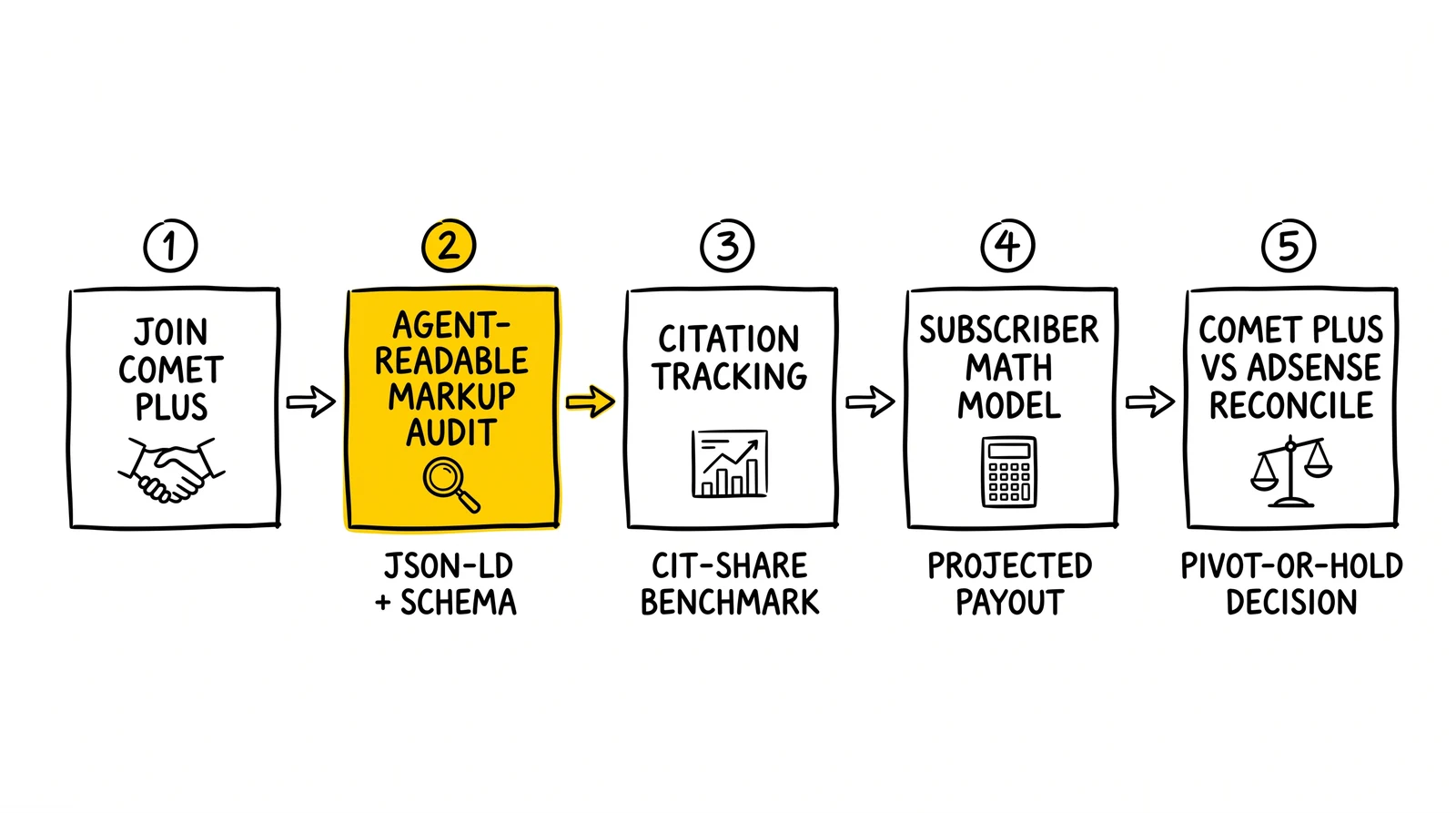
The 90-day operator checklist looks like the following.
Audit Perplexity citation share now. Use any of the available AI-search visibility platforms – Profound, AthenaHQ, Scrunch, Conductor’s AEO module – to measure how often a given publisher’s content is cited in Perplexity answers across vertical-relevant queries. The measurement matters for two reasons: it sets baseline expectations for Comet Plus payout share, and it identifies pages where citation share is recoverable through retrieval-friendly markup investment.
Audit Comet agent-action exposure. Inspect server logs for PerplexityBot and Perplexity-User retrieval, and for any agent-mediated traffic patterns that suggest Comet is reading the site to complete tasks. The signal is not always clean – agent traffic can look like ordinary headless-browser activity – but the directional read is achievable from log analysis. Pages with high agent-action exposure are the highest-value Comet Plus inputs.
Run the pay-per-crawl vs Comet Plus modeling. Cloudflare’s AI Crawl Control allows per-crawler pricing decisions. The question is not whether to block PerplexityBot – for any publisher with material citation share, blocking PerplexityBot forfeits the Comet Plus pool share, which dominates the per-crawl revenue forfeited. The question is whether to price PerplexityBot at a non-zero rate alongside Comet Plus enrollment, accepting a smaller crawl-rate volume in exchange for additional per-crawl revenue. Most lead-gen operators should leave PerplexityBot uncharged through Cloudflare and capture the Comet Plus pool share instead.
Review contract terms before signing. The Comet Plus terms-of-participation document is not currently public for general operators. Operators should ask for the reporting cadence, the audit rights against the engagement-share calculation, the indemnity terms covering any redistribution of publisher content inside Comet’s agent contexts, and the exit conditions. Standard publisher-program review applies.
Tighten retrieval-friendly markup. Comet Plus pays against citation share. Citation share is determined by retrieval – by whether Perplexity’s RAG pipeline pulls the publisher’s content into the answer context. Retrieval favors content with clear schema markup, strong entity authority, well-structured headings and unambiguous claims with attributions. The schema-markup investment that lead-gen publishers have made for AI visibility is the same investment that increases Comet Plus pool share. The two are aligned.
Model the bear case as the planning baseline. If a lead-gen publisher enrolls in Comet Plus and assumes the bear-case payout level of less than $5,000 annually, the model breaks even on entry cost in the first year. Anything above bear case is upside. Operators who assume base case in their planning are setting themselves up for disappointment; operators who assume bear case and are surprised by base or bull case end up running a successful program.
The model is unfinished. Comet Plus is ten months old as a public program and weeks old as an economic structure that operators can plan against with disclosed pool numbers and disclosed split percentages. The pool will expand or contract based on subscriber dynamics that nobody can confidently forecast. The publisher slate will grow beyond the launch partners as more publishers run the same arithmetic. The lead-gen operator question is whether to be inside the program when the model resolves into a base-case or bull-case scenario or outside it. The capital expense of being inside is small. The opportunity cost of being outside in a bull-case scenario is not small.
Key Takeaways
- Perplexity closed a roughly $200 million round at approximately a $20 billion valuation in June 2026 – implication: the underlying company has the runway to operate Comet Plus through at least the next eighteen to twenty-four months without restructuring publisher economics.
- Comet Plus pays publishers 80 percent of subscription revenue out of an initial $42.5 million pool – implication: this is the highest disclosed publisher revenue share among AI-search products and exceeds YouTube Premium’s 55 percent creator-pool share.
- The pool is allocated across three traffic types – human visits, search citations, agent actions – implication: two of the three categories (citations and agent actions) are revenue events that traditional CPC/CPL frameworks cannot capture, and lead-gen sites have unusual exposure to the third (agent actions).
- The launch slate includes CNN, Condé Nast titles, Fortune, The Washington Post, The Los Angeles Times, Le Monde and Le Figaro – implication: CNN and Le Figaro signed despite having previously declined other AI licensing deals, which signals the program’s economic terms cleared a higher bar than most prior AI-publisher arrangements.
- Comet sits at roughly 3 million monthly active users in Q1 2026 against ChatGPT Atlas’s 5 million-plus, with the agentic-browser category exceeding 10 million combined – implication: the $200 million is the capital for closing or holding the gap before category mindshare locks in.
- Comet Plus is non-exclusive – implication: lead-gen publishers can enroll in Comet Plus while also running Cloudflare pay-per-crawl pricing on PerplexityBot and other crawlers, with the two rails priced against different units of value.
- Citation density on Perplexity (roughly 15 percent of answers per Superlines measurement, versus roughly 3 percent for ChatGPT) tilts the Comet Plus pool toward Perplexity’s existing citation favorites – implication: publishers with strong Perplexity citation share capture disproportionate pool share; publishers without it should invest in retrieval-friendly schema markup before enrolling.
- Bear-case per-publisher payouts for mid-citation lead-gen publishers fall under $5,000 annually; base-case payouts reach $5,000 to $20,000; bull-case payouts reach $50,000-plus – implication: bear-case math still exceeds program entry cost, making enrollment the dominant decision for most operators regardless of forecast confidence.
- Pay-per-crawl pricing on PerplexityBot at the Cloudflare edge forfeits Comet Plus pool share for any publisher with material citation share – implication: leaving PerplexityBot uncharged at the Cloudflare edge and enrolling in Comet Plus is the dominant strategy for citation-favored publishers; blocking PerplexityBot is the dominant strategy only for publishers with near-zero citation share.
- The structural risk is subscription growth – Perplexity has refused to run advertising, which removes the largest potential pool-expansion mechanism – implication: operators should model bear case and bull case separately and reassess at twelve and twenty-four months against disclosed subscriber and pool numbers.
Sources
- The Information: Perplexity Finalizes $20 Billion-Valuation Round
- Yahoo Finance: Perplexity reportedly raised $200M at $20B valuation
- Search Engine Journal: Perplexity Launches Comet Plus, Shares Revenue With Publishers
- Press Gazette: Perplexity launches AI subscription revenue-share scheme for publishers
- Editor and Publisher: Perplexity launches AI subscription revenue-share scheme for publishers
- Digiday: How Perplexity’s new revenue model works, according to its head of publisher partnerships
- Engadget: Perplexity has cooked up a new way to pay publishers for their content
- Tracxn: Perplexity 2026 Funding Rounds and Investors
- MarTech: How GA4 records traffic from Perplexity Comet and ChatGPT Atlas
- Semafor: Perplexity announces revenue sharing deal with publishers (2024)
- CNBC: Perplexity AI will share revenue with publishers after plagiarism accusations
- TechCrunch: The New York Times is suing Perplexity for copyright infringement
- Cloudflare: Introducing pay per crawl