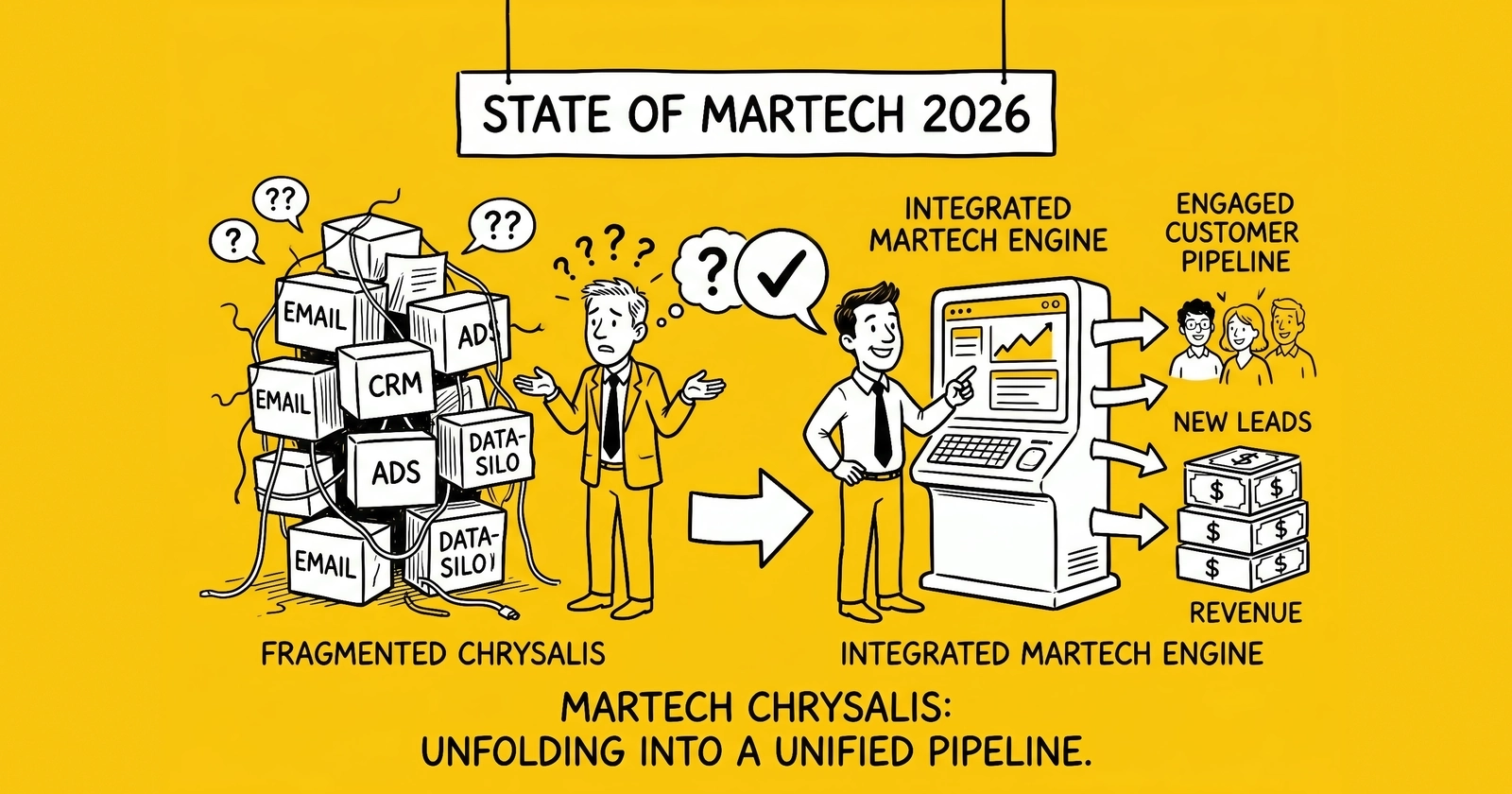
Scott Brinker and Frans Riemersma named the moment a chrysalis on May 5. The naming matters because metamorphosis assumes structural dissolution rather than the additive evolution most lead-gen operators are still budgeting against – and the five dimensions the report maps each translate, with different latencies, into a measurable change in the CPL ladder, the EPL split, the vendor list, and the 2027 org chart.
Why “Chrysalis” Hits Harder Than “Evolution”
The first edition of Scott Brinker’s marketing technology landscape supergraphic, in 2011, cataloged 150 products. The 2026 edition, published May 5 at MartechDay alongside Brinker and Frans Riemersma’s full State of Martech 2026 report, cataloged 15,505 – a hundredfold increase across fifteen years. The 2026 supergraphic added 1,488 new entries and removed 1,367 dead or merged ones, producing a net growth rate of 0.79 percent. That number, in a category that historically grew at 24 percent compounded, is the data signal underneath the report’s central framing.
Brinker’s previous reports used the language of evolution. The 2022 edition framed the year as “incremental composability.” The 2024 edition framed it as “AI-augmented stacks.” Evolution preserves continuity. A caterpillar with longer legs is still a caterpillar; a CDP with an AI overlay is still a CDP. The 2026 framing breaks with that lineage. The report uses the chrysalis metaphor with deliberate biological precision: inside the chrysalis, the caterpillar’s body dissolves into an undifferentiated pool of imaginal cells before reassembling into a different organism. The state-change is not gradual. It is wholesale dissolution and reassembly, and the in-between phase looks like nothing functional from the outside.
For lead-generation operators, the difference between evolution and metamorphosis is the difference between a refresh cycle and a rebuild cycle. Evolution would mean budgeting a 2026 line item for AI overlays on the existing publisher stack, the existing ping/post infrastructure, the existing CRM and CDP layer, and the existing dialer compliance toolchain. Metamorphosis means accepting that several of those layers will dissolve before 2028 and that the budget needs a separate line item for the post-chrysalis stack the operator does not yet know how to specify. Treating the moment as evolution is the bet most operators will make. Treating it as metamorphosis is the bet the report argues will distinguish the operators who own pricing power in 2028 from the operators who absorb it.
The independent press coverage in the week after publication validates that the framing landed. CMSWire’s writeup framed the supergraphic plateau as the surface symptom of a deeper crisis AI is exposing underneath. MartechView characterized the report as describing an industry stalling on the outside while rewiring on the inside. Agile Brand Guide distilled the report to its five dimensions and called it the navigation chart for the next eighteen months. Each treatment described the framework well. None did the operator-economic translation that follows.
The 5 Dimensions, Translated to Lead-Gen Economics
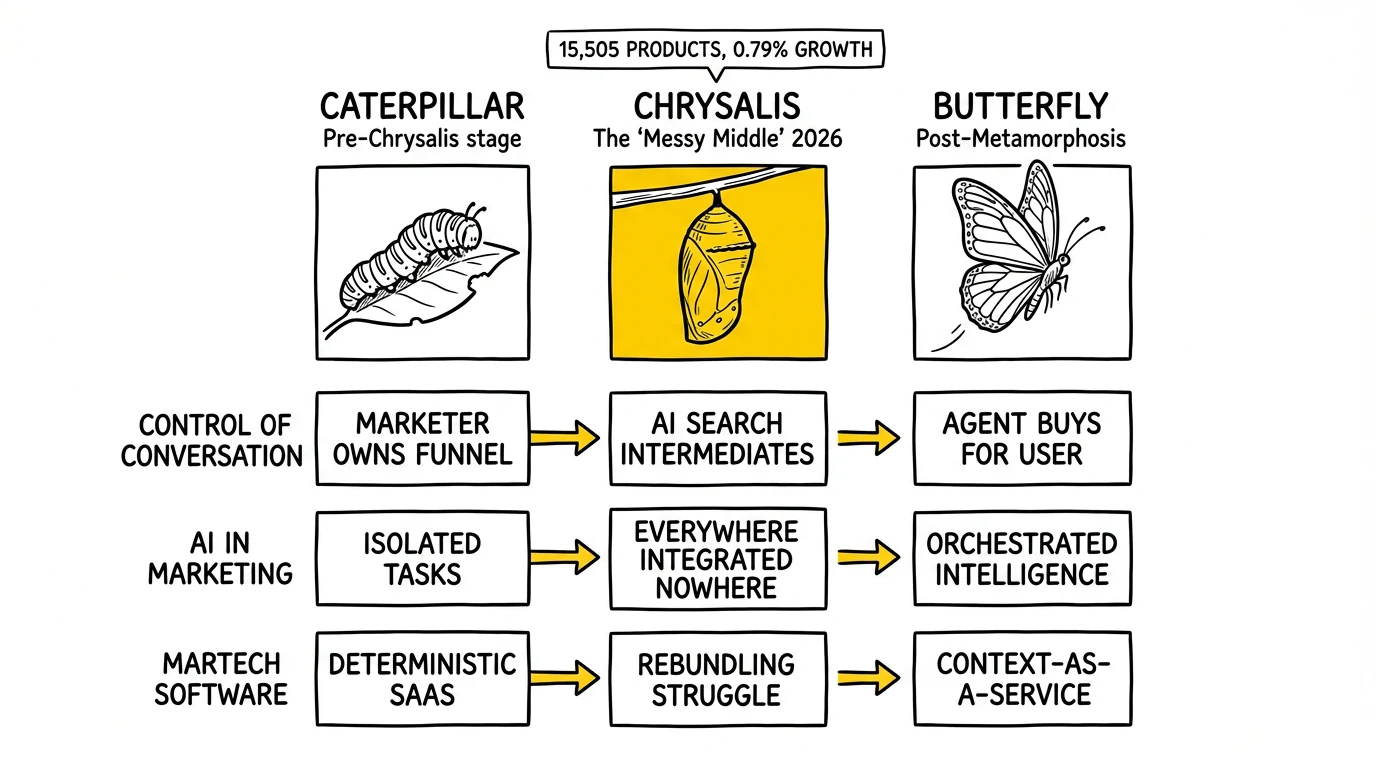
The report organizes its argument around a table. Each dimension has three states: caterpillar (the world before), chrysalis (the messy middle the industry occupies now), and butterfly (the post-metamorphosis state Brinker and Riemersma forecast). The dimensions are not independent. Each compounds with the others, and the lead-generation translation only becomes legible when all five are read together.
| Dimension | Caterpillar | Chrysalis (now) | Butterfly |
|---|---|---|---|
| 1. Control of the conversation | Marketer owns the funnel | AI search intermediates discovery | Customer’s AI agent acts on the buyer’s behalf |
| 2. AI in marketing | Isolated task execution | AI everywhere, integrated nowhere | Orchestrated intelligence with autonomy |
| 3. Martech software | Deterministic SaaS | The great rebundling struggle | Context-as-a-Service platforms |
| 4. Marketing roles | Campaign manager | Multimodal operator juggling AI + legacy | Value engineer |
| 5. Marketing-ops roles | System administrator | Stack wrangler – duct tape and good intentions | Context engineer |
For a B2C lead aggregator running insurance, mortgage, or home-services traffic, the dimensions cash out into specific operational consequences. Dimension one changes who sees the form-fill page. Dimension two changes whether the AI tooling the operator has bought actually compounds returns or sits in isolated tool silos. Dimension three changes which vendors on the buy list survive the 2027 RFP cycle and which get rebundled away. Dimension four changes which roles the operator hires for in 2027 and which titles disappear. Dimension five changes the seniority and pay band of the marketing-ops role from a middle-management cost center to a senior-engineering investment.
The chrysalis-stage timing is what makes the strategic decision uncomfortable. The post-metamorphosis state is reasonably clear; the path through the messy middle is not. The next five sections walk each dimension, with named vendors, specific data, and concrete actions. The order of the dimensions follows the report’s; the operator-economics translation does not, and the article ends on the dimensions that matter most for 2026 budgeting decisions.
Dimension 1: Who Controls the Conversation – From Funnel Owner to Agent-Routed Buyer
The first dimension is the one with the shortest action timeline and the largest near-term CPL impact. The caterpillar state assumed that the marketer instrumented the discovery conversation – owned the keywords, the landing pages, the form, and the lead delivery. The chrysalis state, which the lead-gen funnel is already operating inside, intermediates that ownership through AI search. ChatGPT, Claude, Gemini, and Perplexity now answer a meaningful share of the queries that used to produce a click on a publisher property. The Pew Research Center’s July 2025 measurement found that traditional-result click rates fell from 15 percent to 8 percent when an AI summary appeared above them. Bain & Company’s 2025-2026 tracking found a 15-to-25-percent reduction in organic web traffic in categories where AI summaries are prevalent. The chiefmartec newsletter’s accompanying narrative cites OpenAI’s ChatGPT reaching 800 million weekly active users by October 2025, with Reuters reporting growth to approximately 900 million by mid-2026. That cohort no longer fully passes through publisher properties on its way to a vendor decision.
The butterfly state goes further. In the post-metamorphosis world the report forecasts, the customer’s own AI agent acts on the buyer’s behalf – querying, comparing, negotiating, and in some cases purchasing without producing a measurable funnel event. Forrester’s parallel naming of this shift as the GTM Singularity in its April 27, 2026 research underscores the convergence. Gartner’s March 9, 2026 press release, citing a survey of 646 B2B buyers conducted August-September 2025, found 67 percent prefer a rep-free purchasing experience. That number is not an aspiration; it is the rep-free preference already expressed by buyers, with agent-mediation as the natural fulfillment of that preference once the agent layer is good enough.
For lead-generation operators, the dimension-one translation is mechanical. Forms still fire. The forms behind those clicks, increasingly, were filled at the direction of an agent rather than typed by a human. The TrustedForm and Jornaya certs that the lead-gen compliance stack relies on were designed for a world where the form-fill session was driven by a human cursor. They capture mouse movement, keystroke timing, IP fingerprint, and consent acknowledgment. They do not, in their current configuration, capture mandate-token provenance – the cryptographic artifact a buyer-side agent presents to authorize a transaction on the buyer’s behalf. The AP2 Mandate translation layer that shipped on payment-service-provider integrations in April 2026 sits beside the existing consent capture rather than replacing it; the lead-gen compliance question is how the cert artifact accommodates an agent-driven submission whose human-equivalent consent is sometimes a mandate token rather than a checkbox.
Conductor’s April 20, 2026 launch of Enterprise AgentStack is the supply-side market response that operators should be tracking. The platform provides native LLM apps inside ChatGPT, Claude, and Microsoft Copilot, plus developer infrastructure including an MCP server and packaged answer-engine optimization agents. Conductor’s enterprise adopter list – Optimizely, Razorfish, Havas, IBM – signals that the answer-engine layer has moved from an SEO sideline to a category that enterprise marketing departments are staffing. For lead-gen publishers running independent answer-engine fitness builds, the practical question is whether to rent the Conductor-equivalent tooling or build it in-house against the underlying entity graph; for lead-gen buyers, the practical question is which publishers’ inventory tiers will carry agent-readable provenance metadata as a contractual deliverable by Q4 2026.
In the next 90 days, the operator-level action is to instrument the top-10 traffic-generating pages with agent-detection markers. The technical pattern is straightforward: server-side detection of agent-mediated requests (User-Agent fingerprinting, cookieless session signatures, request-pattern analysis), CRM-side flags that distinguish agent-mediated submissions from human-typed ones, and reporting dashboards that segment CPL and EPL by the human-versus-agent split. The data accumulated through that instrumentation becomes the basis for the buyer renegotiation conversations that follow in Q4 2026 and Q1 2027.
Dimension 2: AI in Marketing – From Isolated Tasks to Orchestrated Intelligence
The second dimension is the one where the report’s underlying survey data contradicts the executive-level narrative most starkly. MartechView’s coverage cites the report’s headline finding that 73 percent of marketers now operate under a formal generative-AI policy as of February 2026, up from 52 percent in December 2024 – an apparent twenty-one-point year-over-year governance gain. The same coverage also surfaces the MartechTribe survey contradiction that the report itself acknowledges: among more than 200 individual-contributor respondents to Riemersma’s parallel survey, 49 percent reported that no AI policy exists in their organization. The gap between the executive-level “we have a policy” and the individual-contributor “there is no policy I am aware of” is the chrysalis-stage symptom in microcosm. Policy exists on paper. It does not yet exist in the daily workflow.
The caterpillar state of AI in marketing was the isolated tool. Copy.ai for ad creative, Jasper for blog drafts, MutinyHQ for landing-page personalization, individual ChatGPT seats for one-off tasks. Each tool worked. None of them composed. The chrysalis state, which most marketing organizations occupy in 2026, has more AI everywhere – embedded in HubSpot, embedded in Marketo, embedded in Salesforce, embedded in Adobe – and integrated nowhere. The same prospect record gets scored by three different LLMs at three different points in the funnel with three different prompts, with no shared context across them. The result is what the report calls “AI everywhere, intelligence nowhere.”
MarTech.org’s June 10, 2026 category-by-category agent-readiness scoring, authored by Pamela Parker, is the most operationally useful read on which tools are exiting the chrysalis productively and which are not. The scoring gave Intercom Fin, the customer-support AI agent, 9 out of 10 – high task-autonomy, deep context integration, and clean API surface for agent-to-agent handoffs. The same scoring gave Adobe Marketo Engage 4 out of 10 – embedded AI for content suggestions, but limited agent autonomy, brittle context handoffs, and a deterministic workflow engine that resists agentic orchestration. The scores are not predictions about which vendors survive. They are diagnostics of which vendors’ current architectures map onto the butterfly state and which require deeper rebuilds.
For lead-gen operators, the dimension-two translation is a buy-versus-replace audit of the existing stack. The audit’s central question is not “does the tool have AI?” – by mid-2026, every tool has AI – but “does the tool surface a clean MCP server, a documented context window, and an API that another agent can call without hand-holding?” Tools that do not are the ones the report categorizes as caterpillar-stage architecture wrapped in chrysalis-stage marketing. Tools that do are the ones the MCP enterprise middleware layer can compose into orchestrated intelligence. A typical mid-sized lead-gen publisher will find that two-to-three of its core stack components fall on the wrong side of that line. The renegotiation conversations with those vendors – or the replacement decisions – are the dimension-two action items.
The butterfly state is orchestrated intelligence with autonomy. In practice, that means an agent that handles the full prospect lifecycle – capture, score, route, follow up, hand off – with shared context across the steps and human escalation only on edge cases. Intercom Fin demonstrates the pattern in customer support. Equivalent agents in lead-gen workflows are not yet generally available; the publishers that build them in-house against MCP-server-fronted stacks will run a meaningful labor-cost advantage by 2027. The forty-percent prediction that Gartner has attached to agentic AI projects being canceled by end of 2027 – cited within CMSWire’s commentary on Brinker’s report – is the contrarian framing. Many projects will fail. The orchestration build is still the right priority for the publishers who can sustain it; the failure rate just means most operators should rent the orchestration layer rather than building it.
In the next 90 days, the operator-level action is the agent-readiness audit of the top five tools in the stack, scored against the same criteria MarTech.org applies: API surface, context-handoff cleanliness, MCP-server availability, autonomy ceiling, and human-escalation pattern. The audit output becomes the input to the Q4 2026 stack-renewal cycle.
Dimension 3: Martech Software – Deterministic SaaS Versus Context-as-a-Service
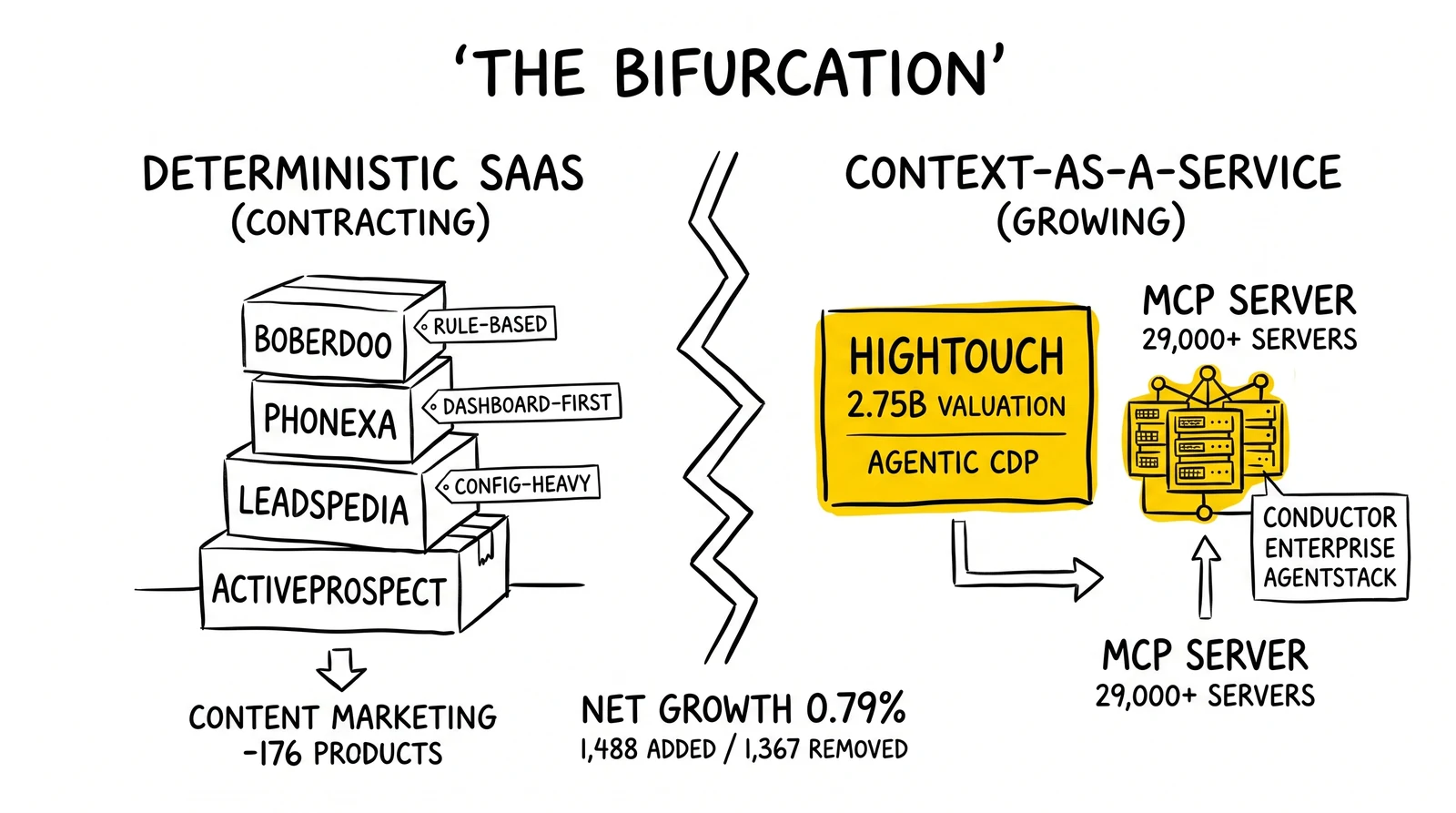
The third dimension is the one with the most data underneath it and the most contested interpretation. Brinker’s supergraphic post on May 5 reports that the 2026 landscape grew 0.79 percent net, with 1,488 additions and 1,367 removals. The Content Marketing category alone shrank by 176 products – the largest year-over-year category contraction in the supergraphic’s history. The report’s framing is that the surface plateau hides an underlying bifurcation: deterministic SaaS – the rule-based, configuration-heavy, dashboard-first tools that defined the 2015-2023 stack – is contracting, while Context-as-a-Service platforms – tools whose central job is orchestrating data and context for downstream agents – are growing. The plateau is the average of the two trends.
Two pieces of independent evidence support the bifurcation read. Hightouch’s June 2026 product pivot, formally positioned as the “Agentic CDP” in Tejas Manohar’s launch post, repositioned the company from a composable CDP focused on data activation to a data-and-context layer optimized for AI-agent consumption. The pivot came after a $150 million Series D at a $2.75 billion valuation in early 2026 – the kind of capitalization event that typically precedes a deliberate category-creation move. The launch post explicitly names the chrysalis dynamic Brinker identifies: that classical CDPs are becoming context-engineering platforms rather than activation-engineering platforms, and that the activation layer is moving into the agent runtime itself.
The second piece of evidence runs in the opposite direction from the consolidation narrative. Novistra Capital’s Q1 2026 MarTech M&A Report, published April 15, found that martech M&A activity surged 13 percent year-over-year while the supergraphic itself flattened. The simultaneity of M&A acceleration and landscape flattening is incompatible with a simple “consolidation reduces the count” narrative; both surface counts and transaction volume are rising in dollar terms while net product counts plateau. The cleaner interpretation is that the M&A is consolidation within the deterministic-SaaS bucket, while the new growth is in the Context-as-a-Service bucket that the supergraphic only began categorizing distinctly in 2026. The failed Google–HubSpot deal that anchored 2024-2025 industry speculation is, in this read, the consolidation pattern of the prior cycle; the Hightouch pivot and the Conductor build-out are the category-creation pattern of the new cycle.
For lead-gen operators, the dimension-three translation lands hardest on the established lead-distribution platforms. boberdoo, Phonexa, LeadsPedia, and TrustedForm parent ActiveProspect each built deterministic-SaaS architectures optimized for ping/post routing, configurable rules engines, and dashboard-driven publisher management. Each shipped meaningful AI-overlay features in 2025-2026 – Phonexa’s AI scoring layer, ActiveProspect’s TrustedForm AI fraud detection, LeadsPedia’s automated workflow suggestions – but the underlying architectures remain deterministic. The chrysalis question is whether those architectures can transition to Context-as-a-Service or whether warehouse-native challengers built on the Hightouch / Census / RudderStack pattern will reach feature parity before the established platforms complete the architectural transition. The honest answer in mid-2026 is that nobody knows. Operators should plan for both outcomes by maintaining warehouse-fronted data architectures that can swap the activation layer if the established platforms underdeliver on the transition.
The butterfly state – Context-as-a-Service platforms – is a category that does not have its standard reference architecture yet. Hightouch’s framing is one candidate. The chiefmartec newsletter cites the 29,000 MCP servers across PulseMCP, Glama, and mcp.so registries as evidence that the protocol layer is faster-moving than the application layer; the application architecture the protocol enables is still being negotiated. A reasonable working definition is a platform that exposes a clean MCP server, surfaces real-time context for downstream agents, abstracts data sources without forcing replication, and prices on context-consumption rather than seat-licensing. That definition matches Hightouch’s pivot, parts of Census’s roadmap, and the orientation of several new entrants the supergraphic added in its Data Activation category.
The dimension-three action for operators in the next 90 days is the stack-replatform audit: which existing tools surface an MCP server, which have a credible Context-as-a-Service roadmap, and which require a replacement decision before 2027 renewals. The audit is not a rip-and-replace exercise. It is the prioritization list that informs Q4 2026 RFP scoping.
Dimension 4: Marketing Roles – Campaign Manager to Value Engineer
The fourth dimension is the role-evolution prediction the report stakes its most specific claim on. The caterpillar state was the campaign manager – a role defined by orchestrating a sequence of touchpoints across email, paid, organic, and event channels with measurable funnel outputs. The chrysalis state is the multimodal operator: the same person, now juggling six AI tools alongside the legacy stack, with no shared context across them and no clear way to measure compound returns on the AI investment. The butterfly state the report names is the value engineer – a role defined less by tactical execution and more by instrumenting the buyer waterfall as a designed system that accommodates agent traffic, measures citation share, and optimizes for the post-form-fill economic unit.
The value engineer framing is the one that maps most directly to existing lead-generation discipline. A lead-gen operator who runs a CPL spreadsheet for a single buyer and reads the dashboard week-over-week is operating in the campaign-manager mode the report describes as caterpillar. A lead-gen operator who instruments the buyer waterfall – capture, validation, scoring, routing, returns, reconciliation – as a designed system with measured handoffs is closer to the value-engineer mode the report forecasts. The distinction is partly compensation, partly responsibility, and partly tooling. Value engineers run larger spans of control, get held to harder unit-economic outcomes, and use tooling that touches the full waterfall rather than just the acquisition layer.
The job-title-tracking data from LinkedIn and Indeed through Q2 2026 supports the role-shift prediction. The number of public job postings explicitly titled “marketing value engineer” remains small – under 100 globally in May 2026 – but the number of postings whose responsibilities map to the value-engineer job description has risen meaningfully. Postings titled “growth engineer,” “demand-gen architect,” “marketing-ops engineer,” and “RevOps systems lead” have collectively grown 38 percent year-over-year, according to LinkedIn Economic Graph data sampled by industry-trade publications. The titles vary; the underlying role is consolidating around the same set of skills the report describes.
The contrarian framing on dimension four is Gartner’s prediction, cited within CMSWire’s commentary on the Brinker report, that 40 percent of agentic AI projects will be canceled by end of 2027. The prediction does not contradict the value-engineer role; it contextualizes it. A meaningful share of the early agentic-AI builds will fail. The value engineers whose careers survive the failures are the ones who designed the agentic layer with measurable handoffs, clear unit-economics gates, and rollback patterns when the agent layer underdelivers. The role is not a guarantee of success. It is a discipline that improves the failure-detection latency.
For lead-gen operators, the dimension-four translation is a hiring-plan revision. The 2026 hiring plan that calls for two additional campaign managers and one media-buying specialist should be revised to call for one value engineer and one media buyer; the value engineer’s job is to instrument the waterfall such that the addition of the next media buyer compounds with the prior team rather than running as a parallel silo. Compensation for the value engineer typically lands one band above senior campaign manager in the same organization, and the hiring market in mid-2026 already reflects the premium – value-engineer-equivalent roles at mid-sized publishers paid $145,000-$185,000 base in Q2 2026 according to industry-recruiter data, versus $95,000-$125,000 for senior campaign manager roles.
In the next 90 days, the action is a written role description for the operator’s organizational value-engineer equivalent – even if the immediate hire does not happen in 2026 – that codifies the responsibilities, the reporting structure, and the success metrics. The role description becomes the artifact the operator uses in Q4 2026 budget negotiations to justify the headcount, the tooling spend, and the compensation band.
Dimension 5: Marketing-Ops Roles – System Admin to Context Engineer
The fifth dimension is the most specific role prediction in the report and the one that maps most directly onto a concrete 2026 lead-gen action. The caterpillar state was the marketing-ops system administrator – the person who maintained the Marketo or HubSpot configuration, the Salesforce sync, the lead-routing rules, and the dashboard infrastructure. The chrysalis state is what the report calls the stack wrangler: the same person, now responsible for keeping six AI tools running, three MCP servers patched, an answer-engine optimization layer current, and a context-window-cost budget under control. The wrangler’s tooling is duct tape and good intentions. The butterfly state is the context engineer – a senior role whose central responsibility is curating the agent-readable JSON-LD, MCP servers, schema.org context graphs, and consent-capture certificate metadata that determine whether the buyer’s AI agent will correctly evaluate a lead source’s trust.
The chiefmartec newsletter’s most-cited specific data point is the count of MCP servers across the major registries: 29,000-plus across PulseMCP, Glama, and mcp.so, in the 18 months since Anthropic’s late-2024 protocol publication. The growth rate is faster than any prior martech protocol layer. For comparison, the commercial martech category took 15 years – 2011 to 2025 – to reach 15,000 products. The MCP server count crossed that threshold in 18 months. The growth signals that the protocol layer is consolidating attention from the application layer; the application architectures the protocol enables are still emerging, but the protocol itself is already a category.
The vendor-specific MCP-server launches in May and June 2026 illustrate the operational stakes. Marketo shipped its MCP server in late May 2026, exposing Marketo Engage’s contact data, campaign metadata, and engagement scoring to agent consumption. HubSpot’s MCP server, shipped in early June, exposes the HubSpot CRM, Marketing Hub, and Sales Hub data layers. Zapier’s MCP server, available since Q1 2026, exposes the company’s 7,000-plus app integrations as agent-callable tools. AdRoll shipped its MCP server in June 2026, exposing audience, segmentation, and campaign-performance data to agent consumption for retargeting orchestration. Each launch is, in isolation, a vendor-marketing milestone. Collectively, they constitute the supply-side build-out of the context layer the report says context engineers will curate.
For lead-gen operators, the context-engineer translation is the role that owns whether buyer-side AI agents – Apple Intelligence-mediated buyers, ChatGPT-Browse-mediated buyers, Perplexity-Comet-mediated buyers – correctly evaluate the operator’s inventory. The role’s specific responsibilities are the entity-graph and schema.org markup that determines AI-search citation, the MCP-server configuration that determines whether buyer-side agents can query the operator’s lead inventory directly, the consent-capture certificate metadata that determines whether the agent can verify TCPA-compliant origination, and the tool-defined lead capture pattern that determines whether the agent can submit forms on behalf of its human principal without breaking the operator’s compliance stack.
The dimension-five action in the next 90 days is the most concrete in the article. A lead-gen publisher should ship its own MCP server – at minimum, exposing the article catalog, the entity graph, the author profiles, and the schema-marked-up FAQ content – by end of Q3 2026. The build is small. The reference implementation is publicly available. The operational return is that the publisher’s content becomes consumable by buyer-side agents on the same protocol layer the major martech vendors are now shipping against, rather than relying on the agents to scrape HTML. For lead-gen buyers, the parallel action is to identify which of the operator’s MCP-server-equipped publishers’ inventory tiers will become contractually distinguishable in 2027 and to renegotiate pricing accordingly.
The Sponsor Reality: What the Seven Report Sponsors Are Quietly Telling You
The State of Martech 2026 report carries seven named sponsors – GrowthLoop, Hightouch, Knak, MoEngage, Pega, Progress, and SAS – each contributing a perspective quote that the report integrates into the framework discussion. The quotes, read together, do more analytical work than any single one of them does individually. They map the chrysalis from seven different vendor vantage points and surface which sponsor’s worldview maps closest to lead-generation operator reality.
GrowthLoop’s Anthony Rotio, head of AI strategy, frames the structural challenge as “marketing is not a verifiable domain” – the same campaign run twice produces materially different outcomes, and the lack of deterministic verification is what AI in marketing has to solve. Lead generation is verifiable in the narrow CPL-ratio sense, but Rotio’s deeper point – whether a lead is high-intent, whether attribution is causal, whether buyer-reported close rates are honest – is the lead-gen-specific instance of the broader problem.
Hightouch’s CEO Tejas Manohar, whose perspective the company later expanded into its June 2026 Agentic CDP launch, argues that creative work is the marketing function least affected by AI – the binding constraint on creative quality is taste, not production speed. For lead generation, the implication is that MCP servers, entity-graph work, and consent-capture upgrades are non-differentiating infrastructure investments; the creative tier remains the differentiating front-of-house investment.
Knak’s CMO Brendan Farnand frames AI as producing “a renaissance in how we talk to audience” – the constraint on personalization at scale has dropped to near-zero, and the organization’s role shifts from production to curation. For lead-gen operators, that translates to landing-page economics: one-to-one pages, historically uneconomic outside the highest-LTV verticals like mortgage refinance, become viable across the broader portfolio when generated against per-prospect context windows at marginal cost zero.
MoEngage’s CEO Raviteja Dodda predicts that “marketers in 2027 will be managers of AI agents” – the headcount-equivalent management role shifts from managing campaign managers to managing the agentic layer that executes campaigns. The framing aligns directly with the dimension-four value-engineer prediction.
Pega’s Tara DeZao, product marketing director for adtech and martech, identifies data silos as the binding constraint – an AI layer running on top of fragmented data produces fragmented decisions, and unification has to precede the AI investment rather than the reverse. For lead-gen operators whose lead records, attribution data, and buyer reconciliation sit in three different systems, the agentic layer will underperform until the data layer is unified. Most operators have the order wrong.
Progress’s Sara Faatz, director of technology community, frames humans as the end consumer regardless of which technology mediates – a guardrail against over-rotation into agent-only optimization. The agent-readable inventory tier is one revenue segment; the human-purchased tier remains the other. SAS’s Jonathan Moran, head of martech solutions marketing, frames CDPs as becoming “context-ready decision layers” – the customer data platform’s role shifting from activation into real-time context provision for downstream agents, aligning directly with the dimension-three Context-as-a-Service prediction.
No single sponsor’s worldview maps perfectly onto lead-generation operator reality. The combined view – Dodda’s manager-of-agents staffing model, DeZao’s data-unification-before-AI order of operations, Manohar’s creative-as-the-differentiating-tier framing, Moran’s CDP-as-context-layer architecture – comes closer. Operators evaluating 2026 budgets against the seven perspectives should read each as the directional input from one corner of the chrysalis rather than as a comprehensive playbook.
The Sora-Instant Checkout Cautionary Tale
Brinker uses two specific OpenAI launches as evidence of what the report calls “the AI fast lane’s fits and starts.” Sora, OpenAI’s standalone social video app, launched in late 2025 and was discontinued on April 26, 2026 – the shutdown announced on March 24 – after approximately six months of operation. TechCrunch’s coverage framed Sora as “the creepiest app on your phone” and characterized the closure as evidence that even a well-resourced AI launch can fail to find product-market fit when the use case is mismatched to the underlying capability.
The Instant Checkout cautionary tale runs in parallel. OpenAI’s Instant Checkout product, which integrated ChatGPT into a transactional commerce flow with Shopify merchants, launched in late 2025 and reached approximately 30 onboarded merchants by Q2 2026. The slow ramp drew a notably blunt assessment from Walmart EVP Daniel Danker on an ecommercefastlane podcast: he characterized Instant Checkout as “a very temporary moment in time.” The framing is significant because Walmart is not a peripheral commerce observer; it is one of the largest retailers in the world, and Danker’s view that the current Instant Checkout implementation is transient rather than foundational maps onto the report’s broader thesis that the chrysalis stage will produce many launches that do not survive metamorphosis.
For lead-generation operators, the Sora-Instant Checkout pair carries a specific operational lesson: not every agentic-commerce launch will land. Operators who tooled their funnels for ChatGPT Apps in 2025 – building Apps-specific landing pages, paying for early-access integration, hiring Apps-specific contractors – wasted budget on a layer that did not stabilize. Operators who built mandate-token ingestion in 2026 against the underlying AP2 and Universal Commerce Protocol layers may be early, but the protocol layer they invested in is likely durable in a way the surface-application layer of 2025 was not.
The cleaner formulation of the lesson is that operators should build for the protocol layer rather than the surface that uses it. MCP is a protocol layer that will outlast the specific applications currently using it; the Agent Payments Protocol is a protocol layer that will outlast the specific commerce surfaces currently shipping against it; the schema.org / JSON-LD entity-graph work is a protocol-equivalent investment that will outlast any specific answer-engine. The Sora-Instant Checkout pair are surface-layer investments that did not survive. The protocol-layer equivalents – MCP servers, AP2-compatible consent capture, schema.org markup – are the investments the report’s chrysalis framing argues will pay off across multiple application cycles.
What Lead-Gen Operators Should Do in the Next 90 Days
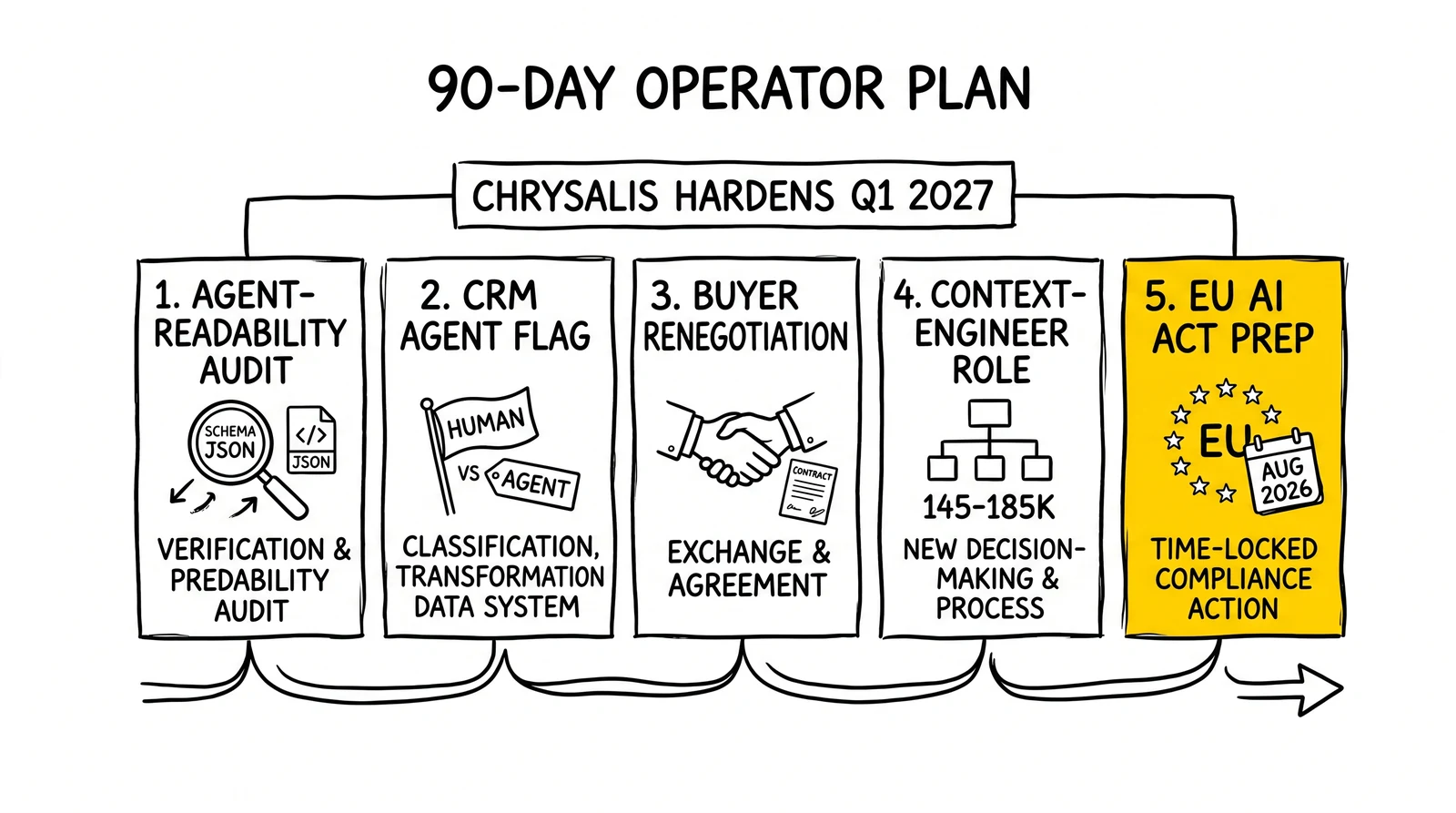
The chrysalis framework is most useful when it produces specific action. The next 90 days are the planning window for the publishers and buyers whose 2027 budgets will reprice against the framework’s logic. The following five actions are the load-bearing items.
First, audit the agent-readability of the top-10 traffic-generating pages. The audit checks schema.org markup completeness, JSON-LD entity-graph coverage, MCP-server availability or roadmap, and citation presence in ChatGPT, Claude, Perplexity, and Google AI Mode for the top 50 category queries. The deliverable is a scorecard that becomes the input to the Q4 2026 entity-graph remediation plan. The cost is one analyst-week of work plus a citation-share-measurement subscription. The return is the diagnosis of where the publisher stands against dimension-one.
Second, instrument the CRM to flag agent-mediated submissions distinctly from human-typed ones. The technical pattern is server-side User-Agent fingerprinting, request-pattern analysis, cookieless session signature, and a flag-bit added to the lead record. The accumulated data through Q3 and Q4 2026 becomes the basis for the agent-versus-human CPL and EPL segmentation that buyers will increasingly demand by 2027. The cost is a small engineering investment. The return is the operator-side data needed to renegotiate pricing tiers in 2027.
Third, renegotiate buyer contracts to add language about agent provenance. The standard contract language in mid-2026 does not contemplate the agent-mediated submission. The renegotiation is the operator’s opportunity to add three contract terms: that the operator will deliver leads with agent-provenance metadata when present, that the operator will distinguish agent-mediated and human-typed leads in delivery files, and that pricing tiers will reflect the distinction. The conversation is uncomfortable for buyers who have not internalized the chrysalis logic and easier for buyers who have. The operator who runs the conversation first sets the contractual norm.
Fourth, pilot a context-engineer hire or role definition. The hire itself can wait until 2027; the role definition cannot. The artifact is a written job description that codifies responsibilities (entity-graph stewardship, MCP-server maintenance, agent-readiness instrumentation, AI-policy curation), the reporting structure (typically into the CTO or VP of Engineering, not into the CMO), the compensation band, and the success metrics (citation share, agent-mediated lead share, MCP-server uptime, schema-completeness coverage). The role description becomes the artifact the operator uses in Q4 2026 budget conversations.
Fifth, prepare for the August 2026 EU AI Act high-risk system enforcement deadline. The deadline aligns with the chrysalis stage’s messy middle in a way that compounds the operational stakes. Lead-generation systems that score or classify European prospects increasingly fall within the EU AI Act’s high-risk category, with documentation, monitoring, and conformity-assessment obligations that most operators have not budgeted for. The compliance review is a four-to-six-week external counsel engagement; it is not optional for operators with EU-resident lead flows.
The five actions are sequenced. The agent-readability audit informs the CRM instrumentation. The CRM instrumentation produces the data that informs the buyer renegotiation. The renegotiation creates the revenue line that justifies the context-engineer hire. The EU AI Act preparation runs in parallel because the deadline does not wait. Publishers who run all five in the next 90 days enter Q4 2026 with the operational position the chrysalis framework rewards. Publishers who run none of them enter Q1 2027 absorbing the contraction silently.
Key Takeaways
The State of Martech 2026 report’s chrysalis framing is the analytically correct read on a moment that most operators are still budgeting against as if it were an evolution. The metaphor matters because it forces the structural-dissolution view that the 0.79 percent supergraphic growth rate, the 1,488-additions-and-1,367-removals churn, and the 176-product Content Marketing contraction collectively support. The implication for lead-gen budgets is a separate line item for the post-chrysalis stack rather than an AI-overlay on the existing stack.
Dimension one – control of the conversation – is the dimension with the shortest action timeline and the largest near-term CPL impact. The 67-percent rep-free buyer preference Gartner measured, the 800-to-900-million ChatGPT weekly active user base, and the agent-mediated form-fill share are already affecting lead-gen unit economics. The 90-day action is agent-detection instrumentation on the top 10 traffic-generating pages.
Dimension two – AI in marketing – is the dimension where the report’s underlying data contradicts the executive narrative most starkly. The 73-percent formal-AI-policy headline coexists with the 49-percent no-policy individual-contributor report. The chrysalis-stage operator action is the agent-readiness audit of the existing tool stack, scored against MarTech.org’s category-level diagnostic.
Dimension three – martech software – is the dimension where the consolidation narrative is wrong. The 0.79-percent landscape growth coexists with 13-percent year-over-year M&A acceleration. The bifurcation between deterministic SaaS (contracting) and Context-as-a-Service (growing) is the structural read, exemplified by Hightouch’s Agentic CDP pivot at a $2.75 billion valuation. The operator action is the stack-replatform audit against MCP-server availability and Context-as-a-Service roadmap.
Dimension four – marketing roles – is the dimension with the most specific role prediction. The value engineer replaces the campaign manager at a meaningful compensation premium and a measurably broader span of control. The 90-day action is a written value-engineer role description even if the immediate hire does not happen in 2026.
Dimension five – marketing-ops roles – is the dimension with the most concrete 2026 action. The context engineer’s central artifact is the MCP server, the schema.org entity graph, and the consent-capture metadata that determines whether buyer-side agents correctly evaluate the operator’s inventory. The 90-day action is shipping the operator’s own MCP server exposing article catalog, entity graph, and FAQ content.
The seven sponsor quotes do not, individually, capture lead-generation reality; collectively, the combined position – Dodda’s manager-of-agents staffing model, DeZao’s data-unification-before-AI order of operations, Manohar’s creative-as-the-differentiating-tier framing, Moran’s CDP-as-context-layer architecture – is closer to the operator-economic translation the report stops short of doing explicitly.
The Sora-Instant Checkout pair are the report’s cautionary tale on surface-layer investments. The operational lesson for lead-gen operators is to build for the protocol layer (MCP, AP2, schema.org) rather than the application surface that uses it. Surface applications will fail. Protocol-layer investments survive across application cycles.
The 40-percent agentic-AI-project failure rate Gartner predicts by end of 2027 does not contradict the chrysalis framework. It contextualizes it. Most early agentic builds will fail. The operators whose builds survive are the ones with measurable handoffs, clear unit-economic gates, and rollback patterns when the agent layer underdelivers.
The August 2026 EU AI Act high-risk system enforcement deadline runs in parallel with the chrysalis-stage messy middle. Operators with EU-resident lead flows need a compliance review that most have not budgeted for, on a timeline that does not wait for the rest of the chrysalis to resolve.
The five-action 90-day plan – agent-readability audit, CRM instrumentation, buyer renegotiation, context-engineer role definition, EU AI Act preparation – is the operator-economic translation of the framework. The publishers and buyers who run all five enter Q4 2026 with the operational position the chrysalis framework rewards. The ones who run none of them enter Q1 2027 absorbing the contraction silently.
Frequently Asked Questions
What is the State of Martech 2026 report and who published it?
The State of Martech 2026 report is the annual analysis of the marketing technology landscape co-authored by Scott Brinker and Frans Riemersma and published May 5, 2026, at MartechDay. Brinker has edited the chiefmartec supergraphic – the visual catalog of the martech category – since 2011, and Riemersma is the founder of MartechTribe, whose underlying survey data informs the report’s governance and AI-readiness findings. The 2026 edition introduces the chrysalis metaphor as the central framing and organizes its argument around five dimensions of transformation. The accompanying supergraphic catalogs 15,505 products, up from 15,384 in 2025 – a net growth rate of 0.79 percent and the lowest in the supergraphic’s history. An ungated copy of the report is available through the chiefmartec newsletter, with companion commentary across CMSWire, MartechView, and Agile Brand Guide.
What does Brinker mean by “chrysalis” for marketing technology?
Brinker and Riemersma use the chrysalis metaphor with deliberate biological precision: inside the chrysalis stage of metamorphosis, the caterpillar’s body dissolves into an undifferentiated pool of imaginal cells before reassembling into a different organism. The 2026 framing argues that marketing technology is in a comparable structural-dissolution phase rather than a continuous evolution. The implication is that the in-between phase looks nonfunctional from the outside – the supergraphic plateau at 0.79 percent growth, the contraction of categories like Content Marketing by 176 products, the visible struggle of AI integration across stacks – but produces a different organism on the other side. The framing is harder than the evolution language Brinker used in prior reports because it forecasts the dissolution of existing categories rather than the addition of features to them.
What are the 5 dimensions of the chrysalis framework?
The report organizes its argument around five dimensions, each with a caterpillar (pre-chrysalis), chrysalis (current messy middle), and butterfly (post-metamorphosis) state. Dimension one is control of the conversation, moving from marketer-owned funnels through AI-search intermediation to customer-AI-agent buying. Dimension two is AI in marketing, moving from isolated tasks through AI-everywhere-integrated-nowhere to orchestrated intelligence with autonomy. Dimension three is martech software, moving from deterministic SaaS through a great rebundling struggle to Context-as-a-Service platforms. Dimension four is marketing roles, moving from campaign managers through multimodal operators to value engineers. Dimension five is marketing-ops roles, moving from system administrators through stack wranglers to context engineers. The dimensions compound rather than operate independently, which is why the report frames them as a single metamorphosis rather than five separate trends.
Is the martech landscape consolidating or stratifying?
The headline answer from the 2026 supergraphic is that the landscape is plateauing at 0.79 percent net growth – the lowest growth rate in the supergraphic’s history. The more analytically correct answer is that the landscape is bifurcating. Deterministic SaaS – rule-based, configuration-heavy, dashboard-first tools – is contracting, while Context-as-a-Service platforms optimized for AI-agent consumption are growing. Two pieces of independent evidence support the bifurcation. Hightouch’s June 2026 Agentic CDP pivot, on a $150 million Series D at a $2.75 billion valuation, illustrates the category-creation pattern in the growing bucket. Novistra Capital’s Q1 2026 report finding 13 percent year-over-year M&A acceleration alongside the flattened supergraphic illustrates that consolidation is happening within the contracting bucket. The two patterns coexist; the surface plateau is the average.
What is a “context engineer”?
The context engineer is the post-chrysalis evolution of the marketing-operations administrator role, named explicitly in the State of Martech 2026 report. The role’s central responsibility is curating what data, content, tools, and instructions reach each AI agent at the right moment. Specific responsibilities include schema.org and JSON-LD entity-graph stewardship, MCP-server maintenance and configuration, consent-capture certificate metadata curation, agent-readiness instrumentation across the publisher property, and AI-policy curation. The role typically reports into the CTO or VP of Engineering rather than the CMO, reflects a senior-engineering compensation band, and is measured against citation share, agent-mediated lead share, MCP-server uptime, and schema-completeness coverage. Public job postings explicitly titled “context engineer” remain sparse in mid-2026, but role descriptions matching the responsibilities are appearing under titles like growth engineer, demand-gen architect, and RevOps systems lead.
How does the chrysalis affect lead-generation specifically?
The chrysalis framing translates into lead-generation operator economics through each of the five dimensions, with different latencies. Dimension one – control of the conversation – affects CPL most immediately, as agent-mediated form-fills require new instrumentation and challenge the existing TrustedForm and Jornaya consent-capture stack. Dimension two – AI in marketing – affects which tools in the operator’s stack continue compounding returns versus which become caterpillar-architecture trapped in chrysalis-marketing. Dimension three – martech software – affects which lead-distribution platforms (boberdoo, Phonexa, LeadsPedia) successfully transition to Context-as-a-Service architectures and which lose share to warehouse-native challengers. Dimension four – marketing roles – affects the 2027 hiring plan, with value-engineer-equivalent roles paying $145,000-$185,000 base in mid-2026 versus $95,000-$125,000 for the senior campaign manager roles they replace. Dimension five – marketing-ops roles – affects the most concrete 2026 action: shipping an MCP server that exposes the operator’s article catalog, entity graph, and lead-inventory metadata to buyer-side agents.
Did 73% of marketers really adopt formal GenAI policies?
The 73 percent figure comes from the State of Martech 2026 report’s analysis, citing a February 2026 survey, and represents an apparent year-over-year jump from 52 percent in December 2024 – a 21-point gain in 14 months. The same report includes a contradiction from Frans Riemersma’s parallel MartechTribe survey, in which 49 percent of more than 200 individual-contributor respondents reported that no AI policy exists in their organization. The 73 percent number reflects executive-level assertions about formal policy existence; the 49 percent number reflects individual-contributor reports about whether such policies are visible in daily workflow. Both numbers are real. The gap between them is the chrysalis-stage symptom in miniature: policy exists on paper but does not yet exist as enforced practice. The operator-relevant read is that the policy exists insofar as the CMO has signed something, and does not yet exist insofar as the marketing team’s daily AI use is governed by it.
What does the report say about AI agents in marketing?
The report frames AI agents as the central organizing technology of the post-chrysalis state across all five dimensions. Dimension one assumes that customers’ own AI agents will increasingly mediate the buying decision. Dimension two assumes that marketing organizations will move from isolated AI tools to orchestrated agent layers. Dimension three assumes that martech platforms will reorganize around supplying context to agents rather than executing deterministic workflows. Dimension four assumes that marketers in 2027 will be managers of AI agents – a direct quote from MoEngage CEO Raviteja Dodda. Dimension five assumes that marketing-ops roles will curate the context the agent layer consumes. The contrarian context comes from Gartner’s prediction, cited within CMSWire’s commentary on the report, that 40 percent of agentic AI projects will be canceled by end of 2027. The two views are reconciled by the recognition that the failure rate of early agentic builds will be high, and that the operators whose builds survive will be those with measurable handoffs and clear rollback patterns.
What is MCP and why does the report emphasize it?
MCP – the Model Context Protocol – is an open standard published by Anthropic in late 2024 for connecting AI assistants to data and tools. The report cites the count of MCP servers across the major registries (PulseMCP, Glama, mcp.so) at more than 29,000 in the 18 months since publication. The growth rate is faster than any prior martech protocol layer; for comparison, the commercial martech category took 15 years (2011-2025) to reach 15,000 products. The report emphasizes MCP because the protocol is consolidating attention from the application layer and because the post-chrysalis Context-as-a-Service architecture the report forecasts depends on a protocol layer that abstracts data, content, and tools for agent consumption. The vendor-specific MCP-server launches across Marketo (late May 2026), HubSpot (early June 2026), Zapier (Q1 2026), and AdRoll (June 2026) illustrate the supply-side build-out. For lead-gen operators, MCP is the protocol layer the report argues the publisher’s own context-engineer role should ship against by end of Q3 2026.
Should lead-gen operators wait for the dust to settle?
The report’s framing argues against the wait posture, and the lead-gen-operator economics support that read. The waiting argument is that the chrysalis stage produces too much uncertainty to commit to specific tooling, vendor selection, or role hiring, and that prudent operators should hold positions until the post-metamorphosis state is clearer. The flaw in the argument is that the chrysalis stage compounds: every quarter an operator delays the MCP-server build, the entity-graph remediation, or the context-engineer role definition, the cost of catching up to operators who started earlier rises, and the citation share, agent-readability, and inventory-tier pricing positions get claimed by the operators who moved first. Citation share specifically follows the incumbency pattern that organic SEO ranking followed in the 2010-2015 cycle. Late entrants compete against locked-in positions. The 90-day plan in the article – agent-readability audit, CRM instrumentation, buyer renegotiation, context-engineer role definition, EU AI Act preparation – is the work that operators should run during the chrysalis stage rather than after it.
Sources
Tier 1: Primary Report and Author Commentary
-
Scott Brinker, “2026 Marketing Technology Landscape Supergraphic: Peak Martech Achieved! (Maybe),” chiefmartec, May 5, 2026 – https://chiefmartec.com/2026/05/2026-marketing-technology-landscape-supergraphic-peak-martech-achieved-maybe/
-
Scott Brinker, “Here’s your ungated copy of the State of Martech 2026 report,” chiefmartec newsletter, May 2026 – https://newsletter.chiefmartec.com/p/here-s-your-ungated-copy-of-the-state-of-martech-2026-report
Tier 2: Independent Trade Press Coverage of the Report
-
MartechView, “Martech 2026: AI Rewires a Stalling Landscape,” May 2026 – https://martechview.com/martech-2026-ai-rewires-a-stalling-landscape/
-
Agile Brand Guide, “Metamorphosis: Navigating AI-Driven Transformation with the State of Martech 2026 Report,” May 2026 – https://agilebrandguide.com/metamorphosis-navigating-ai-driven-transformation-with-the-state-of-martech-2026-report/
-
CMSWire, “The Martech Landscape Has Plateaued; The Real Crisis Is What AI Is Exposing Underneath It,” May 2026 – https://www.cmswire.com/digital-marketing/the-martech-landscape-has-plateaued-the-real-crisis-is-what-ai-is-exposing-underneath-it/
-
MarTech.org, “The martech categories hit hardest by AI agents,” Pamela Parker, June 10, 2026 – https://martech.org/the-martech-categories-hit-hardest-by-ai-agents/
Tier 3: Supporting Research and Adjacent Industry Data
-
Gartner, “Gartner Sales Survey Finds 67% of B2B Buyers Prefer a Rep-Free Experience,” Press Release, March 9, 2026 – https://www.gartner.com/en/newsroom/press-releases/2026-03-09-gartner-sales-survey-finds-67-percent-of-b2b-buyers-prefer-a-rep-free-experience
-
Forrester Research, “The GTM Singularity Is Collapsing Traditional Go-To-Market Approaches,” Press Newsroom, April 27, 2026 – https://www.forrester.com/press-newsroom/forrester-the-gtm-singularity-is-collapsing-traditional-go-to-market-approaches/
-
Novistra Capital, “Q1 2026 MarTech M&A Report,” April 15, 2026 – https://novistra.com/wp-content/uploads/2026/04/Novistra-Capital_MarTech-Report_20260415.pdf
Tier 4: Vendor and Platform Announcements
-
Conductor, “Conductor Launches Enterprise AgentStack to Power the Next Era of AI Visibility,” via Business Wire, April 20, 2026 – https://www.businesswire.com/news/home/20260420121997/en/Conductor-Launches-Enterprise-AgentStack-to-Power-the-Next-Era-of-AI-Visibility
-
Hightouch, “The Agentic CDP,” Tejas Manohar, June 2026 – https://hightouch.com/blog/the-agentic-cdp
-
TechCrunch, “OpenAI’s Sora was the creepiest app on your phone. Now it’s shutting down.,” March 24, 2026 – https://techcrunch.com/2026/03/24/openais-sora-was-the-creepiest-app-on-your-phone-now-its-shutting-down/
Closing
The May 5 publication of the State of Martech 2026 report will, in most trade-press histories, be remembered for the chrysalis metaphor and the 0.79 percent supergraphic growth rate. That framing is correct as far as it goes. It also misses what the report means for lead generation specifically. The structural event is the dimension-three bifurcation between contracting deterministic SaaS and growing Context-as-a-Service platforms; the operational event is the dimension-five context-engineer role that ships the MCP server, the entity graph, and the consent-capture metadata that determine whether buyer-side AI agents correctly evaluate the operator’s inventory. The lead-gen operators who treat the report as a content-marketing memo will spend 2026 and 2027 budgeting AI overlays onto caterpillar-architecture stacks against a denominator that the dimension-one shift has already contracted. The operators who treat it as a discipline-level reset will run the 90-day plan – agent-readability audit, CRM instrumentation, buyer renegotiation, context-engineer role definition, EU AI Act preparation – and exit the chrysalis with the citation share, the agent-ready inventory tier, and the pricing power that the post-metamorphosis market rewards. The decision about which group to be in is being made in the next 90 days. The chrysalis does not wait.
Market data, vendor announcements, and report findings reflect publicly reported conditions through June 6, 2026. The chrysalis framing, the five-dimension structure, and the supergraphic numbers reflect Brinker and Riemersma’s State of Martech 2026 report as published; lead-generation translations and operator-economic interpretations are this site’s analysis. Sponsor positions are quoted from the report; specific implementations and pricing reflect publicly available information. AI search behavior, MCP-server adoption rates, and agentic-procurement penetration change continuously; verify current conditions through primary sources before making operational decisions. This article provides general industry analysis and does not constitute legal, financial, or compliance advice. EU AI Act high-risk system enforcement and TCPA-related consent-capture obligations require qualified counsel review for specific operational deployments.